

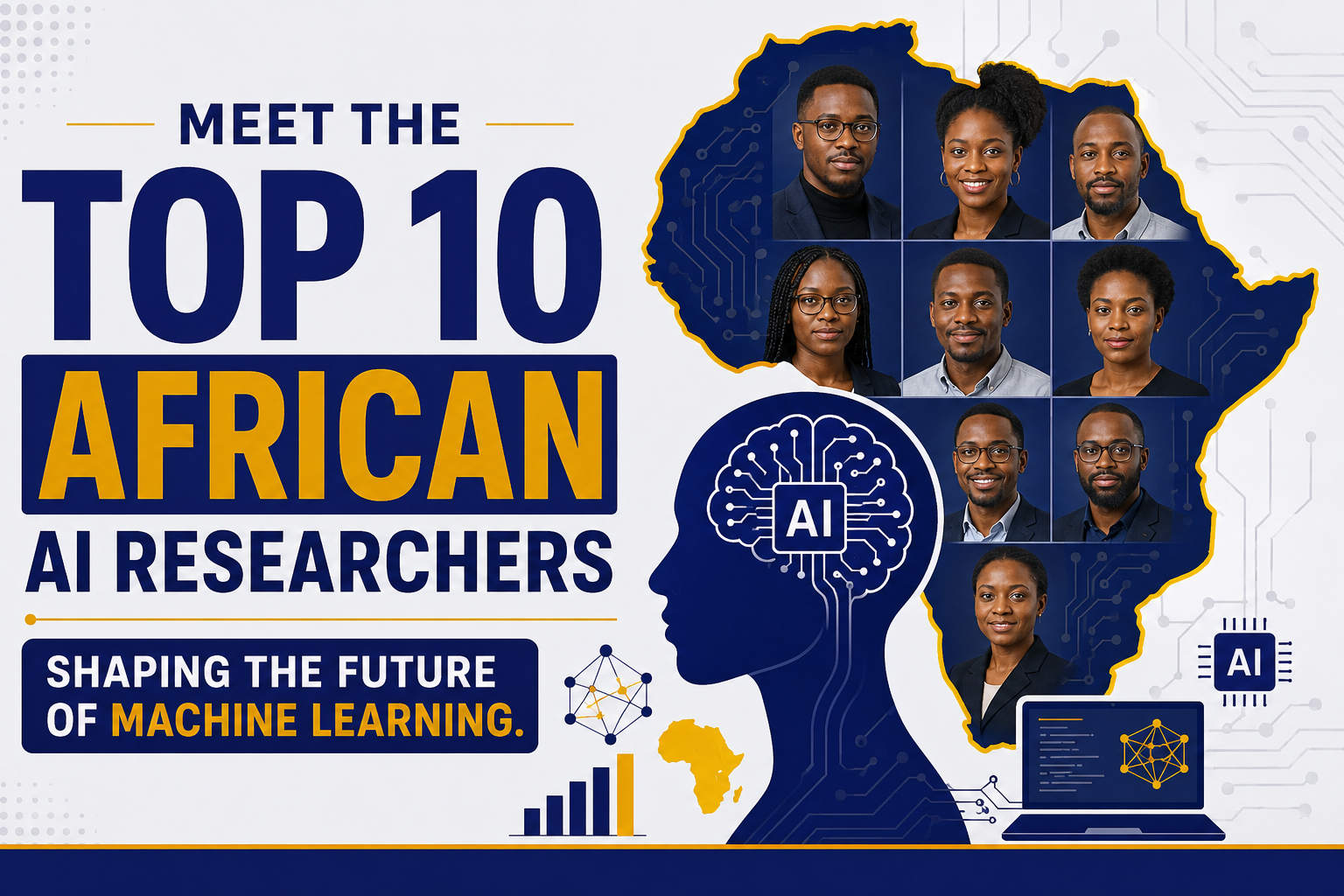
From Addis Ababa to Cambridge, Lagos to Stanford — 10 scientists rewiring the world’s most powerful technology from the inside out.
Africa Is Not Waiting to Be Invited to the AI Table
The popular story of artificial intelligence is one told in Silicon Valley boardrooms, London research labs, and East Coast university halls. But there is another story — one that begins in Addis Ababa secondary schools, Senegalese university common rooms, and South African townships — that is just as consequential, and far less told.
A generation of African and African-diaspora scientists has moved to the centre of machine learning, not simply as participants, but as architects. They are running the labs, writing the papers that reshape entire sub-fields, building institutions that did not exist before they created them, and questioning the assumptions baked into technology that now governs billions of lives. Their research sits at the most pressing intersections of our time: algorithmic fairness, multilingual AI, trustworthy systems, climate modelling, healthcare diagnostics, and the very mathematics of how large-scale data can be compressed and understood.
This article profiles ten of the most influential African AI researchers and machine learning scientists in the world, tracing their journeys from origin to impact, and explaining — in plain terms — why their work matters to every person on the planet who has ever been scanned by a camera, flagged by an algorithm, or served content by a recommendation engine.
Before we dive into individual profiles, one fact sets the scale of what is at stake: by 2050, Africa will be home to nearly 40% of the world’s under-18 population. Whether AI systems recognise, serve, and fairly represent those billions depends substantially on the researchers profiled below — and on whether the field listens to them.
🌍 10 African AI Researchers — At a Glance
The Researchers, Their Stories & Their Impact
Timnit Gebru
Founder & Executive Director, Distributed AI Research Institute (DAIR)
Born in Addis Ababa in 1982 to an Eritrean-Ethiopian family, Timnit Gebru fled political violence and arrived in the United States as a refugee at 16. She enrolled at Stanford University in 2001, eventually earning a Bachelor’s, Master’s, and PhD in electrical engineering from Stanford’s Artificial Intelligence Laboratory — where she combined computer vision with large-scale social data to reveal hidden insights about neighbourhoods from Google Street View imagery.
At the 2016 NeurIPS conference, Gebru noticed that almost no Black researchers were present in the audience. That observation sparked the co-founding of Black in AI alongside Rediet Abebe, Moustapha Cissé, and Sanmi Koyejo. In 2017 she joined Microsoft Research’s FATE group (Fairness, Accountability, Transparency, Ethics), then moved to Google in 2018 as co-lead of the Ethical AI Research Team — becoming the only Black woman researcher in that role at the time.
Her landmark Gender Shades collaboration with Joy Buolamwini exposed systemic racial and gender bias in commercial AI, and her 2020 paper on large language models as “stochastic parrots” challenged the race to scale AI models without addressing harm. Google fired Gebru in December 2020 after asking her to withdraw that paper — an act that triggered a wave of industry protest, Congressional letters, and a pivotal public conversation about Big Tech power and researcher autonomy.
In December 2021, she launched the Distributed AI Research Institute (DAIR) — an independent lab studying AI’s impact on marginalised communities, with a particular focus on Africa and African immigrants. She was named one of Time‘s 100 Most Influential People in 2022 and received the Carnegie Corporation’s Great Immigrants Award in 2023. Her story is not just career trajectory; it is a pivotal chapter in the history of what AI ethics actually costs.
Joy Buolamwini
Founder, Algorithmic Justice League; PhD Researcher, MIT Media Lab
Joy Buolamwini was born in Edmonton, Canada, to Ghanaian parents, and grew up in Mississippi. At age nine, watching MIT’s robot Kismet on television, she taught herself to code in XHTML, JavaScript, and PHP. After undergraduate studies at Georgia Tech as a Stamps President’s Scholar — completing coursework between sessions as a competitive pole vaulter — she won a Rhodes Scholarship to Oxford, then enrolled at MIT’s Media Lab to pursue her doctorate.
The defining moment of her research career came during a student project: facial analysis software simply could not detect her dark-skinned face. The software recognised her only when she wore a white mask. That discovery, which she named the “coded gaze,” became her life’s work. Her 2018 Gender Shades paper (co-authored with Timnit Gebru) found that facial recognition systems from IBM, Microsoft, and Amazon had error rates up to 34.7% higher for darker-skinned women than for lighter-skinned men. IBM and Microsoft took immediate corrective action.
In 2016, Buolamwini founded the Algorithmic Justice League to combine art, research, and advocacy in exposing AI bias. She has spoken at the United Nations, the World Economic Forum, and the Vatican. She served as an advisor to President Biden ahead of the 2023 Executive Order on AI safety. Her 2023 book Unmasking AI: My Mission to Protect What Is Human in a World of Machines became a critically acclaimed call to action. The documentary Coded Bias (Netflix, 2021) follows her work. Fortune called her “the conscience of the AI revolution.”
Shakir Mohamed
Research Director, Google DeepMind; Co-founder, Deep Learning Indaba
Shakir Mohamed grew up in Johannesburg, South Africa, studying electrical and information engineering at the University of the Witwatersrand — where he earned the Chancellor’s Medal, the Bernard Price Prize, and multiple top academic distinctions. After graduation in 2005, he briefly worked at Nedbank as a credit risk analyst before receiving a Commonwealth Scholarship to study at the University of Cambridge. “When I was a PhD student, if someone knew what machine learning was, that was amazing,” he has recalled. “It would literally make our day.”
Mohamed completed his Cambridge doctorate in statistical machine learning under Zoubin Ghahramani, then took a fellowship at the University of British Columbia under Nando de Freitas. In April 2013 he joined a small London startup called DeepMind — before Google acquired it for $600 million the following year. He is now Research Director and has pioneered foundational work in generative AI models, variational inference, and Bayesian deep learning. His Google Scholar profile records over 39,000 citations.
Having noticed the near-total absence of African researchers throughout his career, Mohamed co-founded the Deep Learning Indaba in 2017 — Africa’s largest annual machine learning conference. Named one of Time‘s 100 Most Influential People in AI in 2023, Mohamed represents the rare combination of world-class foundational researcher and institutional builder. Past Indaba conferences have directly incubated startups including Masakhane and LelapaAI, both focused on African language NLP.
Moustapha Cissé
Head, Google AI Center Accra; Director, African Masters of Machine Intelligence (AMMI)
Moustapha Cissé’s entry into machine learning began with an unexpected pivot: while studying mathematics and physics at Cheikh Anta Diop University in Dakar, he began designing an algorithm for a strategic game — and discovered that the mathematical scaffolding of intelligent systems had his full attention. He went on to earn a PhD in machine learning from Pierre et Marie Curie University in Paris, then joined Facebook AI Research as a research scientist before Google recruited him.
In 2018, Google appointed Cissé to lead its newly established AI research center in Accra, Ghana — the first Google AI lab on the African continent. The lab focuses on foundational machine learning research and solving socially complex challenges across health, agriculture, and climate that are specific to Africa’s context. Cissé also co-founded the Black in AI community and serves as a Professor of Machine Learning at the African Institute of Mathematical Sciences, where he founded the African Masters of Machine Intelligence (AMMI) — a programme backed by Google and Meta that trains the next generation of African AI researchers in-country.
His research contributions include influential work on adversarial robustness, Lipschitz-constrained networks, and the parseval networks framework. AMMI graduates are now appearing in top machine learning conferences worldwide, proving that world-class AI research and training can happen on African soil.
Sanmi Koyejo
Assistant Professor of Computer Science, Stanford University; President, Black in AI
Oluwasanmi “Sanmi” Koyejo grew up in Lagos, Nigeria, attending the International School Lagos. As a child, he found a different kind of satisfaction in fixing electrical gadgets — a tactile curiosity that would later translate into an obsession with the internal mechanics of machine learning systems. He completed his PhD in electrical engineering at the University of Texas at Austin, spending three years as a postdoctoral researcher at Stanford before launching his academic career at the University of Illinois, where he rose to Associate Professor. In 2022, he returned to Stanford as an Assistant Professor in Computer Science.
Koyejo leads the Stanford Trustworthy AI Research (STAIR) lab, developing measurement-theoretic foundations for AI systems — encompassing evaluation science, algorithmic accountability, and privacy-preserving machine learning. His research on AI capabilities evaluation has challenged conventional field understanding, and his measurement frameworks were cited in the 2024 Economic Report of the President. He is simultaneously president of Black in AI and a member of the Google Brain team, and a board member of the NeurIPS Foundation.
His awards include the Presidential Early Career Award for Scientists and Engineers (PECASE), Alfred P. Sloan Research Fellowship, NSF CAREER Award, and multiple outstanding paper awards at NeurIPS and ACL. Among his more urgent contributions: work showing that current AI benchmarks are poor proxies for real-world capability — a finding with sweeping implications for how the entire industry validates its models.
Rediet Abebe
Assistant Professor of Computer Science, UC Berkeley; Junior Fellow, Harvard Society of Fellows
Rediet Abebe was born in Addis Ababa in 1991 and went on to earn a BA and MA from Harvard before becoming the first Black woman to receive a PhD in computer science from Cornell University in 2020. Her academic trajectory is matched only by the ambition of her research agenda: she uses algorithms not as ends in themselves but as tools for investigating and addressing inequality in the real world.
Abebe’s work sits at the intersection of computer science, economics, and social policy. She has studied how income shocks push households into poverty, how government benefit allocations can be optimised, and how algorithmic systems can either entrench or diminish social stratification. In 2016, she co-founded Mechanism Design for Social Good (MD4SG) — a research collective that applies mathematical tools to inequality. She also co-founded the ACM Conference on Equity and Access in Algorithms, Mechanisms, and Optimization (EAAMO) in 2021, which she served as inaugural Program Co-Chair.
Abebe has consistently drawn a direct line between her upbringing in Ethiopia and her research motivation: “I was born and raised in Ethiopia,” she has said. “So I look out for AI research focused on helping the people of Ethiopia and the people of Africa more generally.” She is now an Assistant Professor at UC Berkeley and a former Junior Fellow at Harvard’s Society of Fellows, making her one of the most institutionally accomplished AI researchers of her generation.
Tshilidzi Marwala
Rector, United Nations University; UN Under-Secretary-General
Tshilidzi Marwala was born in South Africa in 1971 and pursued mechanical engineering at Case Western Reserve University in the United States before earning a PhD in artificial intelligence at the University of Cambridge, followed by postdoctoral work at Imperial College London. His career traces an arc that few researchers manage: deep technical excellence combined with the highest levels of institutional leadership.
Marwala spent two decades building AI research capacity in South Africa — as a professor at the University of the Witwatersrand, as Executive Dean of Engineering at the University of Johannesburg, and ultimately as Vice-Chancellor of the same university from 2018 to 2023, where he made an AI literacy course mandatory for all 50,000 students. He holds five patents, has authored over 25 books and 500+ articles, and has been cited as one of South Africa’s most cited scientists. His research spans AI applications across engineering, economics, healthcare, finance, and political science.
Since March 2023, Marwala has served as Rector of the United Nations University — a UN Under-Secretary-General who now steers AI governance dialogue at the highest global level. He is a member of the UN Secretary-General’s Scientific Advisory Board, a Fellow of the American Academy of Arts and Sciences, and recipient of South Africa’s highest national honour, the Order of Mapungubwe. New African Magazine named him one of the 100 Most Influential Africans of 2024.
Jelani Nelson
Professor of EECS, UC Berkeley; Founder, AddisCoder
Born in Los Angeles in 1984 to an Ethiopian mother and African-American father, Jelani Nelson grew up in St. Thomas, U.S. Virgin Islands. An early gift of a computer from his parents — his own account of how “big a difference that made in my life” — set him on a path through competitive coding, MIT mathematics and computer science, and eventually a PhD in theoretical computer science from MIT, where he worked on efficient algorithms for massive datasets.
Nelson’s research focuses on streaming algorithms and sketching — mathematical techniques that allow computers to compress and process enormous data streams with radically limited memory. This work has direct applications at companies like Google and Facebook, where petabytes of data must be analysed in real time. After a postdoc, he joined Harvard as an Assistant Professor before moving to UC Berkeley, where he is now a full Professor of EECS and a Research Scientist at Google.
In 2011, while still completing his PhD at MIT, Nelson founded AddisCoder — a free, intensive four-week summer coding programme for Ethiopian high school students in Addis Ababa. The programme has trained over 500 alumni, some of whom have gone on to earn places at Harvard, MIT, Stanford, Cornell, and Princeton. Nelson also co-founded JamCoders (a Jamaican equivalent) in 2022, and co-founded the David Harold Blackwell Summer Research Institute to increase African-American PhD representation in mathematics.
Sara Hooker
VP Research & Head, Cohere for AI; Co-founder, Trustworthy ML Initiative
Sara Hooker was born in Dublin, Ireland, but her formative years were spent across Mozambique, Eswatini, Kenya, South Africa, and Liberia — countries where her Irish mother and British father built a life after meeting in Sudan. She attended middle school in Mozambique where classes were conducted entirely in Portuguese. This itinerant African upbringing gave her, as she has said, “a necessary humility about the world” — and a visceral understanding of what it means for AI systems to fail entire populations by not speaking their languages.
Hooker earned her undergraduate degree in Economics and International Relations, then earned a full scholarship to Carleton University (initially dreaming of working at the World Bank), before pivoting to machine learning. She obtained a PhD in Computer Science from the Mila–Quebec AI Institute and joined Google Brain as a research scientist, where she helped establish Google’s first AI research office in Africa in Accra, Ghana. In 2022, she took charge of Cohere for AI, the nonprofit research arm of enterprise AI company Cohere.
Her flagship project is Aya — a multilingual language model assembled in collaboration with over 3,000 researchers worldwide, supporting more than 100 languages including Swahili and other African languages that are virtually absent from mainstream AI training data. Aya is available free on WhatsApp across Africa. Hooker was named to Time‘s 100 Most Influential People in AI in 2024. She is on the World Economic Forum’s Council on the Future of AI and co-chair of the Trustworthy ML Initiative.
Abubakar Abid
Machine Learning Team Lead, Hugging Face; Co-founder, Gradio; Founder, Fatima Fellowship
Abubakar Abid holds both a Bachelor’s and Master’s in Computer Science and Electrical Engineering from MIT, and a PhD in applied machine learning from Stanford — giving him one of the most formidable technical credentials in the field. But his most significant contribution may be one of the most quietly impactful tools in modern AI: Gradio, an open-source Python library that allows any machine learning engineer to create an interactive web interface for their model in minutes, without front-end coding knowledge.
Gradio was born from a concrete problem Abid encountered during his Stanford PhD: he and his team had trained a medical model that could diagnose cardiac conditions from ultrasound images as well as a cardiologist — but cardiologists were sceptical. He built a quick demo interface, the cardiologist was convinced, and Abid realised that all machine learning models should be tested this way. He co-founded Gradio, Inc., grew it to a tool used by 18,000+ ML engineers at companies including Google, Amazon, and Cisco, then orchestrated its acquisition by Hugging Face in 2021. He is now ML Team Lead there.
Abid also founded the Fatima Fellowship — a free nine-month international programme preparing PhD applicants from around the world for admissions to top computer science programmes, with particular focus on candidates from underrepresented regions. His work represents a thread running through all ten profiles in this article: the conviction that AI’s tools, benefits, and access cannot remain the privilege of a handful of institutions and geographies.
Researcher Profiles at a Glance
Complete comparative overview for quick reference. Institutions listed are primary current or most recent affiliations.
| # | Name | Country of Origin | Key Institution | Research Focus | Career Landmark | Key Organisation |
|---|---|---|---|---|---|---|
| 1 | Timnit Gebru b. 1982/83, Addis Ababa |
🇪🇹 Ethiopia | DAIR Institute | AI Ethics, Algorithmic Bias, LLMs | Co-lead, Google Ethical AI Team; fired 2020 | DAIR, Black in AI |
| 2 | Joy Buolamwini b. Edmonton, Canada |
🇬🇭 Ghana | MIT Media Lab | Facial Recognition Bias, AI Policy | Gender Shades study; advised Biden White House | Algorithmic Justice League |
| 3 | Shakir Mohamed b. Johannesburg |
🇿🇦 South Africa | Google DeepMind | Probabilistic ML, Generative AI, Bayesian DL | Research Director, DeepMind; 39K+ citations | Deep Learning Indaba |
| 4 | Moustapha Cissé b. Senegal |
🇸🇳 Senegal | Google AI Accra | Adversarial Robustness, Lipschitz Networks | Head of Google’s 1st African AI lab | AMMI, Black in AI |
| 5 | Sanmi Koyejo b. Lagos, Nigeria |
🇳🇬 Nigeria | Stanford University | Trustworthy ML, AI Evaluation, Privacy | PECASE Award; cited in 2024 Economic Report to President | STAIR Lab, Black in AI |
| 6 | Rediet Abebe b. 1991, Addis Ababa |
🇪🇹 Ethiopia | UC Berkeley | Algorithms, Inequality, Social Good | First Black woman PhD in CS from Cornell | MD4SG, EAAMO, Black in AI |
| 7 | Tshilidzi Marwala b. 1971, South Africa |
🇿🇦 South Africa | United Nations University | AI for Development, Policy, Engineering | UN Under-Secretary-General; 25 books | UNU, WHO AI Committee |
| 8 | Jelani Nelson b. 1984, Los Angeles |
🇪🇹 Ethiopian-American | UC Berkeley / ex-Harvard | Streaming Algorithms, Big Data Compression | Founded AddisCoder; PECASE Award 2017 | AddisCoder, JamCoders |
| 9 | Sara Hooker Raised in Africa |
🌍 Africa-raised (Mozambique, Kenya, etc.) | Cohere for AI | Multilingual AI, Model Efficiency, Open Source | Time AI 100 (2024); Aya in 100+ languages | Cohere for AI, Trustworthy ML |
| 10 | Abubakar Abid b. Pakistan |
🇵🇰 Pakistan (MIT + Stanford trained) | Hugging Face / ex-Stanford | ML Tooling, Medical AI, Open Source | Created Gradio; acquired by Hugging Face 2021 | Gradio, Fatima Fellowship |
Where They Come From
These researchers represent a continent of 54 countries — their individual journeys reflect the diversity of pathways into global AI leadership.
The Systemic Contributions
Beyond individual careers, these researchers have collectively shifted the direction of machine learning as a discipline. Here are the structural contributions that set them apart.
Algorithmic Fairness as Mainstream Science
Before Gebru, Buolamwini, and their peers, algorithmic bias was a fringe concern. Their work moved it onto the agenda of governments, corporations, and regulators worldwide — including the White House, EU, and UN.
Building African AI Infrastructure
Deep Learning Indaba, AMMI, AddisCoder, Black in AI, and Cohere for AI collectively represent a new pipeline for African AI researchers — from secondary school to PhD to frontier labs.
Multilingual AI for Billions
Sara Hooker’s Aya project and allied efforts represent the first serious attempt to build AI systems that serve the world’s linguistic diversity — including the 2,000+ languages spoken across Africa.
Policy & Global Governance
Marwala (UN), Buolamwini (White House advisor), and Mohamed (Royal Society diversity committee) are shaping the regulatory and governance architecture for AI at the highest institutional levels.
Foundational Research at Frontier Institutions
Mohamed at DeepMind, Koyejo at Stanford, Nelson at Berkeley, and Cissé at Google AI represent African-origin researchers working at the absolute frontier of the discipline — not its periphery.
Open Tools That Democratise AI
Abid’s Gradio (now part of Hugging Face) has enabled hundreds of thousands of researchers worldwide to demo, test, and share machine learning models — lowering the barrier to entry for the entire global field.
The Movement Behind the Names
The ten profiles above are not random stars scattered across the AI sky. They are nodes in an interconnected network that has been consciously built over the last decade. Black in AI, co-founded by Gebru, Abebe, Cissé, and Koyejo, has grown into a community of over 1,500 researchers. Deep Learning Indaba, co-founded by Mohamed and colleagues from DeepMind, now runs satellite conferences in 36 countries and has directly seeded African AI startups. AMMI has trained hundreds of graduate students who are now publishing at NeurIPS, ICML, and ICLR. AddisCoder alumni have enrolled at the world’s top universities.
The institutions that house these researchers — Stanford AI Lab, Google DeepMind, MIT Media Lab, UC Berkeley EECS — are the same institutions defining the trajectory of AI for the next decade. The presence of African and African-diaspora researchers in these places is not symbolic. It changes the questions being asked, the datasets being built, the harms being acknowledged, and the communities being served.
The 2024 Africa Declaration on Artificial Intelligence, adopted in Kigali, Rwanda, and the African Union’s Continental AI Strategy both mark a political inflection point. Marwala’s position at the United Nations ensures that African voices are now at the table where global AI governance is being debated in real time.
But the most important story here is not about institutions or accolades. It is about researchers who faced exclusion — from conferences, from paper reviews, from corporate ethics teams — and chose, overwhelmingly, not simply to exit but to build. They built parallel institutions, parallel conferences, parallel pipelines. They wrote the foundational papers on why AI fails Black faces. They created the tools that allow anyone with a Python script and an idea to put a machine learning model in front of a domain expert. They taught algorithms to Ethiopian high schoolers in Addis Ababa.
These are the researchers shaping the future of machine learning. Not despite being African. Because of what being African — in all its range of experience and geography and language — taught them about what intelligence actually needs to do for the world to be better.
Sources & Further Reading
10 Questions — Sharp Answers
These answers are structured for Google’s Knowledge Panel, featured snippet capture, and AI answer engines (Perplexity, ChatGPT, Claude, Gemini).