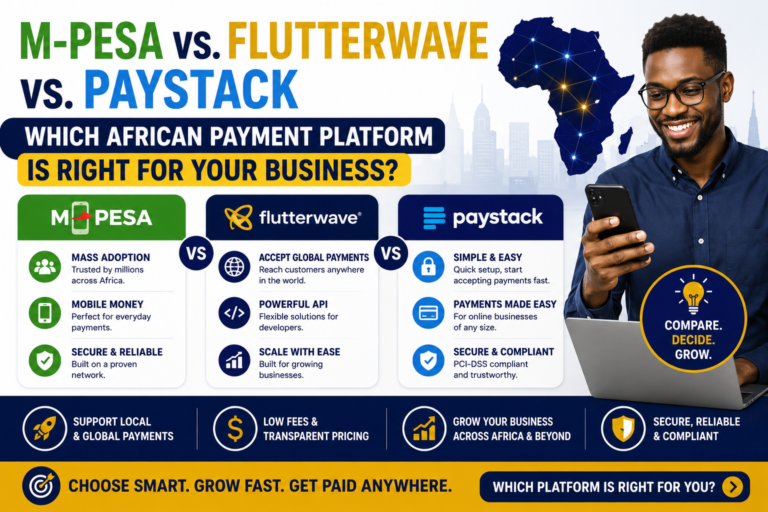



Ten visionaries. Eight unicorns. A continent leapfrogging centuries of banking infrastructure. Here is what Western investors, diaspora readers, and global tech watchers need to know right now.
The Continent the World Underestimated
When Western investors think of fintech disruption, their minds default to San Francisco, London, or Singapore. They should be looking at Lagos, Nairobi, and Cape Town.
Africa is now the world’s fastest-growing fintech market, with revenues projected to expand 13-fold from $10 billion to approximately $65 billion by 2030, according to a 2026 report by Boston Consulting Group. The continent already accounts for 74% of global mobile money transaction volume, a figure that exists entirely independent of whatever happens in Silicon Valley.
McKinsey & Company’s landmark research pegs Africa’s financial services total addressable market at $230 billion — driven by a trifecta of structural advantages no other market possesses simultaneously: the world’s youngest population, the world’s highest mobile-first adoption rate, and over 350 million adults who remain completely unbanked.
“Africa has always been known to leapfrog. We go from nothing to something, consistently — no phones, to mobiles, to internet. People skipped browsers. That’s already happening with payments.” — Olugbenga ‘GB’ Agboola, CEO of Flutterwave
This is not a future story. It is happening right now, led by a generation of brilliant, battle-tested African founders who built billion-dollar companies not despite the continent’s infrastructure gaps — but precisely because of them.
This guide profiles 10 of the most consequential African fintech founders shaping this moment. It is written for Western investors evaluating the opportunity, diaspora communities invested in the ecosystem, and global tech enthusiasts watching the next great wealth-creation story unfold.
📊 Africa Fintech Market Snapshot — 2026
The Four Pillars: Where Capital Flows
Africa’s fintech funding ecosystem is concentrated but powerful. The “Big Four” hubs — Nigeria, South Africa, Kenya, and Egypt — account for 76% of total fintech funding on the continent. Nigeria alone captured 35% of all African tech investment in 2024, with fintech contributing an astonishing 18.9% to the country’s GDP.
Despite a global venture capital correction in 2023–2024, Africa’s fintech sector retained its position as the continent’s leading investment destination. African tech startup funding leaped by almost 50% in early 2026 as the sector began recovering from the global “funding winter.” African fintech is entering what BCG calls its “Second Wave” — beyond consumer payments, into credit, financial infrastructure, and cross-border integration.
Africa’s Fintech Unicorns: The Billion-Dollar Roster
| Company | Founder(s) | Valuation | Total Raised | HQ | Category | Status (2026) |
|---|---|---|---|---|---|---|
| Flutterwave | Olugbenga Agboola | $3.0B+ | $489M | Lagos / SF | Payments Infrastructure | IPO planned; microlender license granted |
| OPay | Opera-backed team | $2.7–3.0B | $570M+ | Lagos | Super-app / Payments | Profitable; expanding |
| TymeBank | Coen Jonker | $1.5B | $600M+ | Singapore / SA | Digital Banking | Profitable; SE Asia expansion |
| Wave (West Africa) | Drew Durbin / Lincoln Quirk | $1.7B | $1.7B (Series A) | Dakar | Mobile Money | Dominant in Francophone W. Africa |
| Moniepoint | Tosin Eniolorunda | $1.0B+ | $256M+ | Lagos | SME Financial Platform | Profitable; UK launched; $297B processed in 2025 |
| Chipper Cash | Ham Serunjogi | $1.25B | $300M+ | San Francisco | Cross-border Payments | Restructuring; Ripple partnership 2025 |
| Interswitch | Mitchell Elegbe | $1.0B+ | VisaCard stake | Lagos | Payment Infrastructure | Legacy leader; IPO delayed |
| MNT-Halan | Mounir Nakhla | $1.0B+ | $400M+ | Cairo | Consumer Lending | Egypt’s first fintech unicorn |
The 10 African Fintech Founders You Need to Know
What follows is not a simple list. These are builders who navigated broken infrastructure, hostile regulators, currency crises, and investor skepticism — and built companies that are genuinely changing how 1.4 billion people interact with money. Western investors: this is your due-diligence starting point.

If there is one name that has come to symbolize the ambition of African fintech globally, it is GB Agboola. A former PayPal engineer and Google product manager from Lagos, he co-founded Flutterwave in 2016 with a mission to “connect Africa to the world and the world to Africa.” The result: a $3 billion+ payments infrastructure giant that processes payments in 30+ currencies across 40 countries, works with Uber, Netflix, and Alibaba’s Alipay, and in 2022 raised the then-largest Series D by any African startup at $250 million.
In 2026, Flutterwave hit a new milestone: receiving a national microlender license from the Central Bank of Nigeria, allowing it to hold customer deposits and extend credit directly — a transformation from payment processor to full-spectrum bank. An IPO in New York and possibly Nigeria has been announced. Agboola was named vice chair of the U.S. Chamber of Commerce‘s US-Africa Business Center and sits on the Wall Street Journal CEO Council.
If Flutterwave built the consumer-facing side of Nigerian payments, Tosin Eniolorunda quietly dominated its informal commercial backbone. A mechanical engineering graduate who taught himself software at Interswitch — where he personally coded Nigeria’s first POS software — Eniolorunda co-founded TeamApt in 2015. By 2022 it had become Moniepoint, and by 2025 it was processing ₦412 trillion (approximately $297 billion) in annual transaction value across more than 14 billion transactions.
Moniepoint is Nigeria’s largest merchant acquirer, serving over 10 million businesses and individuals with POS terminals, working capital loans, and expense management. It achieved unicorn status in 2024 after a $110M round with Google’s Africa Investment Fund, then raised $200M+ in Series C in October 2025 led by DPI and LeapFrog. Crucially, it is profitable — a rarity that has made it the darling of impact investors. It has since launched in the UK, targeting the Nigerian diaspora.
Benjamin Fernandes did not start as a technologist. He was a television host with CNBC Africa in Tanzania before attending Stanford’s GSB and working at the Bill & Melinda Gates Foundation. That unusual background — media, elite academia, and development finance — gave him the ability to see what others missed: that the 8.2% average cost of sending money to Africa was not just an inconvenience but an injustice, systematically draining wealth from the continent’s diaspora.
NALA was the first East African company accepted into Y Combinator (YC W19). After pivoting from budgeting to remittances based purely on user behavior, NALA now holds regulatory licenses across 10+ African countries. Its $40M Series A (2024) funded a major 2025 expansion into Kenya via partnerships with Equity Bank and PesaLink. In 2026, NALA is targeting a $120M raise and expanding its B2B payments API (Rafiki) for global businesses to pay into Africa. Revenue grew 10x in a single year.
In October 2020, the African tech ecosystem celebrated its watershed moment: Stripe acquired Paystack for over $200 million — the largest Nigerian startup exit at the time and the deal that proved to the world that African companies could compete on the global stage. Shola Akinlade, a computer science graduate from Babcock University, co-founded Paystack in 2015 with Ezra Olubi after working on bank payment integrations and witnessing their dysfunction firsthand.
Paystack solved what seemed impossible: making online payments fast, reliable, and developer-friendly for Nigerian businesses. Under Stripe ownership, it has expanded pan-Africa. In March 2025, it launched Zap, its first direct-to-consumer product, though it was temporarily fined ₦250M by the CBN for launching without full regulatory approval — a reminder of how carefully the next phase of African fintech must navigate local regulation. Akinlade’s legacy is the benchmark: every African founder now builds with Paystack in their mental reference frame.
Ham Serunjogi’s journey from representing Uganda in swimming at the 2010 Youth Olympic Games to building a fintech unicorn is the kind of founder story that belongs in business schools. After earning an economics degree in the US and working at Meta in Dublin, Serunjogi co-founded Chipper Cash in 2018 with Ghanaian-born Maijid Moujaled. Their thesis: zero-fee P2P payments across African borders.
Chipper Cash raised over $300 million from Ribbit Capital, Bezos Expeditions, and Deciens Capital, peaked at a $2 billion valuation, and built a 7 million+ user base across 7 African countries plus the US and UK. Its fortunes complicated when key backer FTX collapsed in 2022 — a cautionary tale about backer concentration risk. However, Chipper is rebuilding. In March 2025, it partnered with Ripple to use crypto-enabled payment rails for faster, lower-cost cross-border settlement — a smart pivot that signals the future of African remittance infrastructure.
Coen Jonker built Africa’s most export-ready digital bank. TymeBank — an abbreviation of “Take Your Money Everywhere” — was born from a Deloitte consulting team he led in 2012 and eventually became a standalone fintech when Jonker and Tjaart van der Walt took over the IP. The model is brilliantly simple: no physical branches, over 1,000 self-service kiosks inside Pick n Pay and Boxer stores, and an account you can open in under 5 minutes with just an ID number and mobile phone.
TymeBank achieved its first profitable month in December 2023 — less than 5 years from launch — and reached a $1.5 billion valuation in 2024 after a $250M Series D led by Nubank (Latin America’s largest digital bank). Today it serves 15 million customers across South Africa and the Philippines. Jonker’s stated target: a listed digital bank generating 30%+ return on equity by the late 2020s. Its customer acquisition cost of $4.50 — versus $350+ for traditional banks — is the metric every investor should screenshot.
Founded in the chaos of the 2020 pandemic, Grey solves one of the most painful problems for educated African professionals: not being able to receive payment from global clients. Grey gives Africans free international bank accounts in USD, GBP, and EUR, with real-time currency conversion and virtual cards for global spending. Backed by Y Combinator (YC W22) and regulated by FINTRAC (Canada) and FinCEN (USA), Grey operates in 80+ countries.
In February 2026, Grey launched Grey Business at the Africa Tech Summit in Nairobi — a corporate banking product enabling African SMEs and startups to open USD accounts, send and receive global payments, and transact in USDC and USDT stablecoins. This is a product that Wise and Stripe have not built for Africa at this depth. Grey is the de facto banking layer for Africa’s growing class of remote workers, freelancers, and tech founders who need to operate in dollars while living in naira or cedis.
Mitchell Elegbe is the godfather of Nigerian fintech. He founded Interswitch in 2002 — years before “fintech” was a word anyone used — with the simple mission of digitizing payments in a country still largely transacting in cash. Today, Interswitch is the backbone of Nigeria’s payment infrastructure: its Verve cards are accepted in 178 countries, and its Quickteller platform processes millions of transactions daily.
In 2019, Visa took a minority stake at a $1 billion+ valuation, making Interswitch Africa’s third fintech unicorn. Elegbe’s company trained a generation of Nigeria’s fintech talent — Tosin Eniolorunda (Moniepoint) built his first POS software at Interswitch; Flutterwave co-founder Olugbenga Agboola’s career ran parallel to Interswitch’s rise. Without Elegbe’s two decades of infrastructure building, today’s unicorns would have had no rails to run on.
Stanford GSB-educated, with stints at McKinsey and Cisco, Tayo Oviosu returned to Nigeria in 2009 to solve a problem most Lagos-educated professionals were fleeing: why could Nigerians not send money to each other digitally, reliably, at low cost? His answer was Paga — launched in 2011 — which became one of Nigeria’s most trusted mobile money platforms, processing over $1 billion annually.
What makes Oviosu notable in 2026 is Paga’s evolution. The company has expanded its agent network to over 40,000 touchpoints across Nigeria and launched Paga in the US, allowing diaspora Nigerians to send money and manage naira and dollar accounts from Atlanta, Houston, or London. Speaking at Sui Live in Miami in May 2026, Oviosu is increasingly a voice for responsible cross-border financial infrastructure — the kind of patient, institution-grade building that the next wave of African fintech demands.
No roundup of African fintech is complete without North Africa, and no North Africa conversation is complete without Mounir Nakhla and MNT-Halan. Egypt’s largest consumer and microfinance platform, MNT-Halan became Africa’s first Egyptian fintech unicorn after a $400M+ raise and $1B+ valuation. Operating at the intersection of digital lending, e-commerce logistics, and mobile payments, it has disbursed billions in microloans to underserved Egyptians.
Egypt’s fintech market is projected to grow at a CAGR of 19.2% through 2031, with a market size of $528M in 2024 alone. Nakhla has built not just a lending company but an ecosystem — combining halan, the ride-hailing and delivery super-app, with mnt, a licensed consumer finance entity. For Western investors looking beyond Anglophone Africa, MNT-Halan is the clearest proof point that the African fintech story stretches from Cairo to Cape Town.
What Western Investors Need to Know: 5 Structural Advantages
1. The Leapfrog Effect is Real and Permanent
Africa did not adopt credit cards, then debit cards, then digital wallets in sequence. It skipped the first two steps entirely. When 40% of Sub-Saharan adults are now using mobile money, with Africa accounting for 74% of global mobile money volume, this is not a developing market “catching up.” It is a market that built something structurally different — and potentially superior. The infrastructure that Flutterwave, Moniepoint, and Interswitch built does not need to displace a legacy banking system; it is the system for hundreds of millions of people.
2. Demographics Are the Investment Thesis
Africa’s population is projected to reach 2.5 billion by 2050. It has the world’s youngest median age. Every year, tens of millions of Africans enter the formal economy for the first time — and their first financial interaction is almost certainly digital. This is not a story about charity or development aid. This is a compounding demographic dividend that no other market in the world can offer at this scale and growth rate.
3. Profitability Is Now the Differentiator
The 2022–2024 global VC correction stripped away African fintechs that were built for pitch decks and left behind those built for people. Moniepoint is profitable. TymeBank is profitable. OPay is growing profitably. Wave is holding its users. 76% of Nigerian fintech startups are already profitable, and 57% report annual revenues exceeding $5 million — metrics that would make many US SaaS companies blush. The correction was painful; its outcome is a more resilient sector.
4. The Remittance Corridor Is an Untapped Gold Mine
Sub-Saharan Africa received $54 billion in remittances in 2023 — yet the average cost of sending $200 remains 8.2%, significantly above the global average of 6.3%. Every percentage point reduction in that cost represents hundreds of millions of dollars flowing directly to African families rather than to Western transfer intermediaries. NALA, Grey, Chipper Cash, Flutterwave’s Send App, and Moniepoint UK are all attacking this corridor from different angles. The company that solves affordable, instant, pan-African remittance at scale will be as consequential as Western Union — but in reverse.
5. Regulation Is Maturing, Not Deterring
Early-stage investors feared African regulatory environments as unpredictable. That is changing rapidly. Nigeria’s open banking framework went live in August 2025 — making it the first African country with formal open banking. Ghana and Rwanda signed a fintech passporting agreement that allows licensed fintechs to operate across both markets. The AfCFTA’s unified payments system ambition, covering 55 countries, is moving from aspiration to implementation. The regulatory story in 2026 is not “chaos.” It is “building.”
💸 The Remittance Opportunity — Why Diaspora Capital Matters
Risks Every Investor Must Understand
Intellectual honesty requires acknowledging that this market has real risks. The story of Lidya — the SME lender founded by Tunde Kehinde, once called “the Jeff Bezos of Africa” by the BBC — is instructive. After raising $16.5M and pioneering data-driven SME lending, Lidya shut down operations in October 2025, unable to sustain operations after its leadership team departed and its Lidya Collect product encountered severe operational failures. It is a reminder that fintech in Africa is not immune to the universal startup risks of unit economics, leadership stability, and product-market fit.
Similarly, Chipper Cash’s valuation decline from $2B to an estimated $250–500M after the FTX collapse illustrates backer concentration risk. And Flutterwave’s 2022 Kenyan regulatory freeze — where $51.9M was temporarily seized — demonstrates that licensing gaps can materialize suddenly in rapidly-evolving regulatory environments.
How to Invest in African Fintech: The Access Map
| Route | Examples | Min. Ticket | Stage Focus | Best For |
|---|---|---|---|---|
| VC Funds | Partech Africa, TLcom Capital, Novastar Ventures, QED Investors | $250K+ LP | Seed–Series B | High-net-worth, institutional |
| Development Finance | IFC, BII (UK), DEG, Proparco, AfDB | $1M+ | Growth stage | Institutional, impact-focused |
| Pre-IPO Rounds | Flutterwave (announced), Interswitch | Accredited investor | Pre-IPO | Sophisticated individual investors |
| Public Markets | Jumia (NYSE: JMIA), Airtel Africa (LSE) | Any | Listed | Retail investors seeking exposure |
| AngelList / Syndicates | Launch Africa, Invest Africa syndicates | $1K–$10K | Pre-seed–Seed | Diaspora, individual angels |
| ETFs | VanEck Africa ETF (AFK), iShares MSCI Frontier and Select EM | Market price | Broad exposure | Passive retail investors |
The Second Wave: Beyond Payments
BCG’s 2026 “Beyond Payments” report identifies the next frontier: Africa’s fintech second wave will be defined by credit, embedded finance, and cross-border infrastructure — not the consumer payment platforms that dominated Wave One. With 40% of adults already using mobile money, the “financial inclusion” narrative shifts from account access to financial depth.
This means: SME lending at scale (Moniepoint, MNT-Halan), wealth management and investing tools, B2B payment rails for cross-border trade (NALA’s Rafiki API, Grey Business), and insurance distribution. The stablecoin layer is accelerating: Flutterwave has launched stablecoin balances for merchants; Grey Business supports USDC and USDT; Chipper Cash has partnered with Ripple. Africa’s settlement challenges — fragmented banking systems, high FX friction, slow settlement times — make it uniquely positioned to adopt hybrid fiat-crypto rails faster than any other market.
The AfCFTA’s ambition to create a single African payment zone across 55 countries — if realized even partially — would create the largest common payments market in the world by population. That is the $230 billion opportunity. That is what these founders are building toward.
Frequently Asked Questions
Structured for Google Knowledge Graph and AI search results.