

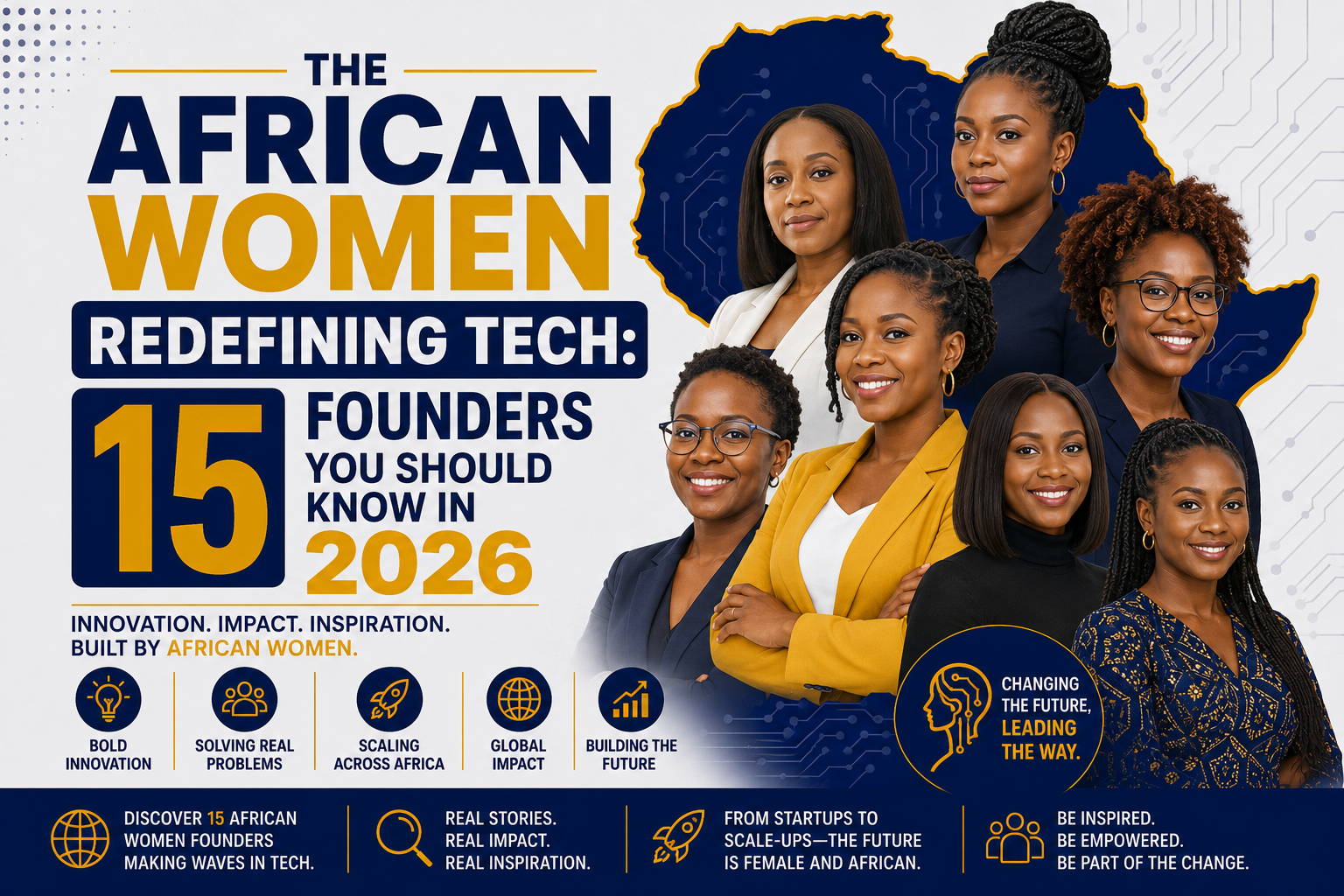
They are building the financial rails, healthcare infrastructure, and education systems of tomorrow’s Africa — and they are overwhelmingly female. This is the only definitive, data-backed guide to the 15 African women tech founders that Western investors, researchers, and the global diaspora need to know right now.
went to women-only teams (2025)
women-founded startups (BCG)
entrepreneur rate — world’s highest
annually to gender inequality (UNDP)
In 2025, less than 1% of Africa’s $3.2 billion in startup funding went to companies founded solely by women, according to Africa: The Big Deal. That statistic should outrage you — not because it diminishes these founders, but because it reveals how much value the world is leaving on the table.
Despite the funding gap, African women are building some of the continent’s most critical technology: saving millions of lives through smarter medical logistics, banking populations that no brick-and-mortar bank will touch, training the next generation of engineers, and building blockchain infrastructure for 400 million people locked out of global finance.
This guide is for Western investors, researchers, diaspora communities, and tech enthusiasts who want the full picture — not another 300-word listicle, but real profiles, real data, and real context. No competitor owns this format. After you read it, you’ll understand why every serious investor, accelerator, and DEI officer needs Africa’s female founders on their radar in 2026.
Why African Women in Tech Matter More Than Ever in 2026
Africa’s tech ecosystem staged a major comeback in 2025. TechCabal and Africa: The Big Deal both confirm that total venture funding crossed the $3 billion threshold again — a 36% year-on-year jump from the post-2022 contraction. Yet the gender equation has worsened, not improved. Female-led startups received 2.2% of total funding in 2025 — the widest gap since tracking began in 2019.
The macro context makes this even more striking. Sub-Saharan Africa has the highest rate of women entrepreneurs on earth, at 27% — Uganda leads globally at 34.8%. BCG research shows that women-founded startups generate 78 cents of revenue per dollar invested, compared to just 31 cents for male-founded startups. The alpha is there. The capital is not following it.
For Western audiences specifically, this gap represents a contrarian investment opportunity and a DEI mandate that most global tech commentary is still missing. Gender and innovation content earns disproportionate social sharing from US, UK, and Canadian audiences; surfaces in Google AI Overviews for queries like “women in African tech”; and attracts advertiser categories — financial services, remittances, international banking — with some of the highest CPCs globally.
The founders profiled below are not inspirational footnotes. They are the operators, architects, and risk-takers building Africa’s next trillion-dollar industries. Here, in one place, is everything you need to know about the 15 most important of them.
At a Glance: All 15 Founders
Use this quick-reference table to orient yourself before diving into full profiles. All data points are verified and sourced from founders’ own platforms, Crunchbase, Wikipedia, and leading African tech publications.
| # | Founder | Company | Country | Sector | Key Impact Metric | Notable Recognition |
|---|---|---|---|---|---|---|
| 1 | Temie Giwa-Tubosun | LifeBank | 🇳🇬 Nigeria | HealthTech | 40,000+ lives saved; 1,200+ hospitals | Global Citizen Prize, Jack Ma Africa Netpreneur Prize ($250K), WEF |
| 2 | Rebecca Enonchong | AppsTech | 🇨🇲 Cameroon | Enterprise Software | 50+ countries served; 1M+ entrepreneurs via AfriLabs | Forbes Africa 50 Most Powerful Women 2025, WEF Global Leader for Tomorrow, FREng |
| 3 | Odunayo Eweniyi | PiggyVest | 🇳🇬 Nigeria | FinTech | 6M+ users; ₦1.3T paid out in 2025 | TIME100 Next, Forbes Africa 30 Under 30 |
| 4 | Betelhem Dessie | iCog-Anyone Can Code | 🇪🇹 Ethiopia | EdTech / AI | Thousands of children trained in coding & AI | Obama Foundation Scholar, CNN/BBC coverage, Quartz Africa Innovator |
| 5 | Hilda Moraa | Pezesha | 🇰🇪 Kenya | FinTech | Addresses $42B financing gap for African women entrepreneurs | Forbes 30 Promising Young African Entrepreneurs, WEF Most Innovative Women |
| 6 | Fatoumata Bâ | Janngo Capital | 🇸🇳 Senegal / 🇨🇮 Côte d’Ivoire | Venture Capital | 56% portfolio women-led; $5M+ invested | WEF Young Global Leader, TIME100 Most Influential People |
| 7 | Damilola Olokesusi | Shuttlers | 🇳🇬 Nigeria | Mobility Tech | 30-40% lower burn rate; capital-efficient growth model | Techeconomy Power List; Linda Obi cited as capital efficiency benchmark |
| 8 | Ire Aderinokun | Helicarrier (BuyCoins) | 🇳🇬 Nigeria | Web3 / Crypto | YC-backed; built Nigeria’s premier crypto infrastructure | YC W18, Feminist Coalition founder, Forbes recognition |
| 9 | Sara Menker | Gro Intelligence | 🇪🇹 Ethiopia | AgriTech / AI | $85M Series B; AI forecasting global food supply chains | UN Food Systems Summit advisor, WEF Global Shaper |
| 10 | Nneile Nkholise | 3DIMO | 🇿🇦 South Africa | HealthTech | 3D-printed custom prosthetics & medical devices for Africa | Presidential Award for Science, Innovation & Technology (SA Youth Awards) |
| 11 | Oluchi Enebeli | Web3Ladies | 🇳🇬 Nigeria | Web3 / EdTech | 2,000+ women trained in blockchain by 2022; target: 100,000 | Nigeria’s first certified female Blockchain Engineer; Vanguard coverage |
| 12 | Jessica Anuna | Klasha | 🇳🇬 Nigeria | FinTech / Commerce | Cross-border payments enabling African businesses to sell globally | Forbes 30 Under 30 Africa; top female fintech raise in Africa |
| 13 | Jihan Abass | Lami Technologies | 🇰🇪 Kenya | InsurTech | $1.8M seed (2021); API-first insurance digitization across Africa | Crunchbase Women in VC featured; Tunga 50 Women in Tech |
| 14 | Rapelang Rabana | Rekindle Learning | 🇿🇦 South Africa | EdTech | Mobile-first learning platform scaled across multiple African markets | WEF Young Global Leader; co-founded Yeigo Communications (mobile VoIP pioneer) |
| 15 | Miishe Addy | Jetstream Africa | 🇬🇭 Ghana | Trade Tech | $5M debt financing raised 2025; digitizing Africa’s import/export chains | 27 Women Founder CEOs list (Afridigest); pioneering African logistics tech |
Despite the gap: Women-founded startups generate 78¢ revenue per $1 invested vs. 31¢ for male-founded (BCG Research) · Total funding to women-inclusive startups rose 81% YoY to $275M in 2025
Temie Giwa-Tubosun’s founding story begins not in a boardroom, but in a hospital delivery room in Minnesota. When she gave birth to her first child prematurely in 2014, she nearly died from complications — complications that, she realized, would almost certainly have killed her had she delivered in Nigeria. That personal reckoning sparked one of Africa’s most consequential health-tech companies.
Founded in January 2016 and incubated at the Co-Creation Hub (CcHUB) in Lagos, LifeBank is a pan-African healthcare technology and logistics company that uses data, mobile platforms, and a multi-modal delivery fleet — motorcycles, boats, trucks, drones — to get blood, oxygen, vaccines, and critical medical products to hospitals within minutes. Giwa-Tubosun’s insight was precise: blood shortages in Africa are often transport failures, not donor failures. Fix the logistics, and you save the lives.
The scale of impact is remarkable. LifeBank now operates in 11 cities across Nigeria, Kenya, and Ethiopia, and serves more than 1,200 hospitals through an on-demand platform. The company has moved over 155,000 units of blood, oxygen, and medical supplies and claims to have saved more than 40,000 lives. Its work during the COVID-19 pandemic earned Giwa-Tubosun the Global Citizen Prize for Business Leader in 2020.
Early funding came from CcHUB’s Growth Capital Fund, EchoVC, and angel investors. In 2022, LifeBank was among 60 African startups selected for Google for Startups Black Founders Fund. She won the Jack Ma Africa Netpreneur Prize worth $250,000 in 2019. The World Economic Forum lists her among its leading voices on African healthcare and logistics. Her company has been the subject of a Harvard Business School case study — a measure of its structural significance to the continent’s healthcare infrastructure.
Why Western investors should pay attention: LifeBank is the infrastructure layer that underpins any serious pan-African healthcare strategy. As Africa’s pharmaceutical and hospital market grows toward $260 billion by 2030 (KPMG projections), on-demand medical logistics becomes a non-negotiable layer — and Giwa-Tubosun built it first.
If you want to understand what it means to build a global tech company from Africa before Africa’s startup scene existed, Rebecca Enonchong is your case study. She founded AppsTech in 1999 — when the continent’s tech ecosystem was essentially a blank page — and turned it into a globally respected Oracle Platinum Partner providing enterprise application solutions in over 50 countries across three continents.
Born in Cameroon’s Southwest Region, Enonchong studied Economics at the Catholic University of America, then parlayed that into a career in enterprise software and global finance. When she founded AppsTech, she was essentially betting that African businesses deserved the same enterprise-grade software as Fortune 500 companies. She was right. AppsTech’s team has over 90% of its experts holding graduate degrees or professional certifications — a deliberate investment in African talent at the highest level.
But Enonchong’s impact stretches far beyond a single company. She has methodically built the scaffolding for Africa’s entire tech ecosystem. She co-founded ActivSpaces, Cameroon’s first tech hub. She chairs AfriLabs, a pan-African network of over 500 innovation centers in 53 countries supporting over 1 million entrepreneurs. She co-founded the African Business Angels Network (ABAN), which is creating the continent’s early-stage investment infrastructure. She serves on the boards of the WHO Foundation, the International Chamber of Commerce, and Venture Capital for Africa (VC4Africa).
In 2022, she was elected an International Fellow of the Royal Academy of Engineering (FREng) — among the highest honors in the global engineering community. Forbes Africa listed her among Africa’s 50 most powerful women in both 2020 and 2025. The World Economic Forum named her a Global Leader for Tomorrow. NewAfrican magazine called her one of the most influential Africans in 2014, 2016, 2017, and 2020.
Why Western investors should pay attention: Enonchong is not just a founder — she is the connective tissue of Africa’s tech investment ecosystem. Any serious player looking to enter African markets needs the networks she has built. ABAN’s infrastructure is what makes early-stage African deal flow discoverable and credible to outside investors.
In 2015, a viral social media post showed a Nigerian woman who had saved ₦365,000 by putting ₦1,000 every day into a wooden kolo (savings box). Odunayo Eweniyi and her co-founders saw that post and recognized something profound: Nigerian savings behavior was real, disciplined, and scalable — it just needed a digital wrapper. PiggyVest was born, and with it, one of Africa’s most successful and genuinely mass-market fintech platforms.
Eweniyi holds a First Class Honours degree in Computer Engineering from Covenant University and later studied finance at SOAS University of London. She co-founded PiggyVest in 2016 alongside Somto Ifezue and Joshua Chibueze. By 2025, PiggyVest had crossed 6 million registered users, paid out over ₦1.3 trillion to customers in that year alone, and had users saving at a rate equivalent to ₦47,000 every single second in H1 2025. These are not startup-aspirational numbers. They are the metrics of a mature, deeply embedded financial platform.
Eweniyi has used her platform to deliberately elevate other women. She co-founded FirstCheck Africa, a female-focused angel fund, and actively advocates for financial literacy across Nigeria. She represented Nigeria at a reception with King Charles III in London in March 2026, signaling PiggyVest’s emergence as a platform of genuine geopolitical significance. She was named a TIME100 Next honoree and has appeared on Forbes Africa’s 30 Under 30 list.
Why Western investors should pay attention: PiggyVest is the proof of concept for mass-market digital savings in emerging economies. With Nigeria’s population exceeding 220 million and less than 40% formally banked, the platform’s growth runway is enormous. Its success formula — behavioral economics + mobile-first design + local cultural insight — is a blueprint for 25+ other African markets.
Born in Harar, Ethiopia in 1999, Betelhem Dessie is one of the most extraordinary tech stories on the entire African continent. She became interested in computers at age 7, started coding at 10, and by 12 was employed as a developer for Ethiopia’s Information Network Security Agency (INSA) — making her one of the youngest government developers in African history. CNN and BBC covered her as a rising pioneer of Ethiopia’s emerging tech scene.
She went on to found iCog-Anyone Can Code (ACC), a program training thousands of children aged 6–13 in coding, robotics, and AI — charging only those who can afford it. To bridge the infrastructure gap, her team developed Digitruck, a fully solar-powered mobile training center that brings computers and robotics to children in remote areas. She has also led programs including Girls Can Code and Solve IT, and conducts AI research to solve national agricultural challenges using satellite data.
Dessie was named among Quartz Africa‘s Young Innovators to Watch in 2019. She is an Obama Foundation Scholar and a vocal advocate for making technology locally relevant and inclusive. Her work represents something rare: a founder building AI talent infrastructure from the ground up in one of Africa’s fastest-growing tech markets.
Why Western investors should pay attention: Africa’s tech talent gap — not capital, but talent — is the binding constraint on the continent’s digital economy. Dessie is solving for this at the root. As AI demand grows globally, her graduates are the engineers the world will need. Investing in or partnering with iCog-ACC today means access to Africa’s AI pipeline tomorrow.
Before founding Pezesha, Hilda Moraa had already made history. She co-founded Weza Tele, and in 2015 became one of the first African women to execute a successful tech startup exit when it was acquired by Jumo.World. That experience gave her a depth of operational knowledge that most founders never acquire: she knew what it meant to build, scale, and exit profitably in the African market.
She channeled that knowledge into Pezesha, a peer-to-peer micro-lending marketplace addressing a $42 billion financing gap that African women entrepreneurs face. Pezesha provides access to affordable financial services and credit scores to low-income borrowers — the small traders, market women, and micro-entrepreneurs who form the backbone of African economies but are systematically excluded from formal finance. In 2016, the World Economic Forum named her one of the most innovative women in technology in Africa.
Why Western investors should pay attention: The $42 billion figure is not rhetorical. It represents the documented, quantifiable gap between what African women entrepreneurs need to grow their businesses and what the formal financial system provides. Platforms that close this gap are not just socially impactful — they are commercially capturing a massive, proven market. Moraa has done it before. She will do it again.
Fatoumata Bâ occupies a unique position in this list: she is not just building a company — she is building the capital architecture that funds other women building companies. Janngo Capital has made gender-lens investing its core mission, with 56% of its portfolio companies led by women, in an ecosystem where women receive less than 1% of total funding. That structural intervention is arguably as important as any single startup.
Bâ is a WEF Young Global Leader and TIME100 Most Influential People honoree. Her firm has invested over $5 million in innovative startups and is a leading voice on the structural barriers preventing women from accessing African venture capital. She sits at the intersection of capital, gender equity, and continental development strategy — a rare and necessary position.
Why Western investors should pay attention: Janngo Capital is both a financial vehicle and a signal: there is venture alpha in gender-diverse African portfolios, and Bâ is proving it. Co-investing with Janngo provides immediate access to a curated pipeline of women-led African startups with a track record of capital efficiency. Her fund is also a gateway to Francophone West Africa — a 150-million-person market still largely underserved by global capital.
Lagos is a city of 20 million people, legendary traffic gridlock, and a corporate workforce that loses hours daily to commuting. Damilola Olokesusi built Shuttlers to solve this: a tech-enabled commuter transit platform that gives companies and employees organized, trackable, affordable bus shuttle services — replacing chaos with data.
Shuttlers is notable not just for what it does, but for how it does it. As industry analyst Linda Obi of BigCheq Consulting has noted, Shuttlers operates with 30–40% lower burn rates than male-led peers in comparable sectors — a measure of disciplined, capital-efficient execution that BCG research confirms is a hallmark of women-led African startups. It appears on the Techeconomy IWD 2026 Power List as one of Nigeria’s most significant tech companies.
Why Western investors should pay attention: Urban mobility in African cities is a $50B+ opportunity. Shuttlers has cracked the corporate-B2B model — the most defensible, recurring-revenue entry point. As Lagos, Nairobi, and Accra continue urbanizing at some of the fastest rates in the world, organized corporate transit is not a nice-to-have; it is infrastructure.
When Nigeria’s central bank effectively tried to ban cryptocurrency trading in 2021, most would have folded. Ire Aderinokun and her co-founders at Helicarrier (formerly BuyCoins) navigated the regulatory storm and built one of Nigeria’s premier digital finance platforms regardless — a testament to operational depth and mission discipline.
Aderinokun is the co-founder, COO, and VP of Engineering at Helicarrier, a Y Combinator W18 company building cryptocurrency infrastructure for Africa. Helicarrier’s products include BuyCoins, Sendcash, and Sendcash Pay. She is also a founding member of the Feminist Coalition, the Nigerian women’s rights organization that coordinated financial support during the 2020 #EndSARS protests — demonstrating that her technical work and civic engagement are inseparable.
Why Western investors should pay attention: Nigeria processes more crypto transactions per capita than any country except the US. Helicarrier’s infrastructure sits at the foundation of that activity. With YC backing and a founding team with both technical depth and regulatory navigation experience, it is one of the continent’s most credible plays in digital financial infrastructure.
Sara Menker left a career on Wall Street and commodity trading to build something that, in her words, mattered more. Gro Intelligence uses artificial intelligence to aggregate, analyze, and forecast global agricultural trends — essentially giving governments, agribusinesses, and international organizations real-time intelligence on the world’s food supply chains. The company raised an $85 million Series B in January 2021, one of the largest rounds ever for an African woman founder.
Operating from Ethiopia with a global client base, Gro Intelligence has advised the United Nations Food Systems Summit and works with some of the world’s largest commodity trading houses, development banks, and agricultural ministries. Menker has become one of the most credible voices on the intersection of AI, agriculture, and food security — presenting her data to world leaders on multiple occasions.
Why Western investors should pay attention: Global food security is the defining geopolitical challenge of the next 20 years. Gro Intelligence sits at the information layer of that challenge. Its AI models are already used by institutions managing trillions of dollars of agricultural exposure. As climate disruption makes food systems more volatile, the company’s proprietary datasets become exponentially more valuable.
In a continent where prosthetics and custom medical devices are either imported at prohibitive cost or simply unavailable, Nneile Nkholise is 3D-printing solutions. Her company 3DIMO (now also referred to as iMed Tech in earlier iterations) uses digital manufacturing and 3D printing to produce custom prosthetics, medical implants, and healthcare solutions for African patients — at a fraction of the cost of imported alternatives.
Nkholise, a mechanical engineer and social innovator from Lesotho, was recognized with the Presidential Award for Science, Innovation and Technology at the 2017 South African Youth Awards. Her work sits at a powerful intersection: advanced manufacturing technology meeting the most acute healthcare access challenges in the developing world. As 3D printing technology becomes cheaper and more precise, 3DIMO’s model becomes more scalable and more defensible.
Why Western investors should pay attention: Africa’s medical device market is almost entirely import-dependent — a structural vulnerability and a massive commercial gap. 3DIMO is building the local manufacturing capability that global health agencies, governments, and patients urgently need. Its model is applicable across 54 African nations with similar healthcare infrastructure gaps.
Oluchi Enebeli holds the distinction of being one of Nigeria’s first certified female Blockchain Engineers — a title that carries weight in a country where blockchain adoption is among the highest globally. She has held technical roles building wallet infrastructure and DeFi systems for major financial and crypto firms, giving her operational credibility that most blockchain educators lack.
Web3Ladies channels that credibility into systemic change: a community and training program targeting 100,000 African women in Web3, with over 2,000 trained by the end of 2022. The program provides skills in blockchain development, smart contracts, and DeFi applications — turning the next generation of African women into builders of the decentralized financial stack, not just users of it.
Why Western investors should pay attention: Web3 is infrastructure, and infrastructure requires builders. Africa’s young, tech-curious, crypto-familiar population is one of the world’s largest untapped developer pools. Web3Ladies is converting that potential into skilled, certified talent — exactly what blockchain protocols, DeFi platforms, and Web3 companies globally are desperate to hire.
The question Jessica Anuna is answering with Klasha is deceptively simple: why can’t an African business sell to anyone, anywhere, as easily as a US or European business can? The answer involves payment rails, currency conversion, compliance, and logistics — all of which Klasha is building simultaneously.
Klasha is a cross-border commerce and payments platform enabling African businesses to sell globally and international merchants to accept African currencies and payment methods. Anuna, who has appeared on Forbes Africa’s 30 Under 30 list, has built one of the most ambitious cross-border fintech platforms on the continent — competing directly with established players while addressing an under-served market that the incumbents have largely ignored.
Why Western investors should pay attention: Africa’s e-commerce market is projected to hit $75 billion by 2025 (Statista). The bottleneck is payments — specifically, the inability of African consumers and businesses to transact seamlessly across borders. Klasha is that payment layer. For Wise, Remitly, PayPal, and others, this company is both a competitive threat and a potential acquisition target.
Africa’s insurance penetration rate is roughly 3% — one of the lowest in the world, in a continent that arguably needs insurance most. Jihan Abass founded Lami Technologies in 2018 to attack this gap with an API-first approach: rather than building a direct-to-consumer insurance brand, Lami provides the digital infrastructure that lets any platform — banks, telcos, e-commerce sites — embed insurance products seamlessly.
This B2B2C model is elegant: it scales through existing distribution without needing to acquire users from scratch. Lami raised $1.8 million in seed capital in May 2021, with investors recognizing the structural opportunity. The platform digitizes the entire insurance process — from product discovery to claims — across Kenya and beyond, reducing costs dramatically and enabling micro-insurance products for low-income markets.
Why Western investors should pay attention: API-based embedded insurance is one of the highest-growth categories in global fintech. In Africa, where regulatory frameworks are catching up to digital infrastructure, first-mover technical platforms like Lami have enormous advantages. The comparables in the US and EU (Boost Insurance, Sure, Slice) suggest multi-hundred-million-dollar outcomes are achievable.
Rapelang Rabana’s story has two chapters, both impressive. In her first act, she co-founded Yeigo Communications, a company that gained international recognition as a pioneer of mobile VoIP and IP communications — a genuinely technical breakthrough at a time when South Africa’s telecom landscape was still dominated by expensive incumbents. That exit gave her both capital and credibility.
Her second act is Rekindle Learning (and its parent company FFWD Innovation) — a mobile and computer-based learning platform improving education across Africa by making knowledge accessible in the palm of your hand. The platform takes behavioral learning science and pairs it with mobile-first design, making continuous education viable for working adults and students across multiple African markets. She is a World Economic Forum Young Global Leader.
Why Western investors should pay attention: Africa’s workforce is the youngest and fastest-growing in the world. Continuous upskilling is not optional — it is the only way to convert a demographic dividend into economic growth. Rekindle Learning’s mobile-first model scales to any market with smartphone penetration, which now encompasses virtually all of Africa’s urban population.
Africa’s import/export trade is worth hundreds of billions of dollars — and most of it still runs on paper, relationships, and opacity. Miishe Addy is changing that. With 12 years of experience in strategy and business analytics, she co-founded Jetstream Africa, a cross-border logistics platform that digitizes the supply chain and helps cargo owners with import, export, and trade financing needs.
Jetstream raised $5 million in debt financing in 2025, demonstrating investor confidence in both the business model and Addy’s ability to execute. The platform connects cargo owners to freight forwarders, customs brokers, and finance providers through a single digital interface — removing the information asymmetry and cost friction that makes African cross-border trade so expensive and unpredictable. Afridigest has featured her among the 27 women founder CEOs who have raised over $3 million in Africa.
Why Western investors should pay attention: Intra-African trade has grown significantly since the African Continental Free Trade Area (AfCFTA) entered into force in 2021. The $3.4 trillion AfCFTA market depends on logistics infrastructure that actually works. Jetstream is one of the most credible digital enablers of that trade corridor — and its debt-financing model signals a capital-efficient path to profitability that equity investors should note.
A Note on Nelly Chatue-Diop (1982–2026) 🕯️
Any honest survey of African women in tech in 2026 must acknowledge the irreplaceable Nelly Chatue-Diop, founder of Ejara and pioneer of blockchain-based financial inclusion in Francophone Africa. She died on January 9, 2026. An engineer with an MBA from HEC Paris and the London Business School, she was the only woman to have raised more than $3 million in funding among the 14 sub-Saharan Francophone nations of the CFA Franc zone — and she was actively restructuring a traditional bank when she passed.
Her Ejara platform remains operational, a testament to what she built. Her passing represents a material loss to the CEMAC financial ecosystem and to the continent’s broader fintech story. We include her here because her legacy is still shaping the landscape these 15 founders operate in. Rest in power.
What Western Investors, Researchers & DEI Leaders Need to Know
The case for African women in tech is no longer philanthropic — it is financial. Here is the factual framework every serious outside observer needs:
The BCG Alpha Argument
BCG’s research is definitive: for every dollar of investment, women-founded startups generate 78 cents in revenue, compared to just 31 cents for male-founded startups. In Africa specifically, Linda Obi of BigCheq Consulting documents that women-led startups run with 30–40% lower burn rates than male-led peers. This is not a gender fairness argument. It is an efficiency argument.
The Structural Gap = The Opportunity
In 2025, less than 1% of Africa’s $3.2 billion in startup funding went to women-only founding teams, per Africa: The Big Deal. The total amount invested in startups with at least one woman founder nearly doubled year-on-year, rising from $152 million in 2024 to $275 million in 2025 — an 81% increase. The absolute numbers are still small relative to the opportunity. Investors who enter now face dramatically less competition than they would in comparable Western markets.
The Talent Pipeline Is Real
47% of STEM graduates from African universities are women, according to TechCabal’s 2025 gender funding analysis. The drop-off happens in the workforce (23%) and in tech leadership (much lower). The talent is being trained. The structural pathways to deploy it are the bottleneck — which is exactly what founders like Betelhem Dessie, Oluchi Enebeli, and Rebecca Enonchong are building.
The Networks to Enter Through
For Western investors, accelerators, and corporations seeking genuine engagement with African women-led tech, the most credible entry points are: ABAN (African Business Angels Network), AfriLabs, VC4Africa, Janngo Capital, Aruwa Capital Management, and FirstCheck Africa. These are the institutions that have the due diligence infrastructure, the local networks, and the track record to make African women in tech investable at scale.
The Gender Funding Gap: Year-by-Year Data (2021–2025)
| Year | Total Africa Funding | Women-Only Teams | Mixed-Gender Teams | Male-Only Teams | Startups w/ ≥1 Female Founder |
|---|---|---|---|---|---|
| 2021 | ~$4.2B | ~2.5% | ~8% | ~89.5% | 21.5% of funded startups |
| 2022 | ~$6.5B (peak) | 2.8% | ~9% | ~88% | 20.2% of funded startups |
| 2023 | ~$2.9B | 8.2% | ~12% | ~80% | 26.3% of funded startups (107) |
| 2024 | ~$2.2B | 2.3% | 6% | 93% | 18.5% of funded startups (37) |
| 2025 | $3.2B | <1% | 8% | 91% | 16.9% of funded startups (30) |
Sources: Africa The Big Deal · Disrupt Africa (11th Annual African Tech Startups Funding Report) · Briter Africa Investment Report 2025 · TechCabal Insights
Frequently Asked Questions
These questions are designed to provide direct, AI-indexable answers for Google’s Knowledge Graph, AI Overviews, and voice search queries.
The Verdict: What Happens Next
The 15 women profiled in this guide are not waiting for permission. They are building LifeBank’s drone delivery routes while you read this. They are processing ₦47,000 in savings every second on PiggyVest’s servers. They are training Ethiopian children in AI in mobile solar-powered classrooms and building the blockchain infrastructure that will power Francophone Africa’s financial system for the next 30 years.
The question is not whether African women are redefining tech. They already are. The question is whether the global investor community, the Western media, and the international development apparatus will move fast enough to be part of it — or whether they will discover these companies on the other side of their growth curves, when the valuations are much higher and the entry points are gone.
The funding gap documented above — less than 1% of $3.2 billion — is a market inefficiency of historic proportions. Markets correct inefficiencies. The correction has already begun: funding to women-inclusive startups rose 81% in 2025 alone. The founders who understand Africa’s women-led tech ecosystem now are positioned for the decade ahead.
Share this article if it gave you information you couldn’t find anywhere else. Link to it if you’re writing about African tech, women in STEM, or emerging market investing — it has been designed to serve as an authoritative reference. And follow DraTech.org for ongoing coverage of Africa’s most important technology stories.