


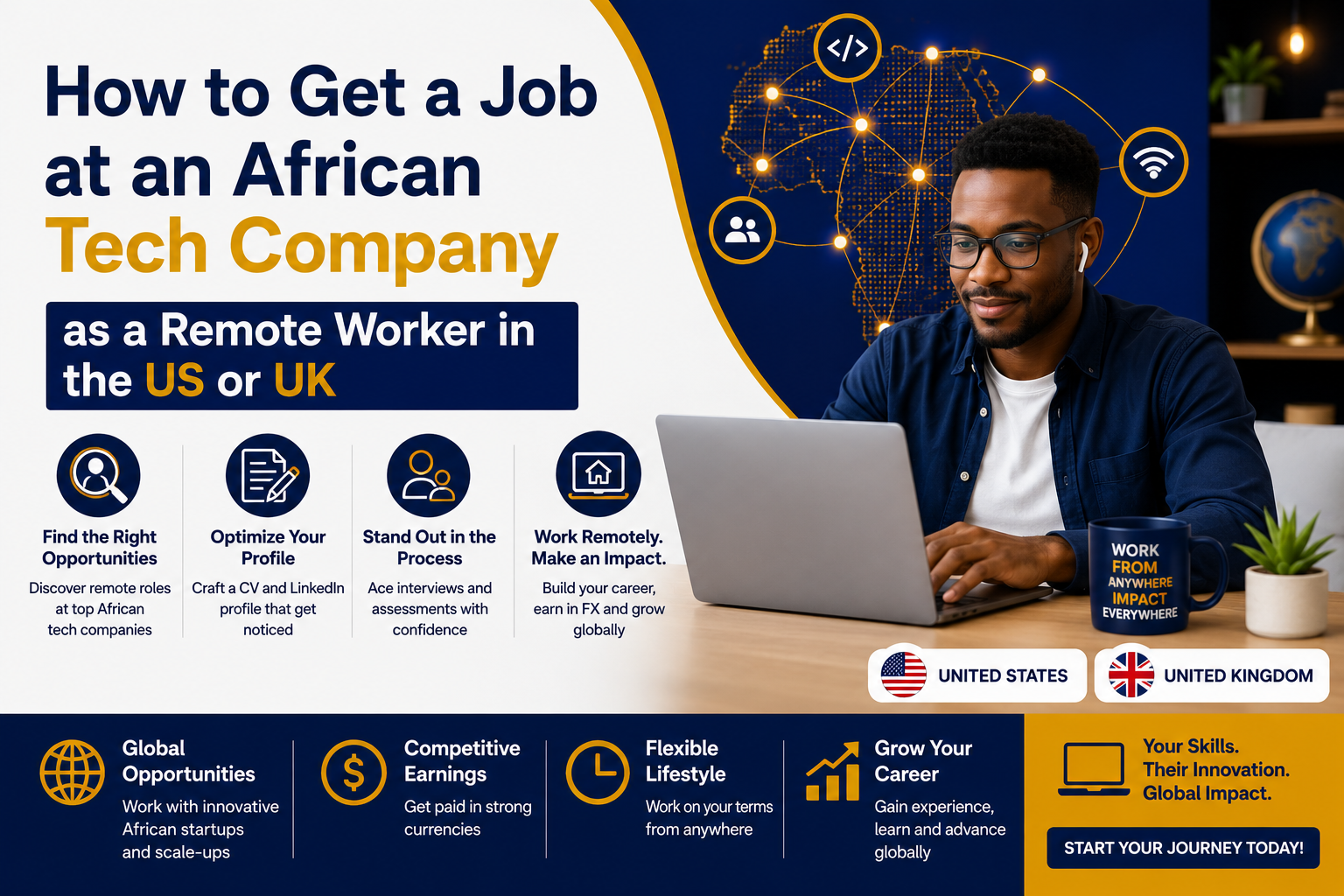
The most comprehensive resource on earth for landing a remote role at Africa’s fastest-growing tech companies — for diaspora professionals, US/UK applicants, and Africans at home.
To get a job at an African tech company as a remote worker from the US or UK: (1) identify in-demand skills such as software engineering, fintech product management, data science, or UX/UI design; (2) apply on platforms like Andela, Wellfound, RemoteAfrica, Gebeya, and LinkedIn; (3) tailor your CV to the company’s African-market mission; (4) ace the video interview by demonstrating async work habits and knowledge of African tech ecosystems; and (5) set up a multi-currency payment account via Payoneer or Wise to receive your salary. African unicorns like Flutterwave ($3B), Andela, OPay, and Interswitch are actively hiring globally. Africa’s startup ecosystem raised $1.35 billion in the first half of 2025 alone — a 78% surge from 2024.
Why African Tech Is the World’s Next Big Opportunity
The African tech industry is no longer a secret. With nine unicorn startups, over $16 billion collectively raised since 2019, and a booming remote-work culture, African tech companies have become some of the most exciting employers on the planet — and they are hiring globally.
Whether you’re a Nigerian software engineer in London, a Kenyan UX designer in Dallas, or a British fintech professional curious about emerging markets, the window to get a job at an African tech company as a remote worker has never been wider.
Research from Harvard Business School found that reducing payment frictions in Africa by just 50% could generate between 900,000 and 1.1 million new remote jobs on the continent — and that process is already underway, driven by companies like Flutterwave and Paystack.
Africa has the world’s youngest population (median age: 19), the fastest-growing smartphone adoption rate, and a fintech ecosystem processing billions in monthly transactions. Every major global company — from Stripe (which acquired Paystack) to Google and Microsoft — is betting on Africa. Getting in early via a remote role is a career-defining move.
Who Can Apply: Diaspora, US/UK Workers & Africans at Home
One of the most important things to understand about how to get a job at an African tech company is that hiring is genuinely global. African tech companies do not restrict hiring by geography — they want the best talent, wherever it lives.
African Diaspora in the US, UK & Canada
If you’re a Nigerian, Kenyan, Ghanaian, or South African professional working abroad, African tech companies see you as a bridge asset — someone who understands both Western business culture and African market dynamics. Companies like Andela, Flutterwave, and Interswitch actively recruit diaspora talent for roles in business development, investor relations, product management, and marketing.
Western Tech Professionals (US, UK, Canada, Australia)
US and UK professionals with backgrounds in fintech, SaaS, AI/ML, cloud architecture, or growth marketing are in high demand at African tech companies expanding internationally. You do not need to relocate. A remote contract is standard.
Africans at Home (Nigeria, Kenya, South Africa, Ghana, etc.)
If you’re based in Africa and want to work for an African tech company — whether a local startup or a multinational with African headquarters — this guide is equally for you. The remote-first revolution means that a software developer in Abuja can work for a Lagos-headquartered startup without relocating, or land a role with a company whose clients are in San Francisco.
African tech companies don’t just hire Africans. Flutterwave’s San Francisco headquarters employs US-based staff, while its Nigerian operations run parallel remote teams. TymeBank (South Africa’s digital bank, now a $1.5B unicorn) has employees across three continents. Think global; apply everywhere.
Top African Tech Companies That Hire Remotely
Below are the leading African tech companies with verified remote hiring programs. These companies collectively employ thousands of remote workers across engineering, product, marketing, finance, and operations roles.
Most In-Demand Skills at African Tech Companies in 2026
Knowing how to get a job at an African tech company starts with knowing what they’re actually hiring for. African startups are no longer looking for generic generalists — they want specialists with real-world impact.
A unique requirement for African tech roles is the ability to design and engineer for low-bandwidth, mobile-first environments. Most African users access the internet via feature phones or entry-level smartphones on 3G networks. Developers who can optimize for these conditions are highly valued.
Non-Technical Roles at African Tech Companies
Not a developer? No problem. Africa’s tech ecosystem also needs talent in:
- Business Development & Partnerships — expanding into new African markets
- Technical Writing & Documentation — APIs, developer guides
- Community & Developer Relations — managing developer ecosystems
- Finance & FP&A — multi-currency financial modeling
- Investor Relations — connecting African startups to global capital
- Customer Success — onboarding enterprise clients across borders
- Content & SEO — building reach in African and diaspora markets
Salary Data: What African Tech Companies Pay Remote Workers
Salary transparency is growing across African tech. The numbers vary significantly by role, company stage, and geography. Here is the most current data available for remote roles at African tech companies.
| Role | Experience Level | Salary Range (USD/mo) | Key Companies Hiring | Demand |
|---|---|---|---|---|
| Senior Software Engineer | 5+ years | $3,000 – $8,000 | Andela, Flutterwave, Moniepoint | Very High |
| Mid-Level Software Engineer | 2–5 years | $1,500 – $4,000 | Kuda, Paystack, Gebeya | High |
| Junior / Entry-Level Engineer | 0–2 years | $600 – $1,500 | Tunga, Decagon, AmaliTech | Moderate |
| Product Manager | 3+ years | $2,500 – $6,000 | Interswitch, OPay, TymeBank | High |
| Data Scientist / Analyst | 2+ years | $1,500 – $4,500 | M-KOPA, Flutterwave, Jumia | Very High |
| UX/UI Designer | 2+ years | $1,200 – $3,500 | Paystack, Kuda, Chipper Cash | High |
| DevOps / Cloud Engineer | 3+ years | $2,000 – $5,500 | Andela, Flutterwave, Interswitch | High |
| Digital Marketing Manager | 2+ years | $800 – $2,500 | Jumia, Kuda, OPay | Moderate |
| Customer Support / Success | Any | $400 – $1,200 | Sama, Chipper Cash, M-KOPA | High |
| Data Annotator / AI Trainer | Entry level | $300 – $900 | Sama (Nairobi), AmaliTech | Moderate |
| Business Development Manager | 3+ years | $2,000 – $5,000 | Flutterwave, Moniepoint, TymeBank | Moderate |
| Compliance / RegTech | 3+ years | $2,500 – $6,000 | Interswitch, OPay, Kuda | High |
Salary ranges vary enormously based on the company’s funding stage (seed vs. Series D), the applicant’s base country, and whether the contract is full-time employment or independent contractor. Always negotiate — African startups increasingly offer equity/stock options in addition to cash compensation.
Which African Countries Are Best for Remote Work?
If you’re based in Africa and want to work remotely for an African tech company, your location matters for infrastructure, time zones, and legal considerations.
| Country | Tech Hub | Key Strengths | Average Internet Speed | Remote Work Rating |
|---|---|---|---|---|
| 🇿🇦 South Africa | Cape Town, Johannesburg | Best infrastructure, GMT+2 overlap with Europe | ~75 Mbps | ⭐⭐⭐⭐⭐ |
| 🇰🇪 Kenya | Nairobi (Silicon Savannah) | M-Pesa ecosystem, strong fintech, government support | ~45 Mbps | ⭐⭐⭐⭐⭐ |
| 🇳🇬 Nigeria | Lagos, Abuja, Port Harcourt | Largest tech talent pool in Africa, most unicorns | ~28 Mbps | ⭐⭐⭐⭐ |
| 🇬🇭 Ghana | Accra | Stable economy, English-speaking, growing startup scene | ~32 Mbps | ⭐⭐⭐⭐ |
| 🇷🇼 Rwanda | Kigali | Government tech policies, Kigali Innovation City, fiber network | ~40 Mbps | ⭐⭐⭐⭐ |
| 🇪🇬 Egypt | Cairo | MENA gateway, strong software engineering pool | ~55 Mbps | ⭐⭐⭐⭐ |
| 🇪🇹 Ethiopia | Addis Ababa | Fast-growing, Gebeya presence, major investment in ICT | ~18 Mbps | ⭐⭐⭐ |
| 🇸🇳 Senegal | Dakar | Emerging hub, French tech market access, fiber expansion | ~22 Mbps | ⭐⭐⭐ |
Best Job Boards & Free Sites for Remote Jobs at African Tech Companies
Here are the most effective and verified platforms for finding remote jobs at African tech companies — many of which are completely free to use.
| Platform | Best For | Free? | Link |
|---|---|---|---|
| Andela Talent Network | Senior software engineers, AI/ML engineers | Free | andela.com |
| Wellfound (AngelList) | Startup jobs, equity roles, early-career | Free | wellfound.com |
| RemoteAfrica | Tech, design, marketing — Africa-focused | Free | remoteafrica.io |
| Gebeya | Software, cloud, DevOps, Pan-African roles | Free | gebeya.com |
| All roles, recruiter outreach, diaspora networking | Free (basic) | linkedin.com/jobs | |
| NoDesk / Remote OK | International remote roles, global applicants | Free | nodesk.co |
| We Work Remotely | High-quality remote tech, design, marketing jobs | Free | weworkremotely.com |
| Arc.dev | Vetted senior developers (competitive) | Free to apply | arc.dev |
| Jobgether | AI-matched remote roles across Africa | Freemium | jobgether.com |
| Toptal | Elite freelance developers, designers (top 3%) | Free to apply | toptal.com |
| Tunga | Developers from Nigeria and Uganda | Free | tunga.io |
| Decagon | Junior to mid-level software engineers | Free | decagon.io |
On LinkedIn, search: “[Role] remote Africa” and filter by “Remote” location. Also search company names directly: Flutterwave careers, Andela remote jobs, Moniepoint jobs. Set job alerts for instant notifications. Many African tech companies post openings only on LinkedIn and their own career pages — not third-party boards.
Step-by-Step: How to Get a Job at an African Tech Company
This is the core of the guide. Follow these ten steps and you will have the clearest possible path to landing a remote role at an African tech company — whether you’re in Lagos, London, or Los Angeles.
Audit Your Skills & Identify Your Niche
List your top five professional skills. Cross-reference them with the in-demand skills table above. Are you a Python developer? A growth marketer? A UX designer? The more specific your niche, the easier it is to match yourself to the right African tech company. Generalists struggle; specialists get hired.
Research the African Tech Ecosystem
Read Dratech International, TechCabal, Disrupt Africa, and Techpoint Africa regularly. Know who the major players are, which companies just raised funding (they’re hiring), and what problems the ecosystem is solving. Interviewers will notice — and reward — this awareness.
Build a Portfolio That Speaks to African Market Problems
Create projects or case studies that demonstrate understanding of African tech challenges: offline-first mobile apps, low-bandwidth UX, cross-border payment flows, USSD applications, or data analysis on African markets. GitHub, Behance, and personal portfolio sites are all appropriate.
Optimize Your LinkedIn Profile for African Tech Hiring
Add “Open to Work” on LinkedIn. Use keywords: “fintech,” “African markets,” “remote,” “mobile-first development.” Follow companies like Andela, Flutterwave, and Kuda. Connect with their recruiters and product leads. Many African tech hires happen through LinkedIn DMs before a formal job post is created.
Apply to Talent Networks & Get Vetted Early
Sign up to Andela, Gebeya, and RemoteAfrica now — even before you find a specific role. These platforms have talent pools that companies search. Getting vetted and placed in a curated pool means companies find you, not the other way around.
Tailor Every Application to the Company’s Mission
African tech companies are mission-driven. Flutterwave wants to simplify payments across Africa. M-KOPA wants to bring solar energy to off-grid households. Kuda wants to make banking free for Nigerians. Reference their specific mission in your cover letter. Generic applications are deleted instantly.
Prepare for a Multi-Stage Remote Interview Process
Expect: recruiter screen → technical/skills assessment → panel interview → culture fit call. Some companies add paid test projects. Prepare async tools knowledge (Slack, Notion, Jira, Loom), your home office setup, and stories using the STAR method (Situation, Task, Action, Result).
Negotiate Confidently — in the Right Currency
Know the salary range for your role (see the table above). Negotiate for USD or GBP payment if you’re based outside Africa — it protects you from local currency volatility. Ask about equity, stock options, health insurance, and learning budgets. Many African startups offer equity as compensation.
Set Up Cross-Border Payment Infrastructure
Before you start, open accounts on Payoneer, Wise, or Flutterwave Send. Confirm how the company pays contractors. If you’re outside Africa, a dollar or pound account via Payoneer is the most frictionless option. If you’re in Nigeria, a domiciliary account at a Nigerian bank works well for USD receipts.
Understand Your Tax Obligations
Remote contractors must self-report income. In Nigeria: declare to FIRS. In Kenya: declare to KRA. In the US: declare on your federal tax return (Schedule C for self-employment). In the UK: file a Self Assessment with HMRC. Consult a tax professional familiar with cross-border income in your country.
CV, Portfolio & LinkedIn Optimization for African Tech Roles
What African Tech Recruiters Look for in a CV
- Quantified impact: “Reduced API response time by 40%” beats “worked on backend systems.”
- Relevant tech stack: List specific languages, frameworks, and tools — not just “programming.”
- Remote work experience: Mention any experience with Slack, Notion, Jira, Zoom, Loom, or Asana.
- African market knowledge: If you’ve worked on anything related to mobile money, USSD, agent banking, or low-bandwidth apps, highlight this prominently.
- Brevity: One to two pages max. African startup recruiters are time-poor — make every line count.
Portfolio Tips for Non-Developers
If you’re a marketer, product manager, writer, or designer, your portfolio should include: case studies with results, links to live work, and at least one project that demonstrates African market awareness. A growth experiment you ran for a Nigerian or Kenyan audience will impress a Lagos-based recruiter more than a polished case study for a US brand.
Add “Available for remote work with African tech companies” to your About section. Connect with at least 10 founders or hiring managers from African tech companies this week. Engage with their posts — comment thoughtfully. Turn on “Creator mode” and post one insight about African tech per week. Recruiters will come to you.
How to Interview for a Remote Job at an African Tech Company
The Typical Interview Process
Most African tech companies follow a structured 3–5 stage interview process for remote candidates:
| Stage | What Happens | Tips |
|---|---|---|
| Stage 1: Recruiter Screen | 15–30 min video or phone call. Background check, salary alignment, availability. | Be ready to discuss your motivation for working with an African company specifically. |
| Stage 2: Technical / Skills Test | Take-home coding challenge (48 hrs), portfolio review, or written task for non-technical roles. | Treat it as a real project. Add documentation and explain your decisions. |
| Stage 3: Panel Interview | 60–90 min video call with hiring manager, team lead, and sometimes a founder. | Prepare STAR stories. Research the interviewers on LinkedIn beforehand. |
| Stage 4: Culture Fit / Values Interview | Informal conversation about working style, values alignment, async habits. | Be authentic. African tech companies value directness, hunger, and adaptability. |
| Stage 5: Reference & Offer | References checked, offer letter sent, onboarding arranged. | Negotiate salary and equity now. Once references begin, leverage shrinks. |
The 5 Hardest Interview Questions at African Tech Companies (and How to Answer Them)
What Are Common Mistakes to Avoid During a Remote Interview?
- ❌ Poor internet connection or background noise — test everything 30 minutes before
- ❌ Not researching the company’s funding history, product, and recent news
- ❌ Giving vague answers — always use specific, quantified examples
- ❌ Forgetting to account for time zone differences when scheduling
- ❌ Not asking thoughtful questions at the end — it signals disinterest
- ❌ Dressing casually just because it’s remote — first impressions still count
- ❌ Using a free Zoom plan that cuts off at 40 minutes — use the company’s link
Getting Paid: Cross-Border Payment Solutions for Remote Workers
One of the biggest concerns for remote workers at African tech companies — especially for Africans in the diaspora and foreigners — is how to receive payment. Here are the most reliable options:
| Payment Method | Best For | Currencies Supported | Fee Estimate |
|---|---|---|---|
| Payoneer | Africans working for international clients | USD, EUR, GBP, JPY, AUD, + | 2–3% FX fee |
| Wise (TransferWise) | Low-cost multi-currency transfers | 50+ currencies | 0.4–1.5% |
| Flutterwave Send | Payments within Africa, USD payouts | NGN, KES, GHS, ZAR, USD | Variable |
| Chipper Cash | Cross-African transfers, USD accounts | USD + 7 African currencies | 0–1% |
| Deel | Employer-of-record payroll | USD, EUR, GBP + local | $49/mo (employer pays) |
| Nigerian Dom Account | Nigerians receiving USD from employers | USD | Bank fees apply |
| Direct Wire Transfer | Large salary payments from established companies | USD, GBP, EUR | $15–$30 per transfer |
Harvard Business School research found that 72% of African remote workers use multiple payment platforms simultaneously — choosing the cheapest option for each specific currency. Set up Payoneer AND Wise as a baseline. For Nigeria specifically, a Payoneer USD account feeding into your domiciliary account is the most cost-efficient setup.
Common Mistakes When Applying for Remote Jobs at African Tech Companies
- Applying to too many companies at once with a generic CV. Quality over quantity — each application should be tailored.
- Ignoring company culture signals. African tech companies are often founder-led and move fast. If their job description says “no bureaucracy,” believe them and reflect that in how you communicate.
- Underestimating competition. Andela’s vetting process is legendary for its difficulty. Prepare for technical assessments as seriously as you would for Google or Meta.
- Not following up. If you haven’t heard back in 7–10 business days, follow up with a brief, professional email. African startup recruiters are juggling a lot — a polite nudge shows initiative.
- Accepting verbal offers without a written contract. Always get the offer letter, scope of work, payment terms, and IP clauses in writing before starting work.
- Ignoring time zone planning. If you’re in Los Angeles (UTC-8) and the company is in Lagos (UTC+1), that’s a 9-hour gap. Establish overlapping hours clearly in your contract.
How to Earn $1,000 a Month Working From Home for an African Tech Company
Earning $1,000/month — roughly £800 — working remotely for an African tech company is an achievable goal for most skilled professionals, and for some roles, it’s the starting point, not the ceiling.
Roles That Consistently Pay $1,000+/Month
- ✅ Junior Software Engineer at Andela, Decagon, or Gebeya: $800–$1,500/month
- ✅ Customer Success Manager at Kuda or Chipper Cash: $800–$1,200/month
- ✅ Digital Marketing Specialist at Jumia or OPay: $700–$1,500/month
- ✅ Technical Writer at Flutterwave or Paystack: $900–$2,000/month
- ✅ Data Analyst at M-KOPA or Moniepoint: $1,000–$2,500/month
- ✅ QA Engineer at any Series B+ African startup: $800–$2,000/month
Fast Track to $1,000/Month: The 90-Day Plan
Week 1–2: Skill Inventory & Platform Registration
List your skills. Register on Andela, Gebeya, RemoteAfrica, Wellfound, and LinkedIn. Update your CV and LinkedIn profile. Set up Payoneer and Wise accounts.
Week 3–4: Portfolio Build Sprint
Create or update two to three portfolio pieces relevant to African tech (an app, a case study, a campaign). Publish them on GitHub, Behance, or your personal site.
Month 2: Targeted Applications
Apply to 15–20 well-researched roles across the platforms above. Aim for 3–5 interviews. Join African tech Slack communities and Discord servers to network directly with hiring managers.
Month 3: Interview & Offer Stage
With practice, most candidates receive at least one offer by month 3. Negotiate for the top of the salary range using the data in this guide. Start with a 3-month contract if needed — most convert to full-time.
Ready to Find Your African Tech Career?
Dratech International tracks Africa’s fastest-growing tech companies, their founders, and their innovations. Subscribe to our newsletter to get the latest hiring news, funding announcements, and career guides delivered to your inbox.
Explore Dratech International →15 Frequently Asked Questions: How to Get a Job at an African Tech Company
These FAQs are optimized for Google’s AI Overview, featured snippets, and the Knowledge Graph. Each answer is written for maximum clarity and richness of information.
1. How do I get a job at an African tech company as a remote worker?
To get a job at an African tech company remotely: identify your highest-value skills, build a portfolio with African market relevance, apply through Andela, Wellfound, RemoteAfrica, Gebeya, and LinkedIn, tailor each application to the company’s specific African market mission, and prepare for a multi-stage remote interview process including technical assessments and culture-fit conversations. Set up multi-currency payment accounts (Payoneer, Wise) before your start date.
2. Can I work remotely for a US company from Nigeria?
Yes. Nigerian professionals legally work remotely for US companies as independent contractors or through employer-of-record (EOR) platforms like Deel or Remote.com. Payment is typically via Payoneer, Wise, or into a Nigerian domiciliary (USD) bank account. You are legally required to declare this income to Nigeria’s Federal Inland Revenue Service (FIRS).
3. Which African countries are best for working remotely?
The top African countries for remote work are: South Africa (best internet infrastructure, GMT+2 Europe overlap), Kenya (Silicon Savannah, M-Pesa ecosystem), Nigeria (largest tech talent pool, most African unicorns), Ghana (stable, English-speaking, growing hub), and Rwanda (government-backed innovation, fiber coverage). South Africa leads on infrastructure; Nigeria leads on opportunity volume.
4. What is the easiest WFH job to get hired at with no experience?
The easiest work-from-home jobs to enter with minimal experience are: customer support representative ($400–$900/month), data annotator/AI trainer (Sama, AmaliTech), virtual assistant, social media manager, and content moderator. Many African tech companies like Sama and Andela offer training programs for entry-level roles.
5. How to earn $1,000 a month working from home?
Earn $1,000/month working from home by targeting roles at African tech companies that pay in USD: junior software engineer ($800–$1,500/month), technical writer ($900–$2,000/month), data analyst ($1,000–$2,500/month), or customer success manager ($800–$1,200/month). Register on Andela, Gebeya, and Wellfound, build a strong portfolio, and apply consistently to 15–20 well-targeted roles.
6. How do I interview for a remote job at an African tech company?
Remote interviews at African tech companies typically include: a recruiter phone/video screen, a technical or skills assessment (take-home), a panel interview via Zoom or Google Meet, and a culture-fit conversation. Prepare STAR-method answers, demonstrate async tools proficiency (Slack, Notion, Loom), ensure your audio/video setup is professional, and research the company’s product and recent funding rounds thoroughly.
7. How to successfully apply for a remote job at an African startup?
To successfully apply: research the company deeply, tailor your CV to their specific product and African market mission, write a cover letter that references their recent news or product launch, quantify your achievements (e.g., “grew email list by 35%”), apply within the first 48 hours of a job posting going live, and follow up professionally after 7 business days if you haven’t heard back.
8. What are the most common remote interview mistakes to avoid?
Common mistakes include: poor audio/video quality (test 30 minutes before), not researching the company’s product and funding history, giving vague non-specific answers, failing to account for time zone differences when scheduling, not asking thoughtful questions at the interview’s end, and dressing too casually for a video call. First impressions count even on screen.
9. What are the 5 hardest interview questions at African tech companies?
The 5 most challenging questions are: (1) How would you adapt our product for markets with low internet penetration? (2) Describe working across multiple time zones — what was your system? (3) How would you handle a client payment failing due to cross-border banking restrictions? (4) Walk me through a portfolio project and the business problem it solved. (5) How do you stay productive in a fully asynchronous, globally distributed team?
10. Is RemoteAfrica legit?
Yes. RemoteAfrica (remoteafrica.io) is a legitimate, Africa-focused remote job board that lists full-time and freelance roles across tech, design, marketing, and finance. Always independently verify any employer before sharing banking details or signing contracts. Legitimate employers will not ask for upfront payments or personal financial information during recruitment.
11. What are the best free sites for remote jobs for Africans?
The best free remote job sites for Africans are: RemoteAfrica.io, Wellfound (formerly AngelList), LinkedIn (basic plan), Andela Talent Network, Gebeya, NoDesk, We Work Remotely, Remote OK, and Decagon. All allow free applications. Toptal and Arc.dev are also free to apply but have rigorous vetting processes.
12. Can foreigners from the US or UK work remotely for an African tech company?
Yes. African tech companies actively hire US and UK-based remote workers, especially for roles in fintech, business development, investor relations, AI/ML engineering, and marketing. Flutterwave, Andela, and TymeBank all have US and UK-based remote staff. You work as an independent contractor under a services agreement — no relocation or African work visa is required.
13. What skills are most in demand at African tech companies in 2026?
The most in-demand skills at African tech companies in 2026 are: AI and machine learning engineering, fintech product management, cloud architecture (AWS, GCP), mobile development (Flutter, React Native), data science and analytics, cybersecurity, UX/UI design optimized for low-bandwidth mobile environments, DevOps/SRE, and regulatory compliance (especially for fintech). Non-technical roles in growth marketing and business development are also highly sought.
14. How are remote workers paid by African tech companies?
African tech companies pay remote workers via Payoneer, Wise (TransferWise), direct USD/GBP wire transfer, Flutterwave Send, Chipper Cash, and employer-of-record platforms like Deel or Remote.com. For Nigerian workers, a domiciliary (USD) account at a local bank is recommended. Always agree on currency, payment frequency, and platform before accepting an offer — and get it in writing.
15. Which African tech companies are actively hiring remote workers right now?
African tech companies actively hiring remote workers include: Andela, Flutterwave, Paystack (Stripe), Interswitch, Jumia, Kuda Bank, OPay, TymeBank, Chipper Cash, M-KOPA, Moniepoint, Gebeya, Tunga, and Decagon. Check their careers pages directly, set up LinkedIn job alerts, and register on RemoteAfrica and Wellfound for real-time opportunities. Companies that recently raised funding are the most active hirers.
Authoritative External Resources
- Andela — Africa’s premier tech talent marketplace
- Wellfound Africa Jobs — startup jobs across Africa
- RemoteAfrica — Africa-focused remote job board
- Tech In Africa — leading African tech news and job listings
- TechCabal — the authoritative voice of African tech news
- Disrupt Africa — African startup funding and ecosystem research
- Nexford University: Finding Remote Jobs in Africa
- Wise (TransferWise) — low-cost multi-currency payment platform
- Payoneer — global payment platform popular among African remote workers
Dratech International is Africa’s leading platform for celebrating, discovering, and connecting African tech talent. We track the continent’s most innovative founders, startups, and companies — from Nigeria’s fintech unicorns to Kenya’s Silicon Savannah pioneers. Learn more about our mission →