

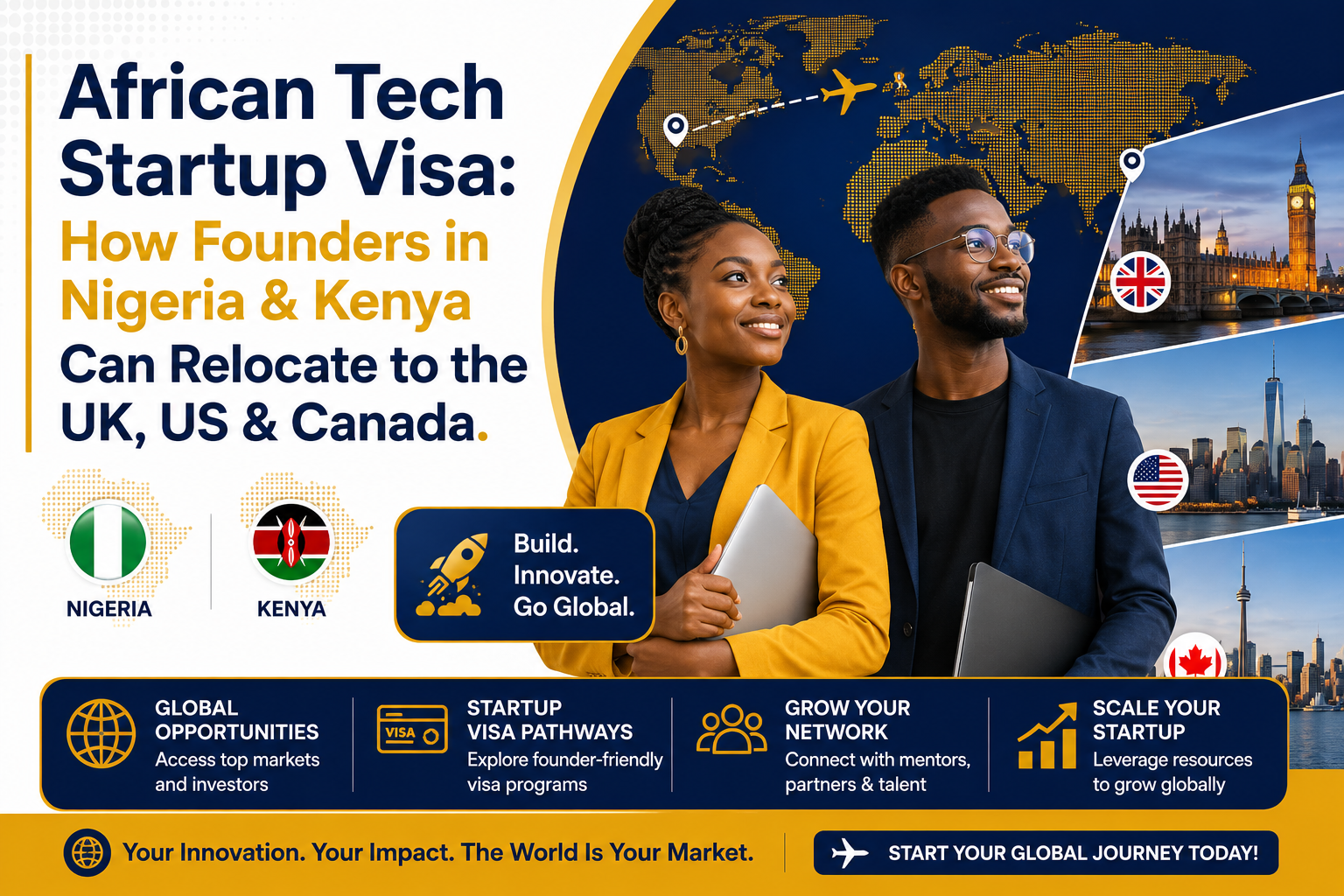
The most comprehensive resource on African startup founder visa routes — UK Global Talent Visa, US O-1A, Canadian Startup Visa, accelerator programs, step-by-step application roadmaps, costs, and real-world success strategies.
The next wave of Africa’s most ambitious tech founders is not only building from Lagos, Nairobi, Accra, and Cairo — they are also relocating to London, Toronto, New York, and San Francisco, and building businesses that span two continents. In the first half of 2025 alone, African startups raised $1.42 billion across 150+ deals — a 78% surge year-on-year. But funding is only part of the equation.
The other half is mobility. Access to deep capital markets, strategic accelerators, talent networks, and global partnerships requires founders to be present in the rooms where those decisions happen. The African Tech Startup Visa — a collective term for immigration pathways open to African tech entrepreneurs — is the key that unlocks that access.
This guide is the most comprehensive resource on every legal pathway available to African tech founders in Nigeria, Kenya, Ghana, South Africa, and beyond who want to relocate to the United Kingdom, United States, or Canada. We cover requirements, costs, timelines, accelerators, and the strategic moves that turn a startup into a visa-qualifying profile.
This guide is for African tech founders, co-founders, and startup executives in Nigeria, Kenya, Ghana, South Africa, and across the continent — as well as diaspora founders already in the West and non-African founders building Africa-focused startups — who want to understand every available pathway to legally relocate and operate from the UK, US, or Canada.
1. Why African Tech Founders Are Relocating in 2026
Africa’s startup ecosystem has matured rapidly. Yet structural barriers persist. Brain drain is accelerating — many Nigerian founders are incorporating offshore in Delaware or Mauritius and relocating to escape naira volatility and regulatory uncertainty. Kenya’s founders face limited late-stage capital. For many, the path to a Series B or C round requires being physically present in investor hubs like London, New York, or Toronto.
The data tells a clear story: while African startup funding surged 78% in H1 2025, fintech’s share of overall equity funding dropped from 60% (2022) to 25% (2025), forcing founders to diversify into climate tech, AI, and health tech — sectors where Western capital is concentrated. Being on the ground in these markets is not optional; it is strategic.
🗺️ Why African Founders Are Targeting These Three Destinations
Europe’s #1 tech hub. London has 35,000+ tech companies and the Global Talent Visa offers the most flexible route for recognized innovators. No employer sponsorship required.
World’s largest VC ecosystem — $170B+ invested annually. The O-1A visa has a ~94% approval rate and no annual cap, making it the go-to route for accomplished African founders.
Most direct path to permanent residency (PR) for founders. Strong tech hubs in Toronto, Vancouver, and Waterloo. African founders (especially Nigerians) benefit from English language advantage.
2. What Is the “African Tech Startup Visa”? A Plain-English Explanation
Let’s be direct: there is no single visa called the African Tech Startup Visa. What exists is a collection of immigration pathways — designed by the UK, US, and Canadian governments — that are highly favorable to, and actively used by, African tech founders seeking to establish or expand their startups globally.
The term “African Tech Startup Visa” has become the informal shorthand within the ecosystem for all of these pathways combined. Think of it as an umbrella concept covering:
- UK: Global Talent Visa (Digital Technology) + Innovator Founder Visa
- US: O-1A (Extraordinary Ability) + International Entrepreneur Parole (IEP)
- Canada: Startup Visa Program (SUV) + Express Entry STEM draws
Each pathway has different eligibility criteria, costs, timelines, and end-goals. Together, they represent the most viable legal immigration toolkit for African startup founders today. The sections below break down each pathway in detail.
3. UK Visa Routes for African Tech Startup Founders
The United Kingdom offers two primary pathways for African tech founders: the Global Talent Visa for established innovators and emerging talents, and the Innovator Founder Visa for entrepreneurs launching new UK-based businesses. Both are open to Nigerian, Kenyan, and all other African nationals without age restrictions.
Global Talent Visa (Digital Technology)
- No job offer or employer sponsorship needed
- Two routes: Exceptional Talent (ILR after 3 years) and Exceptional Promise (ILR after 5 years)
- Barclays Eagle Labs now the primary tech endorsing body
- Single GOV.UK Stage 1 form required (from Aug 2025)
- CV + 3 letters of recommendation + evidence portfolio
- Endorsement fee: ~£456; visa fee: ~£167
Innovator Founder Visa
- For launching a NEW, innovative, viable, scalable UK business
- Requires endorsement from approved body (UK Endorsing Services, Envestors, Innovator International)
- No fixed minimum investment threshold
- English at CEFR B2 level required
- Settlement (ILR) after 3 years with continued business progress
- Application fee: £1,274 (outside UK); check-ins at 12 and 24 months
UK Global Talent Visa: What African Founders Need to Know in 2026
Since August 2025, the Tech Nation application form has been permanently withdrawn. Applicants for the Digital Technology pathway now complete only the single GOV.UK Stage 1 form. Barclays Eagle Labs has taken over as the primary endorsing body for tech, emphasizing measurable impact, innovation, and commercial success.
For African founders, the pathway splits into two categories:
Exceptional Talent is for those already recognized as leaders — founders with funded startups, significant media coverage in major publications (TechCrunch, Forbes, BBC, CNN), major exits, or recognized industry awards. A successful Exceptional Talent endorsement leads to Indefinite Leave to Remain (ILR) in just 3 years.
Exceptional Promise is the more accessible route — designed for early-stage founders who show potential. You need at least two of the following: evidence of innovation as a startup founder, innovation as an employee in a new tech field, contributions to the digital technology sector beyond your primary role (e.g., mentoring, speaking), or research published/endorsed by experts. The ILR pathway here is 5 years.
Many African founders underestimate what counts as evidence. Participating in accelerators like Y Combinator, Techstars, or the Visa Africa Fintech Accelerator, winning startup competitions, getting featured in TechCabal, Disrupt Africa, or Bloomberg, or receiving grants from Google for Startups all constitute valid endorsement evidence for the UK Global Talent Visa. Start building this paper trail 6–12 months before applying.
UK Innovator Founder Visa: The Business-First Route
Unlike the Global Talent Visa, the Innovator Founder Visa requires you to build a new business in the UK — not bring an existing one. Your business idea must be innovative (genuinely new, not a copy), viable (real market potential), and scalable (potential for growth and job creation). The four currently authorized endorsing bodies as of 2026 are: UK Endorsing Services, Envestors Limited, Innovator International, and the Global Entrepreneurs Programme.
For Nigerian applicants, biometric appointments are conducted at UK Visa Application Centres in Abuja, Lagos (Ikeja or Victoria Island). The visa application fee is £1,274 if applying from outside the UK, plus the Immigration Health Surcharge (£1,035/year). You must also maintain a minimum of £1,270 in personal savings for 28 consecutive days before applying.
4. US Visa Pathways for African Tech Founders: The O-1A and Beyond
The United States has no dedicated “startup visa” — a gap that has long frustrated African founders. However, three routes have emerged as the most effective pathways for tech entrepreneurs: the O-1A Extraordinary Ability Visa, International Entrepreneur Parole (IEP), and for the long term, the EB-1A and EB-2 NIW green card routes.
From January 2026, a US visa bond program requires applicants from over 20 African countries — including Nigeria, Uganda, Tanzania, Kenya, Ghana, and Senegal — to post a $5,000–$15,000 refundable bond when applying for B1/B2 visitor visas. This affects short-term business travel for fundraising and accelerator attendance. It does not directly affect O-1A or other employment-based visa applications, but adds financial burden for early-stage founders.
The O-1A Visa: The African Founder’s Best US Option in 2026
The O-1A is designed for individuals with extraordinary ability in business. It has no annual cap, no lottery, and a ~94% approval rate — making it dramatically more reliable than the H-1B. As of 2026, premium processing costs $2,965 and guarantees an initial response within 15 business days.
To qualify, you must satisfy at least 3 of 8 USCIS criteria:
| USCIS Criterion | What It Means for African Founders | Strength Level |
|---|---|---|
| 1. Awards / Prizes | Won a notable startup competition, accelerator award, or industry prize | 🟢 Strong |
| 2. Membership in elite organizations | Member of YC, Techstars, Forbes 30 Under 30 Africa | 🟢 Strong |
| 3. Press coverage | Featured in TechCrunch, Bloomberg, CNN, BBC, Forbes | 🟢 Strong |
| 4. Judging others’ work | Served as a judge at startup competitions, accelerators, or VC pitches | 🟡 Moderate |
| 5. Original contributions | Built a genuinely novel product with measurable market impact | 🟢 Strong |
| 6. Authored articles / research | Published research, op-eds, or white papers in tech media | 🟡 Moderate |
| 7. Critical/essential role | CEO/Founder/CTO of a funded or high-revenue startup | 🟢 Strong |
| 8. High salary/remuneration | Commanding a salary or revenue significantly above peers | 🟡 Moderate |
Founder Self-Sponsorship on O-1A
One of the most important 2025 USCIS updates: a founder can use their own US-registered company as the O-1A petitioner. USCIS confirmed that a founder may hold sole or majority ownership in the petitioning company. This resolves earlier uncertainty and means Nigerian and Kenyan founders can incorporate a US entity (a Delaware LLC or C-Corp is standard) and use it to sponsor their own visa.
International Entrepreneur Parole (IEP): For VC-Backed Founders
The IEP is a temporary stay option (not a visa) for founders with significant US VC backing. To qualify, you need at least $311,071 in qualified investment from a US investor or $124,429 in government grants. It is not as commonly used by early-stage African founders but becomes relevant once you close a US-backed seed round.
Long-Term US Pathway: EB-1A and EB-2 NIW Green Cards
Many African founders use the O-1A as a bridge, then transition to permanent residency through the EB-1A (Extraordinary Ability green card) or EB-2 National Interest Waiver — both of which allow self-petition without employer sponsorship. Typical timeline: 1–3 years on O-1A, then 7–16 months for EB-1A processing.
5. Canada Startup Visa for African Tech Founders: The Direct PR Route
Canada’s Startup Visa program was the world’s first immigration pathway to directly link startup founding with permanent residency. For Nigerian and Kenyan founders, its appeal was strong: English language advantage, no annual cap (historically), and faster PR timelines than most alternatives.
The original Canada Startup Visa program was paused for new applicants as of January 1, 2026. Founders who received a valid Letter of Support from a designated organization before the pause have until June 30, 2026, to apply for PR. IRCC has announced a new targeted entrepreneur pilot program with details expected in 2026. Monitor the IRCC website for updates.
How the Canada Startup Visa Worked (and How the New Program Will Likely Work)
The Canada SUV required founders to have a qualifying innovative business supported by a designated Canadian organization — either a venture capital fund, angel investor group, or accredited business incubator. The key was securing a Letter of Support from one of these organizations, which required pitching your startup and demonstrating global scalability and job creation potential in Canada.
Key requirements of the original program (likely to inform the new pilot):
Innovative Business Concept
A scalable, globally competitive product, service, process, or technology with job-creation potential in Canada. Nigerian and Kenyan founders with proven local traction have a strong advantage — it shows execution, not just ideation.
Letter of Support from a Designated Organization
Pitch to an accredited VC fund (e.g., BDC Capital), angel investor group, or business incubator. If convinced, they issue the Letter of Support — the most critical document in the application.
Language Requirement (CLB 5)
Must achieve Canadian Language Benchmark (CLB) 5 in all four components. Most Nigerian founders easily meet this via IELTS — English mother-tongue is a recognized advantage. Test results must be less than 2 years old.
Settlement Funds
From CAD$15,263 for a single applicant to CAD$40,392 for a family of seven (2025/2026 figures). These must be personal, unencumbered funds — not startup investment capital.
Application to IRCC
Processing fee: approximately CAD$2,385. Historical processing times: 12–36 months for full permanent residency. Up to 5 co-founders can be included in a single SUV application.
Canada Express Entry STEM Draws: An Alternative Pathway
While the SUV is paused, Canada’s Express Entry STEM-focused category draws remain active and are now a primary pathway for African tech founders. IRCC’s category-based draws targeting STEM occupations allow software engineers, AI researchers, data scientists, and tech product leaders to fast-track Canadian PR through the Federal Skilled Worker (FSW) stream. Kenyan and Nigerian applicants with degrees in engineering, computer science, or related fields — and Canadian work experience or job offers — are well-positioned for this route.
6. African Tech Startup Visa Comparison: UK vs US vs Canada
| Feature | 🇬🇧 UK Global Talent Visa | 🇬🇧 UK Innovator Founder Visa | 🇺🇸 US O-1A Visa | 🇨🇦 Canada SUV / New Pilot |
|---|---|---|---|---|
| Purpose | Recognize existing talent | Launch new UK business | Recognize extraordinary ability | Build innovative startup + PR |
| Employer/Sponsor Needed | No (self-endorsed) | Endorsing body only | Own US company possible | Designated organization |
| Funding Requirement | None (evidence-based) | No fixed minimum | None (evidence-based) | CAD$15,263+ settlement funds |
| Path to Permanent Residency | ILR in 3–5 years | ILR in 3 years | Via EB-1A/EB-2 NIW (7–16 months) | Direct PR route |
| Annual Cap / Lottery | No cap, no lottery | No cap, no lottery | No cap, no lottery | No cap (historically); new pilot TBD |
| English Language | Not required | CEFR B2 required | Not required | CLB 5 required |
| Processing Time | 4–10 weeks total | 6–12 weeks total | 2–6 months (15 days premium) | 12–36 months (historically) |
| Visa Fee (approx.) | £456 endorsement + £167 visa | ~£1,274 + Immigration Health Surcharge | $1,055 (I-129) + $600 + optional $2,965 premium | ~CAD$2,385 |
| Best For | Recognized founders, media-covered founders | Founders with an innovative new idea for a UK business | Funded, award-winning, or high-profile founders | Founders ready to build and permanently relocate |
| Family Benefits | Dependents can work/study | Dependents can work/study | Dependents (O-3) cannot work | Full family PR included |
7. Accelerators That Power African Tech Startup Visa Applications
Accelerator participation is one of the most powerful evidence-builders for every startup visa pathway. Being accepted into a competitive accelerator program demonstrates innovation, viability, and peer validation — exactly what visa endorsers and immigration officers look for.
Top Accelerators for African Tech Startups in 2026
| Accelerator | Focus | Equity | Global Recognition | Visa Value |
|---|---|---|---|---|
| Visa Africa Fintech Accelerator | Fintech, Africa | None | High | 🟢 Very High (investor access, VC meetings) |
| Y Combinator | All sectors, global | 7% for $500K | Very High | 🟢 Very High (top-tier credential worldwide) |
| Google for Startups Accelerator Africa | Tech, Africa | None | High | 🟢 Very High (Google branding, $200K cloud credits) |
| Techstars | All sectors, global | 6% for $120K | Very High | 🟢 High (global network, press coverage) |
| Flat6Labs | MENA/Africa | Yes | Moderate | 🟡 Moderate |
| 500 Global (Africa) | All sectors | Yes | High | 🟢 High |
| CcHub (Nigeria) | Social tech, Africa | None/equity | Moderate | 🟡 Moderate |
| Founders Factory Africa | Tech, Africa | Yes | Moderate | 🟡 Moderate |
| Antler (Africa) | Pre-seed, Africa | Yes | Moderate-High | 🟡 Moderate |
Google for Startups Accelerator Africa: What You Need to Know
Google for Startups Accelerator Africa is a 3-month equity-free program for seed-to-Series A tech startups on the African continent. Accepted startups receive hands-on mentorship from Google engineers, access to $200,000 in Google Cloud credits, go-to-market support, and connections to a global startup network. For immigration purposes, Google’s name on your profile is one of the most recognized validation signals globally — directly useful for UK Global Talent Visa endorsement submissions and US O-1A applications.
8. Visa Africa Fintech Accelerator 2026: Cohorts, Stats & How to Apply
The Visa Africa Fintech Accelerator is the continent’s most impactful corporate-backed accelerator for fintech startups. Launched in 2023 as part of Visa’s pledge to invest $1 billion in financial inclusion in Africa by 2027, it has now supported 104 startups across five cohorts, with a combined estimated portfolio value of $1.4 billion.
Visa Accelerator Program Cohort 4 (2025): Breakdown
Visa Accelerator Cohort 4 launched in 2025 and selected 22 startups from 12 African countries. The cohort included 5 Kenyan startups (Lemonade Payments, Muda, Sevi, ShopOkoa, Twiva) and 4 Nigerian startups (PressPayNg, Shiga Digital, Startbutton, Vittas). Themes covered SME digitization, cross-border payments, AI-driven transactions, climate insurance, and neo-banking.
Visa Accelerator Program 2026: Cohort 6
Applications for Cohort 6 of the Visa Africa Fintech Accelerator opened in April 2026 with a deadline of May 17, 2026. The program is open to fintech innovators based in Africa or with a strong commitment to expand into African markets. Apply at africa.visa.com.
📊 Visa Africa Fintech Accelerator: Key Stats
| Metric | Data (as of 2026) |
|---|---|
| Total startups supported | 104 across 5 cohorts |
| Combined portfolio valuation | ~$1.4 billion |
| Countries represented | 17+ African countries |
| Program duration | 12 weeks (virtual + in-person Demo Day) |
| Demo Day location (Cohort 5) | GITEX Africa, Marrakech, Morocco |
| Women in leadership (cohorts 1–3) | ~62% of startups |
| Cohort 6 application deadline | May 17, 2026 |
| Visa’s Africa investment target | $1 billion by 2027 |
9. Can a Startup Sponsor a Visa? (Direct Answer)
Yes — but how it works depends on the country and visa type.
In the United States, a founder’s own US-registered company can act as the petitioner (sponsor) for an O-1A visa. USCIS confirmed in current entrepreneur guidance that a founder may hold sole or majority ownership in the petitioning company. This allows Nigerian and Kenyan founders to incorporate a US LLC or C-Corp and use it to file their own O-1A petition. Many founders work with a US immigration attorney to set up this structure correctly.
In the United Kingdom, the Global Talent Visa is self-sponsored — no company or employer sponsorship is needed. The Innovator Founder Visa requires endorsement from an approved body, not an employer. However, Skilled Worker Visas (for employees) require a UK licensed sponsor company.
In Canada, the Startup Visa requires a designated organization — a VC fund, angel investor group, or accredited accelerator — to issue a Letter of Support. This is not technically “sponsorship” in the traditional employment sense but is a formal endorsement of your business by a recognized Canadian institution.
For the purposes of the African Tech Startup Visa ecosystem: yes, your startup can sponsor you (in the US via O-1A), an endorsing body can validate you (in the UK), or a designated organization can back you (in Canada). None of these require a traditional third-party employer to sponsor you — which is precisely what makes these routes so valuable for independent founders.
10. What Is Start-up Africa? The Ecosystem Powering Global Relocations
“Start-up Africa” refers to the rapidly maturing technology entrepreneurship ecosystem across the African continent. As of 2024, there are more than 1,000 identified tech hubs across Africa, with Nigeria, South Africa, and Kenya hosting the largest share (according to the International Trade Centre). In the first half of 2025, African startups raised $1.42 billion across 150+ deals — a 78% increase over the same period in 2024.
The ecosystems in the four key markets break down as follows:
| Country | Key Strengths | Top Startup Sectors | 2025 Funding Raised | Top Challenge for Founders |
|---|---|---|---|---|
| Nigeria | Largest population, diaspora network, deep fintech roots | Fintech, healthtech, e-commerce | $572M (4th in Africa) | Naira volatility, regulatory uncertainty |
| Kenya | Stable environment, M-Pesa ecosystem, East African gateway | Fintech, agritech, climate tech | Growing rapidly | Limited late-stage capital |
| South Africa | Sophisticated capital markets, developed infrastructure | Fintech, insurtech, AI | 2nd in Africa (2025) | Economic inequality, skills gap |
| Egypt | Government co-investment, $5B VC target by 2031 | Fintech, e-commerce, edtech | Growing strongly | FX restrictions, regulatory speed |
The term “Startup Africa” is also increasingly used by policy makers to describe formal frameworks — including Kenya’s Vision 2030 Innovation Agenda, Nigeria’s National Digital Economy Policy, and Egypt’s Startup Charter (launched February 2026) — aimed at reducing bureaucratic barriers, attracting venture capital, and retaining talent. Related content: explore African startup founder stories on Dratech.
11. What Is a FinTech Accelerator? And Why African Founders Need to Know
A FinTech accelerator is a structured program — typically 10–16 weeks — that provides early-stage financial technology startups with intensive mentorship, business coaching, technology infrastructure, investor introductions, and co-development opportunities with corporate partners.
Unlike traditional incubators (which are longer-term and space-based), accelerators are time-bound, cohort-driven, and focused on rapid validation and scaling. The best fintech accelerators provide access to payment infrastructure, banking APIs, regulatory guidance, and — critically for visa purposes — investor meetings, press coverage, and partnerships that become evidence in immigration applications.
For African founders specifically, participating in a recognized fintech accelerator is one of the fastest ways to build the credentials portfolio needed for a UK Global Talent Visa endorsement or US O-1A application. The Visa Africa Fintech Accelerator stands as the gold standard on the continent — 104 startups backed, $1.4B combined valuation, active partnerships with Visa, Onafriq, and global VC networks.
Other notable fintech accelerators open to African startups include: Plug and Play Fintech (global), MasterCard Foundation (education-focused), Barclays Accelerator (UK), and the Catalyst Fund (inclusive fintech). See also our coverage of African fintech brands and innovations on Dratech.
12. Step-by-Step Relocation Roadmap for African Tech Founders
The 18-Month Roadmap to an African Tech Startup Visa
📅 Your 18-Month Visa Preparation Timeline
Months 1–3: Build Your Evidence Profile
Apply for competitive accelerators (YC, Google for Startups, Visa Africa). Enter startup competitions. Begin getting press coverage in TechCabal, Disrupt Africa, or international tech media. Register a US LLC if targeting O-1A.
Months 4–6: Deepen Your Credentials
Secure mentorship positions or judging roles in startup competitions. Pitch to VC firms and angel investors. Close your first funding round if possible. Build relationships with London, Toronto, and US-based investors.
Months 7–9: Choose Your Destination & Visa Route
Based on your profile, select UK Global Talent, UK Innovator Founder, US O-1A, or Canada SUV. Engage a specialist immigration lawyer. Begin gathering letters of recommendation (minimum 3 strong endorsers). Prepare your CV and evidence dossier.
Months 10–12: Submit Endorsement Application
UK: Submit to Barclays Eagle Labs (Global Talent) or an approved endorsing body (Innovator Founder). US: File I-129 (O-1A) through your US entity. Canada: Pitch to designated VC/accelerator partners for Letter of Support.
Months 13–15: Visa Decision & Biometrics
UK: Attend biometrics at VAC in Lagos (Ikeja/Victoria Island) or Nairobi. US: Respond to any RFEs (Requests for Evidence) within the response window. Canada: Complete medical exams and security checks.
Months 16–18: Relocation & Soft-Landing
Arrange housing, banking, and company registration in destination country. UK Innovator Founder Visa holders: First endorsing body check-in at month 12 after arrival. Begin building local partnerships, attend ecosystem events.
13. African Tech Startup Visa: Full Cost & Timeline Breakdown
| Visa Route | Endorsement/Filing Fee | Visa Application Fee | Premium Processing | Legal Fees (est.) | Processing Time | Validity |
|---|---|---|---|---|---|---|
| UK Global Talent (Digital Tech) | ~£456 | ~£167 (outside UK) | N/A | £2,000–£5,000 | 4–10 weeks | Up to 5 years (renewable) |
| UK Innovator Founder | ~£1,000 endorsement | £1,274 (outside UK) + IHS | N/A | £2,500–£6,000 | 6–12 weeks | 3 years (extendable) |
| US O-1A | $1,055 (I-129) + $600 | Included in I-129 | $2,965 for 15 days | $5,000–$15,000 | 2–6 months (15 days premium) | 3 years (extendable in 1-yr increments) |
| Canada SUV (when active) | Varies by VC/incubator | ~CAD$2,385 | N/A | CAD$5,000–$15,000 | 12–36 months | Permanent Residency (direct) |
The UK Global Talent Visa (Exceptional Promise) route has the lowest barrier to entry cost-wise and requires no job offer. For founders with strong accelerator credentials but limited capital, this is often the most accessible first step. The total cost including legal advice can be under £8,000 — significantly less than most other routes. Explore Dratech’s Work Abroad guides for more resources on global tech mobility.
14. African Tech Startup Visa: 15 FAQs (AI Overview & Knowledge Graph Optimized)
These questions are written and answered to be captured by Google’s AI Overviews, Bing Copilot, ChatGPT web search, and Google’s Knowledge Graph — delivering sharp, authoritative answers for high-intent searches by African founders.
📚 Related Resources on Dratech International
- African Startup Founder Stories — Profiles & Lessons
- Top African Fintech Brands & Innovators
- Work Abroad Guides for African Tech Professionals
- Latest African Tech News & Ecosystem Updates
- African Tech Events, Conferences & Demo Days
- African Tech Awards — Who Wins and Why It Matters for Visas
UK Global Talent Visa — Official GOV.UK · US O-1A Visa — USCIS Official · Canada Startup Visa — IRCC Official · Visa Africa Fintech Accelerator · Google for Startups Accelerator Africa
Disclaimer: This article is for informational purposes only and does not constitute legal advice. Immigration rules change frequently. Consult a qualified immigration lawyer before making any visa application decisions. All fees and requirements cited reflect information available as of May 2026.