

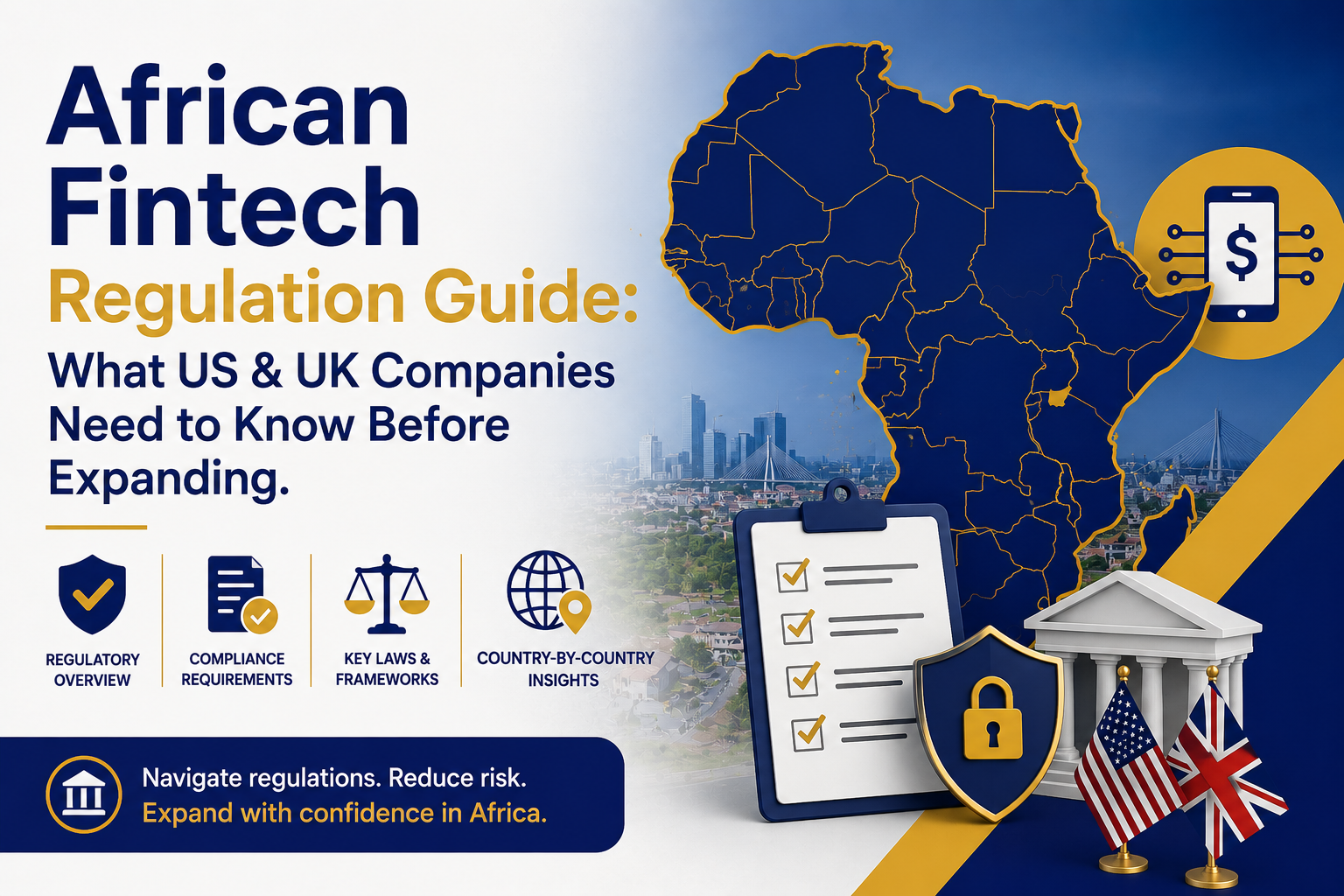
The most comprehensive African fintech regulation guide online — covering license requirements, AML/KYC compliance, data privacy laws, regulatory sandboxes, capital thresholds, and market-entry strategies across Africa’s six major fintech hubs. Built for founders, compliance officers, investors, and diaspora professionals.
African Fintech Regulation Guide — Quick Answer: Any US or UK fintech company expanding to Africa must first incorporate locally, obtain the appropriate license from the country’s central bank or financial regulator, comply with AML/KYC requirements, adhere to data privacy laws, and maintain minimum capital thresholds. Africa’s six major fintech markets — Nigeria, Kenya, South Africa, Rwanda, Ghana, and Egypt — each have distinct licensing regimes, capital requirements, and compliance obligations. Nigeria alone has five CBN license categories with capital requirements ranging from ₦100 million to ₦5 billion. Licensing timelines range from 2 months (Rwanda) to 12+ months (Nigeria, South Africa).
Why Africa? The Fintech Market Opportunity in 2025–2026
Africa is not a frontier market — it is a leapfrog economy that is rewriting the rules of financial services at scale. For US and UK fintech companies, the continent represents one of the most significant untapped opportunities in the global financial ecosystem.
Africa’s digital payments sector was valued at $195.5 billion in 2024 and is forecast to reach $314.8 billion by 2028, growing at a compound annual rate of 12.65%, according to Statista. The e-payment space alone was valued at approximately $40 billion in 2025. Meanwhile, nearly 300 million African adults remain unbanked — representing an enormous addressable market that traditional banking infrastructure has failed to serve.
The “Big Four” African fintech markets — Nigeria, South Africa, Egypt, and Kenya — account for roughly 72.5% of funded fintech startups and 88% of capital raised across the continent. With over 330 million active mobile money accounts (2023 data), Africa already leads the world in mobile-first financial services adoption.
For the African diaspora in the US and UK — and for Western tech founders with emerging-market ambitions — understanding the African Fintech Regulation Guide is no longer optional. It is the entry ticket to one of the fastest-growing financial markets on Earth.
African Fintech Licensing: The Big Picture
The most critical thing foreign fintechs must understand about Africa is this: there is no single “Africa license.” Each of the continent’s 54 countries maintains its own regulatory regime, and even within a country, different activities (payments, lending, insurance, crypto) require separate authorizations from different regulators.
The typical licensing framework across Africa requires: (1) local incorporation as a subsidiary or joint venture, (2) appointment of local directors who meet “fit and proper” criteria, (3) submission of business plans, IT architecture documentation, AML/KYC policies, and consumer protection frameworks, and (4) deposit of minimum capital with the central bank.
Application timelines vary dramatically — from as fast as 2 months in Rwanda to 6–12+ months in Nigeria and South Africa. Many successful US and UK fintechs have accelerated their entry by acquiring existing licensed entities rather than applying from scratch — a strategy employed by Moniepoint (which acquired Bancom Europe Ltd in the UK and an 78% stake in Kenya’s Sumac Microfinance Bank for its existing license).
Africa’s Key Fintech Regulatory Bodies
Nigeria: The Definitive African Fintech Regulation Guide for CBN Licensing
Nigeria is Africa’s largest economy and its most complex fintech market. With over 200 million people and an 83% adult mobile banking adoption rate, Nigeria is non-negotiable for any serious Africa expansion strategy. But navigating the CBN’s licensing framework demands precision.
Nigeria’s Five CBN License Categories
The CBN’s landmark circular of December 9, 2020, introduced a four-category payment license classification system (expanded in practice to five key categories) under the Banks and Other Financial Institutions Act (BOFIA) 2020. All Payment Service Providers are now formally recognized as Other Financial Institutions (OFIs) under direct CBN supervision.
| License Type | What It Covers | Min. Paid-Up Capital | CBN Escrow | Typical Timeline |
|---|---|---|---|---|
| PSSP (Payment Solution Service Provider) | Payment gateways, internet banking, online payment processing | ₦250 million | ₦100 million refundable | 6–9 months |
| PTSP (Payment Terminal Service Provider) | POS terminal deployment, management, maintenance | ₦100 million | ₦100 million refundable | 6–9 months |
| MMO (Mobile Money Operator) | Mobile wallets, fund storage, transfers, bill payments, agent banking | ₦2 billion | ₦2 billion escrow deposit | 9–12 months |
| Switching & Processing | Payment gateways linking multiple payment channels; clearing | ₦2 billion | Separate escrow required | 9–12+ months |
| Payment Service Bank (PSB) | Deposit accounts, debit cards, rural/unbanked populations | ₦5 billion | Substantial deposit | 12+ months |
| Super Agent | Last-mile agent banking distribution (kiosks, field agents) | ₦50 million+ | Varies | 6–9 months |
Source: CBN New Licence Categorisations for the Nigerian Payments System (2020), EBC Consults (2026). Naira amounts are based on 2025–2026 CBN guidelines. Exchange rates fluctuate; always verify current USD/NGN equivalent with your legal team.
The Nigeria Startup Act 2022: A Game-Changer for Foreign Fintechs
The Nigeria Startup Act (NSA) 2022 was enacted to remove “onerous legal, regulatory, tax and administrative bottlenecks” blocking technology companies. For US and UK fintechs incorporating in Nigeria, the Act offers significant advantages:
- Creation of a National Council for Digital Innovation providing policy coordination across regulators
- Tax reliefs for certified startup companies during their early years
- Streamlined business registration through a dedicated startup portal
- Easier visa processing for foreign tech entrepreneurs and employees
- Access to a government-backed startup fund and accelerator framework
To qualify, companies must apply for “startup label” certification through the Startup Portal (startup.gov.ng), be incorporated in Nigeria, and be less than 10 years old with annual turnover below a defined threshold.
Nigeria’s CBN Regulatory Sandbox
The CBN Regulatory Sandbox Framework (2021, expanded December 2022) allows fintech innovators to test new products and services under CBN supervision for up to 6 months without requiring a full license. This is ideal for US/UK companies wanting to validate their product-market fit before committing to the full licensing process. However, conversion from sandbox to full license remains low due to stringent compliance timelines — it is an exploratory tool, not a licensing shortcut.
Nigeria’s Open Banking & Data Framework
Nigeria’s CBN issued Operational Guidelines for Open Banking in 2023, mandating API-based data sharing between licensed financial institutions with customer consent. This creates significant integration opportunities for foreign fintechs building account aggregation, embedded finance, or credit scoring products.
Kenya: CBK Rules, Digital Credit Licensing & Data Privacy
Kenya is East Africa’s fintech powerhouse — home to M-Pesa, the product that proved Africa could leapfrog traditional banking. Today, Kenya has one of the most active fintech regulatory ecosystems on the continent, with 126 licensed digital credit providers (as of mid-2025) and a well-developed mobile money infrastructure processing trillions of Kenyan Shillings annually.
Kenya’s Multi-Regulator Fintech Framework
Unlike Nigeria’s predominantly CBN-centric model, Kenya’s fintech regulatory environment involves multiple authorities:
- Central Bank of Kenya (CBK) — Primary regulator for PSPs, banks, microfinance institutions, digital credit providers, and mobile money operators
- Capital Markets Authority (CMA) — Regulates investment fintechs, peer-to-peer lending platforms, and securities-related products
- Communications Authority of Kenya (CAK) — Oversees mobile network operators providing mobile money services (e.g., Safaricom/M-Pesa)
- Insurance Regulatory Authority (IRA) — Governs insurtech companies
- Office of the Data Protection Commissioner (ODPC) — Enforces the Data Protection Act 2019
- National Payment Systems Authority (NPSA) — Coordinates payment system regulation
Digital Credit Provider (DCP) Licensing in Kenya
The CBK (Digital Credit Providers) Regulations 2022 made Kenya one of the strictest markets globally for digital lending. Any company providing “credit facilities or loan services through a digital channel” must apply to the CBK for a license. The CBK targets a 60-day decision window, though processing times have been longer in practice — the CBK has received over 700 applications since March 2022 and is processing them in batches.
DCP license applications require: certificate of incorporation, memorandum and articles of association, ICT system description, AML policies, data protection policies, consumer redress systems, proof of financing sources, and background checks on directors and senior management.
The Rwanda–Kenya Fintech Passporting Deal (March 2026)
In a landmark development for African fintech, Rwanda’s BNR and Kenya’s CBK signed a fintech passporting agreement in March 2026, modeled on the EU passporting system. A fintech licensed in either country can expand services into the other without obtaining a separate full license. This dramatically reduces the compliance cost of dual-market expansion and has been called the most significant regulatory development in East African fintech in a decade.
South Africa: FSCA, SARB & POPIA — Africa’s Most Sophisticated Regulatory Framework
South Africa operates Africa’s most mature and complex financial regulatory environment. It is the continent’s leading market for AI-related fintech (accounting for 43.8% of funded AI fintech startups in 2025) and its most institutionalized capital market. For US and UK fintechs, South Africa offers the most familiar regulatory DNA — but demands the most rigorous compliance infrastructure.
South Africa’s Dual Regulatory Architecture
South Africa uses a Twin Peaks model that separates prudential supervision from market conduct regulation:
- South African Reserve Bank (SARB) / Prudential Authority — Oversees banking licenses, payment system operators, and financial stability. The SARB’s Payments Ecosystem Modernisation Programme (PEMP) is overhauling South Africa’s payments infrastructure for the first time in nearly three decades.
- Financial Sector Conduct Authority (FSCA) — Regulates market conduct for financial advisors, investment products, insurance, and crypto assets. Fintechs offering financial advisory, investment, or insurance-related services must obtain FSCA authorization under the Financial Advisory and Intermediary Services (FAIS) Act.
- Information Regulator — Enforces POPIA (Protection of Personal Information Act) for all data processing activities
South Africa’s FATF Grey List Exit (2025)
A major milestone: South Africa was removed from FATF’s grey list in October 2025 after completing a 22-point action plan covering investigations, prosecutions, and supervisory effectiveness. This dramatically improves South Africa’s attractiveness to international capital and reduces the enhanced due diligence burden that grey-listed markets impose on correspondent banking relationships.
South Africa & Crypto: FSCA Classification
The FSCA classified crypto assets as financial products in 2022, bringing them under the Financial Advisory and Intermediary Services Act. This means crypto businesses must obtain FSCA authorization — but it also means South Africa has clearer crypto rules than most African markets, reducing regulatory uncertainty for crypto-adjacent fintechs.
Rwanda: Africa’s Fastest Fintech Licensing Gateway
Rwanda punches far above its weight in African fintech. Under the vision of an ambitious National Fintech Strategy, Rwanda’s National Bank (BNR) has positioned itself as East Africa’s most business-friendly regulator — with licensing approvals in approximately 2 months, the fastest on the continent.
Rwanda’s innovative regulatory diplomacy has produced two bilateral fintech passporting agreements: one with Ghana’s Bank of Ghana (February 2025) and one with Kenya’s CBK (March 2026). This means a Rwanda-licensed fintech can now access three markets — Rwanda, Ghana, and Kenya — with a single license, making the country a compelling regional licensing hub strategy for US and UK companies entering East and West Africa simultaneously.
Ghana & Egypt: Africa’s Rising Fintech Hubs
Ghana: Bank of Ghana Licensing Under Payment Systems and Services Act 2019
Ghana’s Bank of Ghana (BoG) regulates e-money issuers (EMIs) and PSPs under the Payment Systems and Services Act, 2019. Application fees are approximately $1,500 with processing timelines of 3–5 months. Local partnerships can significantly speed up BoG approval. Ghana was also one of the first countries to pilot a CBDC (e-Cedi), signaling strong regulatory openness to financial innovation.
Ghana and Rwanda’s fintech passporting agreement (signed February 2025) has made Ghana increasingly attractive as a West Africa gateway market — similar to Rwanda’s role in East Africa.
Egypt: Financial Regulatory Authority (FRA) & Strict AML Controls
Egypt is Africa’s third-largest economy and an increasingly important fintech market, particularly for payments and digital lending serving its 105 million-person population. The Central Bank of Egypt (CBE) regulates banking-related fintech, while the Financial Regulatory Authority (FRA) enforces strict AML controls for non-bank financial services.
Egypt’s large unbanked population, young demographic, and government digitization agenda make it a high-growth market — but FRA’s regulatory framework is among the most stringent on the continent. US and UK fintechs should budget for extensive AML/KYC infrastructure before entering Egypt.
AML & KYC Requirements: What Every Foreign Fintech Must Build
Anti-Money Laundering (AML) and Know Your Customer (KYC) compliance is non-negotiable across all African fintech markets. The continent has accelerated its FATF alignment dramatically in recent years, with both Nigeria and South Africa removed from the FATF grey list in 2025 after comprehensive reform programs.
Core AML/KYC Requirements Across Africa
Customer Identity Verification
All African markets require fintechs to verify customer identities using government-issued IDs, biometrics, or digital identity systems. Nigeria’s NIN (National Identification Number) and BVN (Bank Verification Number) are the standard KYC anchors for Nigerian customers.
Real-Time Transaction Monitoring
Nigeria’s CBN issued Baseline Standards for Automated AML Solutions in March 2026, mandating that banks and financial institutions adopt real-time or near-real-time transaction monitoring. This standard is expected to cascade to licensed fintechs. RegTech solutions that automate this monitoring are increasingly mandatory, not optional.
Sanctions & PEP Screening
Fintechs must screen customers and transactions against domestic and international sanctions lists (UNSC, OFAC, UK HMT) and Politically Exposed Persons (PEP) databases. This is especially critical for US/UK companies given their own regulatory obligations under FinCEN, FCA, and OFAC.
Suspicious Activity Reporting (SAR)
All markets require suspicious transactions to be reported to the relevant financial intelligence unit — Nigeria’s NFIU, Kenya’s Financial Reporting Centre, South Africa’s FIC (Financial Intelligence Centre).
ISO 20022 Compliance
Since 2025, ISO 20022 has become the rising global standard for cross-border payments. Kenya’s CBK migrated to ISO 20022 in 2024. Fintechs building cross-border infrastructure must ensure their systems support rich structured data formats required by this standard.
Data Privacy & Localization: The Hidden Compliance Layer
Data privacy regulation is the most underestimated compliance layer for foreign fintechs entering Africa. Unlike licensing (which is highly visible), data compliance failures tend to surface quietly — until they result in enforcement action, breach notifications, or loss of the data-processing license that underpins every fintech’s core operations.
| Country | Key Data Law | Regulator | Key Requirements | Cross-Border Transfer Rules |
|---|---|---|---|---|
| 🇳🇬 Nigeria | Nigeria Data Protection Act (NDPA) 2023 | NITDA / NDPC | Data minimization, consent, breach notification within 72h; register with NDPC | Transfers restricted unless recipient country provides adequate protection |
| 🇰🇪 Kenya | Data Protection Act 2019 | ODPC (Office of the Data Protection Commissioner) | Register with ODPC; appoint a Data Protection Officer; user consent required | Exports restricted without adequacy or binding agreements |
| 🇿🇦 South Africa | POPIA (Protection of Personal Information Act) | Information Regulator | Lawful processing, data subject rights, security safeguards, breach notification | Transfers only to countries with adequate protection or consent |
| 🇷🇼 Rwanda | Law No. 058/2021 on Personal Data Protection | RDB / RURA | Consent-based processing, data subject rights; DPO appointment required for large processors | Restricted to adequate jurisdictions |
| 🇬🇭 Ghana | Data Protection Act 2012 | Data Protection Commission | Register with DPC; purpose limitation; consent; security safeguards | Restricted transfers without adequacy |
| 🇪🇬 Egypt | Personal Data Protection Law No. 151/2020 | MCIT (Ministry of Communications) | Consent required; sensitive data has extra protections; breach notification | Significant localization requirements for sensitive data categories |
Regulatory Sandboxes: Your Low-Risk Entry Point
Regulatory sandboxes are purpose-built programs that allow fintech companies to test innovative financial products under regulatory supervision for a defined period — typically 6 to 12 months — without requiring full licensing. For US and UK companies exploring Africa for the first time, sandboxes offer the most cost-effective way to validate product-market fit, build regulatory relationships, and gather the evidence needed to support a full license application.
| Country | Sandbox Operator | Duration | Open to Foreign Fintechs? | Notable Feature |
|---|---|---|---|---|
| Nigeria | CBN Sandbox Framework (2021) | Up to 6 months | Yes (with local entity) | Tests payments innovations outside normal licensing |
| Kenya | CBK Regulatory Sandbox | 12 months (extendable) | Yes (with local entity) | Active PSP testing program |
| South Africa | IFWG Innovation Hub (joint SARB/FSCA) | 12 months | Yes | Collaborative multi-regulator sandbox; crypto & AI testing |
| Rwanda | BNR Fintech Regulatory Sandbox | 12 months | Yes | Fast-track sandbox aligned with national fintech strategy |
| Tanzania | Bank of Tanzania Sandbox (launched Nov 2024) | 12 months | Yes | New — opened for innovative financial solutions including DeFi testing |
| Ghana | Bank of Ghana Sandbox | 6–12 months | Yes | Active e-money and CBDC testing |
African Fintech License Capital Requirements: Complete 2025–2026 Comparison
Minimum capital requirements are one of the most critical planning inputs for any market entry strategy. Below is the most comprehensive comparison available, drawn from 2025–2026 regulatory guidance.
| Country | License Type | Min. Capital (Local) | Approx. USD Equiv. | Timeline | Speed Rating |
|---|---|---|---|---|---|
| 🇳🇬 Nigeria | PSSP (Payment Gateway) | ₦250M + ₦100M escrow | ~$175,000–$220,000* | 6–9 months | Medium |
| 🇳🇬 Nigeria | MMO (Mobile Money) | ₦2 billion + escrow | ~$1.3M–$1.6M* | 9–12 months | Slow |
| 🇳🇬 Nigeria | Payment Service Bank | ₦5 billion | ~$3.2M–$4M* | 12+ months | Slow |
| 🇰🇪 Kenya | PSP License | KES 5M+ | ~$35,000–$50,000 | 2–4 months | Fast |
| 🇿🇦 South Africa | FSP (Financial Services Provider) | Varies by activity | $5,000–$10,000 (fees) + capital | 4–8 months | Medium |
| 🇷🇼 Rwanda | Fintech/PSP License | BNR-specified | Low (BNR is business-friendly) | ~2 months | Fastest |
| 🇬🇭 Ghana | PSP / EMI License | GHS-specified | ~$1,500 in fees | 3–5 months | Fast |
| 🇪🇬 Egypt | Payment/Fintech License | EGP-specified | Varies widely by activity | 4–8 months | Medium |
*Nigeria Naira amounts converted at approximate 2025 market rates. USD equivalents are approximate and fluctuate with currency movements. Always verify current requirements with a licensed Nigerian attorney and the CBN directly.
Crypto & Digital Assets Regulation Across Africa
Crypto regulation in Africa has moved from hostility to structured oversight between 2022 and 2026. Here is the current landscape US and UK crypto-adjacent fintechs need to understand:
- Primary LawSEC Rules on Digital Assets (2022); Securities Act 2025
- CBDCeNaira (launched 2022)
- VASP RequirementSEC registration required
- StatusComprehensive framework; crypto-positive post-2023
- Primary LawVirtual Asset Service Provider Bill (2025)
- CBDCExploratory phase
- VASP RequirementLicensing under 2025 Bill
- StatusLegal foundation created; rules being finalized
- Primary LawFAIS Act (crypto classified as financial product 2022)
- CBDCPilot phase (Project Khokha)
- VASP RequirementFSCA authorization mandatory
- StatusMost mature crypto regulatory framework in Africa
- Primary LawVirtual Assets Bill (in progress 2025)
- CBDCe-Cedi pilot underway
- VASP RequirementBoG oversight pending formal law
- StatusCautiously progressive; CBDC-forward
Step-by-Step African Fintech Market Entry Checklist for US/UK Companies
Select Your Target Market(s) — Strategically
Do not try to enter all of Africa at once. Define your initial market based on: addressable user base, product-regulatory fit, capital availability, and your team’s existing networks. Consider Rwanda as a licensing hub if targeting East Africa. Consider Nigeria if you have scale capital and appetite for complexity.
Engage a Local Legal Counsel in Each Market
This is not optional. Regulatory requirements change frequently and nuances matter enormously. Engage reputable local law firms — in Nigeria firms like Templars, Banwo & Ighodalo, and Strachan Partners specialize in fintech licensing. In Kenya, firms like MMAN Advocates and CR Advocates LLP have deep CBK experience.
Incorporate a Local Subsidiary
All African markets require local incorporation before a fintech license can be issued. In Nigeria, incorporate at the CAC (Corporate Affairs Commission). In Kenya, at the BRS (Business Registration Service). Expect 1–4 weeks for incorporation.
Appoint Local Directors & Build Compliance Team
Most regulators require at least one locally resident director. Build or contract your AML compliance officer, Data Protection Officer, and Risk Manager roles before submitting your license application. Regulators assess the quality of your compliance team as part of “fit and proper” review.
Consider the Regulatory Sandbox Route
If your product is genuinely novel or you are uncertain about regulatory category, apply to the relevant sandbox first. Sandbox participation builds regulator trust, provides direct feedback on your product, and creates a narrative for your subsequent full license application.
Build AML/KYC & Data Infrastructure
Deploy RegTech solutions for real-time transaction monitoring, automated KYC verification, sanctions screening, and SAR generation before your license goes live. Regulators increasingly audit your technology infrastructure, not just your policy documents.
Submit License Application & Capital
Follow the exact format specified by each regulator. In Nigeria, submit to the CBN’s Payments System Management Department with all required attachments and proof of capital deposit. Track your application status proactively — applicants who maintain responsive communication with regulators move faster through the queue.
Plan for Ongoing Compliance Post-Launch
Obtaining a license is the beginning, not the end. All markets require annual renewals, periodic regulatory reporting, capital adequacy monitoring, and prompt notification of material changes to your business model. Budget for ongoing compliance costs of 8–15% of operating expenses.
Common Compliance Mistakes US & UK Fintechs Make in Africa
7 Compliance Mistakes That Sink African Fintech Expansions
African Fintech Licensing Ease: Relative Speed Index
Based on average licensing timelines, capital accessibility, and regulatory clarity (100 = fastest/easiest):
Frequently Asked Questions: African Fintech Regulation Guide
These 15 questions are optimized for Google’s AI Overview, rich snippets, and knowledge graph capture — covering every critical query US/UK fintechs and African diaspora professionals search for.
Stay Ahead of African Fintech Regulation
Dratech International tracks regulatory changes across Africa’s fintech markets in real time. Bookmark this guide — it is updated as major regulatory changes occur. Share it with your legal and compliance team.
Explore More at Dratech.org →Sources & Authoritative References
This African Fintech Regulation Guide draws on the following authoritative sources. We encourage readers to access these primary and secondary sources directly for the most current regulatory guidance:
- Central Bank of Nigeria (CBN) — cbn.gov.ng
- Central Bank of Kenya (CBK) — centralbank.go.ke
- South African Reserve Bank (SARB) — resbank.co.za
- Financial Sector Conduct Authority South Africa (FSCA) — fsca.co.za
- National Bank of Rwanda (BNR) — bnr.rw
- Bank of Ghana (BoG) — bog.gov.gh
- Global Legal Insights — Nigeria Fintech Laws 2025
- Chambers & Partners — Kenya Fintech 2025
- Sumsub — AML Compliance for Fintechs in Africa 2026
- Fintech Magazine Africa — Policy & Regulatory Developments 2024–2025
- TechCabal — CBN Licences in Nigeria 2025
- Lucid.now — Licensing for Fintech Startups in Emerging Markets 2026
- Statista — Africa Digital Payments Market Forecast 2024–2028
- EY — The Power of Together: Africa Fintech Report 2025