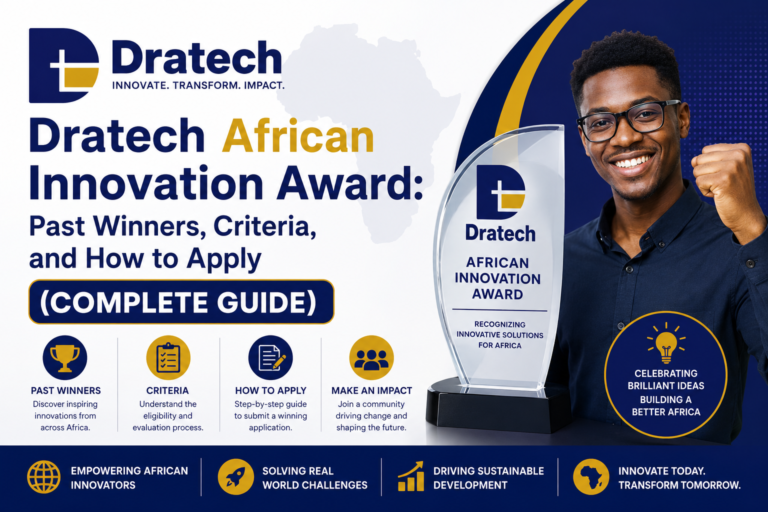



The Dratech Innovative Founder Award 2024 is conferred on Joshua Oluwagbenga Ajayi in recognition of his demonstrated excellence in applied technology innovation and founder-level execution.
This recognition reflects a body of work defined by disciplined system building, sustained ownership across the product lifecycle, and the practical translation of engineering insight into reliable, scalable platforms. His approach to founding emphasises execution quality, operational maturity, and long-term accountability rather than visibility or narrative appeal.
The award further acknowledges his integration of structured thinking on governance, risk, and responsible technology use into real-world system design, reinforcing standards of resilience, clarity, and stewardship within complex technology environments.
Joshua Oluwagbenga Ajayi was selected as one of the top three recipients in this category following a competitive evaluation process and in alignment with the approved criteria for the 2024 award cycle.
The Dratech International Innovation Awards were created to identify and document founders whose work reflects applied innovation, execution depth, and sustained accountability within the technology ecosystem. Rather than serving as a celebratory platform, the awards are positioned as an editorial and evaluative exercise, focused on how technology is built, governed, and scaled in real operating environments.
At this year edition of the awards, announced during the Dratech International Conference 2024, Joshua Oluwagbenga Ajayi was named a recipient of the Dratech Innovative Founder Award. He was selected as one of the top three honourees in the category following a competitive review process that assessed fifteen shortlisted nominees against the approved judging framework for the 2024 award cycle.
The Innovative Founder Award recognises founders whose work demonstrates execution quality over narrative visibility. Evaluation is centred on applied problem-solving, system reliability, adoption in real contexts, and founder-level ownership beyond initial product launch. Ajayi’s selection reflects the judging panel’s assessment of his work as meeting these standards consistently.
From Hands-On Engineering to System Stewardship
Joshua Ajayi’s professional trajectory reflects a builder’s progression rather than a conventional leadership ascent. His career developed through sustained engagement with technology as infrastructure, shaped by direct responsibility for how systems are designed, deployed, and maintained over time.
His early work was rooted in hands-on engineering, where proximity to code, infrastructure, and delivery timelines defined his learning curve. This phase established a practical understanding of system behaviour, failure modes, and the long-term consequences of architectural decisions. Rather than treating technology as an abstract capability, his experience positioned it as an operational asset with real dependencies and constraints.
As his responsibilities expanded, Ajayi’s role evolved toward architectural oversight and coordination across functions. He began to assume accountability not just for individual components, but for how systems interacted, how teams aligned around shared platforms, and how technical decisions translated into operational outcomes. This transition marked a shift from execution at the component level to stewardship at the system level.
Over time, his work increasingly involved building and guiding platforms intended for sustained use rather than short-term deployment. Across these phases, his career remained anchored in environments where technology was core to operations, and where leadership demanded continued engagement beyond initial delivery.
Founder Mindset Anchored in Execution
Ajayi’s founder profile is defined by continuity of ownership. His approach treats founding not as a moment of ideation, but as a long-term responsibility extending through adoption, scaling, and operational maturity.
From early concept through deployment and iteration, his work reflects direct involvement across the product lifecycle. This continuity enables informed decision-making under pressure, particularly when growth introduces competing demands around speed, stability, and scope. Product choices are framed by operational realities rather than speculative scale assumptions.
Execution discipline is central to this approach. Systems are built with attention to durability, governance, and maintainability, not just time-to-market. Rather than deferring structural concerns, his work integrates operational safeguards early, recognising that technical debt and governance gaps compound over time.
Adaptability also features prominently. Across different growth stages, Ajayi has navigated evolving requirements without abandoning foundational principles. Adjustments are made deliberately, preserving system coherence while responding to new constraints. This balance between flexibility and structure characterises his execution style as a founder.
Intellectual Contribution and Applied Frameworks
Beyond product delivery, Ajayi’s work reflects sustained engagement with the intellectual foundations of responsible technology building. His contributions in this area are not positioned as academic exercises, but as practical frameworks that inform real-world decision-making.
A central theme in his thinking is governance. His work engages with how risk, compliance, and accountability can be embedded into system design rather than imposed after deployment. This perspective treats governance as a design concern, shaping architecture, workflows, and organisational roles from the outset.
His structured thinking also addresses complexity management within growing organisations. Issues such as decision authority, data integrity, and risk visibility are approached through defined frameworks that support clarity under scale. These ideas influence not only system architecture but also how teams operate and how responsibility is distributed.
Another dimension of his intellectual contribution is responsible technology use. His work reflects a measured approach to automation and artificial intelligence, emphasising transparency, oversight, and human accountability. Rather than prioritising novelty, this perspective focuses on sustainability and trust in technology-enabled systems.
Importantly, these ideas are operationalised. They inform how platforms are built, how controls are implemented, and how organisations prepare for long-term resilience. This integration of theory and practice strengthens the coherence of his founder profile.
Alignment with the Dratech Innovative Founder Award
The Dratech Innovative Founder Award is intended to recognise founders whose work demonstrates applied innovation, resilience, and execution maturity. Ajayi’s selection aligns with these criteria across multiple dimensions.
First, his work reflects real-world adoption. Systems developed under his leadership are designed for continuous use in operational contexts, where reliability and clarity are non-negotiable. This emphasis distinguishes applied innovation from conceptual experimentation.
Second, his founder profile demonstrates sustained accountability. Ownership does not end at launch, but extends into refinement, governance, and long-term system health. This continuity aligns with the award’s focus on founder-level responsibility.
Third, resilience is evident in how his work navigates complexity. Rather than relying on visibility-driven growth narratives, his approach prioritises structural soundness and adaptability. Systems are built to endure change, not just attract attention.
Finally, the quality of execution remains central. Decisions are informed by structured thinking that balances technical capability with governance considerations. This focus reflects the award’s emphasis on execution quality as a defining measure of innovation.
Taken together, these factors formed the basis of the judging panel’s decision to recognise Ajayi as one of the top three recipients in the category for the 2024 award cycle.
Within the wider technology and innovation landscape, Ajayi’s work contributes to a growing emphasis on responsible, execution-led founding. His approach reinforces the importance of governance, clarity, and long-term stewardship in technology leadership, particularly in environments where systems underpin critical operations.
By integrating structured thinking with hands-on execution, his work influences how teams approach building and scaling technology. It offers a reference point for founders and technical leaders navigating growth without compromising reliability or accountability.
As the ecosystem continues to mature, profiles such as Ajayi’s reflect a shift toward founders whose impact is measured by system durability and organisational discipline rather than narrative reach. His recognition at the 2024 Dratech International Innovation Awards aligns with this editorial perspective.
The Dratech Editorial Desk notes that this recognition underscores the platform’s mandate to document founders whose work advances not only innovation, but the standards by which innovation is evaluated and sustained.