

Dratech International · Definitive Guide ·
The most comprehensive, data-driven resource for diaspora investors, foreign capital, and global innovators who want to invest in African tech startups — covering every platform, fund, risk, regulation, sector, and strategy you need.
Africa is no longer a frontier opportunity for the brave few — it is a structured, data-driven investment thesis that is attracting serious capital from across the globe. In 2025, African tech startups raised a combined $4.1 billion, a 25% jump from the previous year, according to Partech Africa’s 10th annual Africa Tech VC Report. That figure includes $2.4 billion in equity and a record $1.64 billion in debt financing — a sign that the ecosystem is not just growing, but maturing.
Yet despite this momentum, most US, UK, and Canadian investors — and even many in the African diaspora — still don’t know where to start. There is no single authoritative resource that tells you which platforms to use, which funds to back, which risks to price in, or how to structure your first investment from outside the continent. Until now.
This guide exists to close that gap. Whether you are a first-time investor in Dallas, a diaspora professional in London, a fintech enthusiast in Toronto, or a VC analyst in New York, this page gives you everything you need to intelligently invest in African tech startups. Bookmark it. Share it. Come back to it.
1. Why Now Is the Best Time to Invest in African Tech Startups
The case for investing in African tech startups has never been stronger, and the timing has never been more strategic. Here is why:
The Numbers Tell the Story
According to Partech Africa’s 2025 Africa Tech VC Report, total investment in Africa’s startup ecosystem reached $4.1 billion — the strongest funding level since 2022. After two bruising years of global “funding winter,” capital is returning with more discipline and selectivity than before. This is not irrational exuberance; it is a structurally grounded recovery.
Disrupt Africa’s 11th annual African Tech Startups Funding Report confirms the upward trend: 178 startups raised a combined $1.64 billion in equity funding in 2025, a 46.2% increase from 2024 levels. The big four markets — Nigeria, Kenya, South Africa, and Egypt — each grew their funding year-on-year, while Francophone West Africa and North Africa recorded increased early-stage depth.
Structural Tailwinds Unique to Africa
- Youth demographic dividend: Africa’s median age is 19.7 years — the youngest population of any continent. By 2050, 1 in 4 people on Earth will be African, most of them digital natives.
- Mobile-first leapfrogging: Africa skipped landlines and went straight to mobile money. Over 400 million mobile money accounts exist on the continent, more than the rest of the world combined.
- Underbanked population as opportunity: 57% of Sub-Saharan adults remain unbanked — and African fintechs are systematically solving this with mobile wallets, credit scoring, and digital banks.
- Rising middle class: The African Development Bank projects a 4.3% average GDP growth rate for Africa in 2025, the world’s second-fastest-growing region.
- Growing local capital base: As international capital pulled back, local and diaspora angels stepped in. Angel deal participation rebounded in 2025 after a two-year decline, per ABAN’s 2025 report.
- AfCFTA unlocking scale: The African Continental Free Trade Area creates a single market of 1.4 billion people and $3.4 trillion in GDP — the largest free trade zone by number of countries in the world.
📊 Africa Investment Opportunity — Snapshot 2025
2. Understanding the African Tech Startup Landscape
Before you can successfully invest in African tech startups, you need to understand the terrain. Africa is 54 countries, each with its own legal system, currency, regulatory body, and market dynamics. Treating “Africa” as a monolith is the number one mistake new investors make.
The Big Four Markets
Four countries — Nigeria, Kenya, South Africa, and Egypt — dominate venture activity, capturing 72% of total funding in 2025 and 68% of all deals. Together, they define the African startup playbook:
| Country | 2025 Funding Share | Key Strength | Top Sectors | Risk Profile |
|---|---|---|---|---|
| Nigeria | ~25% | Largest population (220M), fintech powerhouse | Fintech, B2B SaaS, logistics | Medium-High (currency, regulation) |
| Kenya | ~22% | “Silicon Savannah”, M-Pesa ecosystem | Fintech, agritech, healthtech | Medium (stable regulatory) |
| South Africa | ~15% | Most developed financial markets | Fintech, insurtech, e-commerce | Low-Medium (rand volatility) |
| Egypt | ~10% | North Africa gateway, Islamic fintech | Fintech, edtech, e-commerce | Medium (FX pressure) |
Emerging Markets Worth Watching
Beyond the Big Four, a second tier of markets is increasingly attracting both founder activity and investor attention. Morocco, Rwanda, Ghana, Senegal, Ethiopia, and Côte d’Ivoire are showing strong early-stage pipeline depth. Rwanda in particular is ranked the most reform-driven state in Africa, offering one of the easiest environments for starting a business, with the government’s technology-first posture attracting global attention.
For investors willing to go off the beaten path, these emerging hubs offer earlier entry points, less competition, and potentially higher returns — though with proportionally higher risk.
3. What Are the Emerging Tech Hubs for Startups in Africa?
Africa now has over 1,000 active tech hubs — a figure that grew from fewer than 50 in 2010. These hubs are not just co-working spaces; they are the connective tissue of the investment ecosystem, providing deal flow, talent pipelines, and soft infrastructure that every investor needs access to.
4. Which Fintech Sectors Are Attracting the Most Capital in Africa?
When you invest in African tech startups, knowing which sectors are drawing the most capital — and why — is as important as knowing which companies to back.
💼 African Startup Funding by Sector — 2025
Fintech: Africa’s Dominant Investment Sector
Fintech is, by a wide margin, the single largest sector for investors in African tech startups. According to FurtherAfrica, fintech startups raised an estimated $640 million in the first half of 2025 alone — representing over 45% of all startup capital deployed across the continent. Key deals included Wave Money’s $137 million debt financing round in Francophone West Africa, Nigeria’s LemFi raising $53 million for cross-border payments, and South Africa’s Stitch closing a $55 million Series B.
Why fintech? Because Africa’s financial infrastructure problem is also Africa’s biggest business opportunity. With 57% of Sub-Saharan adults still unbanked, and mobile penetration rapidly rising, the market gap is enormous. Of Africa’s nine tech unicorns, eight are fintechs — including AZA Finance, Flutterwave, Moniepoint, Interswitch, TymeBank, and Yellow Card.
| Fintech Sub-Sector | Investment Appeal | Notable Startups | Investor Risk Level |
|---|---|---|---|
| Digital Payments | High — mass market, recurring revenue | Flutterwave, Moniepoint, Wave | Low-Medium |
| Mobile Banking / Neobanks | High — underbanked population | TymeBank, Kuda, Carbon | Medium |
| Cross-Border Remittances | High — large diaspora send flows | LemFi, AZA Finance, Chipper Cash | Medium |
| Credit / Lending | Very High — credit gap is massive | MNT-Halan, FairMoney, Carbon | Medium-High |
| Insurtech | Medium — nascent but growing | Turaco, Casava, Lami | High |
| Islamic / Sukuk Finance | Rising — Egypt, North Africa focus | Bokra ($59M sukuk, 2025) | Medium |
| Blockchain / Crypto | High interest, volatile | Yellow Card, Mara, Fluna | High |
| Wealthtech / Investment | Nascent, high upside | Chaka, Bamboo, Hisa | High |
Beyond Fintech: The Next Wave
Climate tech and agritech are rapidly emerging as the second and third priority sectors for investors in African startups. Sustainability-focused startups saw a 19% increase in funding in 2024–2025, per ABAN’s angel survey. Healthtech — spanning telemedicine, diagnostics, and pharmaceutical logistics — is gaining traction in Nigeria and Kenya, where healthcare access remains a pressing challenge. Applied AI is also rising: investors in 2025 favoured companies integrating AI into finance, agriculture, logistics, and healthcare, rather than standalone AI platforms without clear paths to monetisation.
5. How to Invest in African Tech Startups: 5 Entry Routes
There is no single way to invest in African tech startups. Your ideal entry route depends on your capital, risk tolerance, time horizon, and how hands-on you want to be. Here are the five primary paths, from most accessible to most sophisticated:
Equity Crowdfunding (Lowest Barrier)
Platforms like Uprise.Africa and VC4A allow investors to participate in funding rounds with relatively small ticket sizes ($100–$5,000). Ideal for first-timers who want portfolio exposure without committing large capital. Deals are pre-vetted, but returns are long-term and illiquid.
Angel Investing (Direct Equity)
Investing directly in early-stage startups (pre-seed to seed) in exchange for equity. Typical cheque sizes: $5,000–$50,000. Access via ABAN networks, AngelList Africa syndicates, or direct founder relationships. High risk, but highest potential upside. Requires active due diligence.
Syndicated Angel Investing
Pool capital with other investors into a single deal through syndicates. Reduces individual risk, increases deal credibility, and allows participation in larger rounds. Platforms like AngelList Africa and VC4A syndicates facilitate this. Nearly 50% of ABAN angels now invest through syndicates.
Venture Capital Funds (LP Position)
Commit capital to a professionally managed Africa-focused VC fund as a Limited Partner (LP). Fund managers like Partech Africa, TLcom Capital, Ajim Capital, or Future Africa deploy your capital across a portfolio of startups. Minimum LP commitments typically start at $25,000–$100,000. Ideal for passive investors who want diversification and professional management.
Corporate / Strategic Investment
For companies or high-net-worth individuals, strategic investment through corporate vehicles, accelerator-linked investments, or ecosystem partnerships. Examples: Visa’s Africa Fintech Accelerator (which has provided investment-linked participation), Google’s Africa Investment Fund, and Microsoft’s Africa Development Centre partnerships. Typically reserved for institutions with $500K+ capacity.
New to African startups? Start with equity crowdfunding or a small VC fund LP position. Have local market knowledge or startup experience? Consider direct angel investing or a syndicate. Managing institutional capital? VC funds with established track records and Africa-specific mandates are your entry point.
6. Best Platforms to Invest in African Tech Startups
The ecosystem of platforms that enable foreign investors to invest in African tech startups has matured significantly. Here is the authoritative breakdown:
Africa’s largest startup investment platform. Hosts thousands of startup profiles, facilitates co-investment, and runs the Africa Early Stage Investor Summit (AESIS) with ABAN. Free to browse; membership unlocks deal flow. Accessible to global investors. vc4a.com ↗
The continent’s largest pan-African angel investor organization — 75+ member networks across 37 countries, representing 5,000+ angels. Join as a member to access vetted deal flow, syndicates, and the AESIS summit. Diaspora-friendly. abanangels.org ↗
South Africa-based equity crowdfunding platform. Vetted African startups raise from the crowd. Low minimum investment. Open to retail investors and diaspora. Strong governance and investor disclosure standards. uprise.africa ↗
SEC-registered US-based fund (506(c)) focused exclusively on African pre-seed and seed-stage tech startups. Open to accredited US investors. Targets B2B/B2B2C software in billion-dollar markets. Has invested in companies like Eazipay, Tappi, and Moneco. ajimcapital.com ↗
Nigeria-headquartered fund and co-investment platform founded by Iyin Aboyeji. Backs early-stage African founders and offers co-investment opportunities. Has a community-based investor model welcoming diaspora and global angels. future.africa ↗
AngelList’s global platform now features Africa-focused syndicates led by experienced angels. Allows pooled investment at lower minimum ticket sizes than direct angel deals. Good for US/UK investors already familiar with AngelList mechanics.
South Africa’s leading rewards and equity crowdfunding platform. Focuses on creative, social, and early-stage ventures. Lower barrier to entry for first-time investors in the South African market. thundafund.com ↗
The most comprehensive African startup funding database. Annual funding reports, startup profiles, and investor activity tracking. Essential for due diligence and market mapping. Invaluable for any investor doing Africa research. disruptafrica.com ↗
7. Top VC Funds Focused on Early-Stage African Technology
If direct startup investing feels too concentrated, Africa-focused VC funds let you access diversified portfolios managed by teams with deep on-the-ground expertise. Here is the definitive table of funds investors use to invest in African tech startups:
| Fund | Stage Focus | Geography | Key Sectors | Accessible to US/UK/CA? |
|---|---|---|---|---|
| Partech Africa | Seed–Series A | Pan-Africa | Fintech, SaaS, logistics | Institutional LPs |
| TLcom Capital | Seed–Series B | Sub-Saharan Africa | B2B, fintech, healthtech | Institutional LPs |
| Ajim Capital | Pre-seed–Seed | Sub-Saharan Africa | B2B SaaS, fintech | ✅ Accredited US investors |
| Future Africa | Pre-seed–Seed | Pan-Africa | Diverse | ✅ Diaspora + global angels |
| Ventures Platform | Pre-seed–Seed | Nigeria + Pan-Africa | Fintech, SMB tools | Select LPs |
| Launch Africa Ventures | Pre-seed–Seed | Pan-Africa | Broad tech | Select LPs |
| Ingressive Capital | Pre-seed–Seed | West Africa | Developer tools, SaaS | Select LPs |
| 4DX Ventures | Seed–Series A | Pan-Africa | Digital infrastructure | Institutional LPs |
| Madica Ventures | Pre-seed | Pan-Africa | Early-stage diverse | Select LPs |
| Novastar Ventures | Seed–Series B | East + West Africa | Impact tech, agritech | Institutional LPs / DFIs |
8. How to Find Vetted African Tech Startups for Investment
Deal flow is everything in early-stage investing. Here is how sophisticated investors find vetted African tech startups:
Primary Deal Flow Sources
- VC4A platform: Browse thousands of startup profiles. Filter by country, sector, and stage. Apply for co-investment on active rounds.
- ABAN member network: Once you join ABAN, you get access to curated deal-sharing across 37 countries. Syndicates move fast.
- Accelerator demo days: Y Combinator Africa batches, Techstars Africa, MEST Africa, and Google for Startups Africa all host demo days open to investors. Many are now virtual, making them accessible from the US, UK, or Canada.
- TechCabal, Disrupt Africa, TechPoint Africa: These media outlets break funding rounds, accelerator cohorts, and ecosystem shifts that signal momentum. Follow them closely.
- Dratech International (dratech.org): Our platform specifically spotlights vetted African tech innovators and startup founders that have demonstrated impact, innovation, and investability. This is curated signal, not noise.
- AngelList Africa syndicates: Follow active Africa-focused syndicate leads on AngelList to access curated deal flow without doing primary sourcing yourself.
Secondary Intelligence Sources
- Africa: The Big Deal — tracks all disclosed funding rounds in African tech in near-real-time. Essential for market mapping.
- Briter Bridges — comprehensive ecosystem maps, investor directories, and startup databases for 20+ African markets.
- Partech Africa annual VC report — the most authoritative pan-African VC data. Released every February.
- LinkedIn Africa Tech groups — direct access to founders and early investors. Attend virtual office hours hosted by funds.
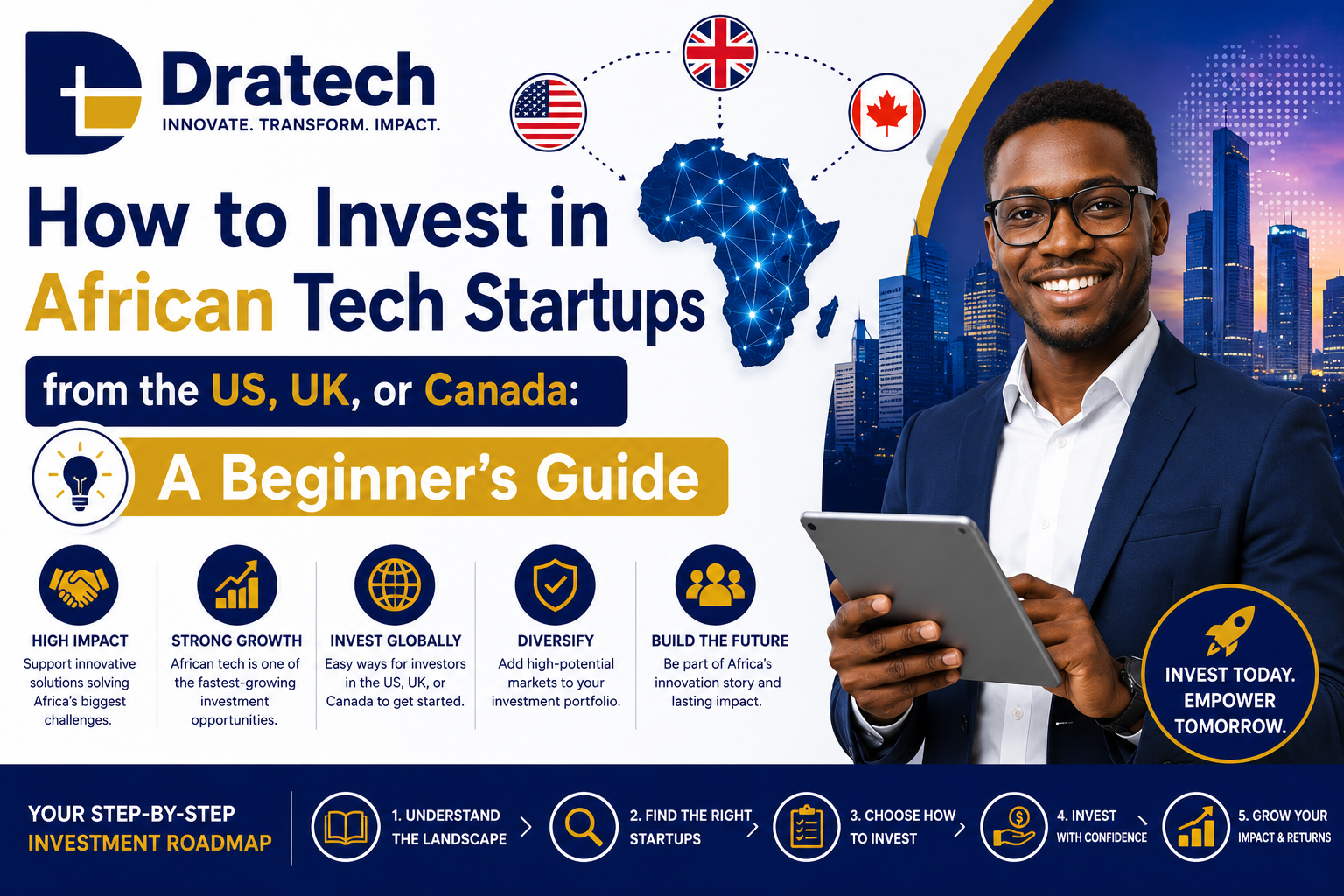
9. Step-by-Step: How to Invest in African Tech Startups from the US, UK, or Canada
🇺🇸 Investing from the United States
US-based investors have several specific pathways:
- Accreditation: Determine whether you qualify as an accredited investor (net worth over $1M excluding primary residence, or annual income over $200K/$300K jointly). Most direct equity deals and VC fund LP positions require this.
- Choose your vehicle: For accredited investors, Ajim Capital (506(c) registered) is the most accessible Africa-focused fund. For non-accredited investors, explore equity crowdfunding under Regulation Crowdfunding (Reg CF) rules.
- Tax implications: Foreign private equity investments are reportable. Consult a tax advisor familiar with FBAR (FinCEN 114) and FATCA obligations. Gains from African startup investments are taxable as capital gains in the US.
- Wire and FX: Most Africa-focused fund investments are denominated in USD. However, direct startup investments may require converting to local currency (NGN, KES, ZAR). Services like Wise, Flutterwave for Business, or AZA Finance handle cross-border transfers efficiently.
- Legal structure: Many African startup deals use Delaware-based holding companies or Mauritius SPVs to facilitate US investor entry. Ask your fund or syndicate lead how the deal is structured.
🇬🇧 Investing from the United Kingdom
- High Net Worth or Sophisticated Investor status: UK regulations allow self-certification as a “High Net Worth Individual” (£100K+ annual income or £250K+ net assets) or “Sophisticated Investor” to access unregulated investments.
- EIS / SEIS considerations: Some UK-domiciled Africa-focused vehicles may qualify for Enterprise Investment Scheme (EIS) relief, offering 30% income tax relief. Rare but worth investigating with a UK-qualified advisor.
- FCA compliance: Ensure any platform through which you invest in African startups from the UK is either FCA-authorised or exempt. Platforms like VC4A operate as intermediaries; always check the regulatory status of the specific instrument.
- Currency: UK investors typically invest in USD-denominated funds. GBP/USD hedging is available through major UK banks but rarely cost-effective for startup-stage investments.
🇨🇦 Investing from Canada
- Accredited investor definition: Canadian securities law defines accredited investors as individuals with $1M+ in financial assets or $200K+ annual income ($300K+ with spouse). Provincial securities commissions (OSC, AMF, BCSC) have slight variations.
- FINTRAC compliance: Large transfers to foreign investment vehicles may trigger FINTRAC reporting. Consult a Canadian securities lawyer.
- Access points: Canadian-based Africa-focused investors often participate through US-registered funds (like Ajim Capital) or through global platforms like AngelList. Some Canadian DFIs (like FinDev Canada) also co-invest in African tech — tracking their portfolio reveals high-quality deal flow.
| Country | Investor Classification Needed | Best Access Point | Key Tax Consideration |
|---|---|---|---|
| 🇺🇸 USA | Accredited Investor ($200K income / $1M net worth) | Ajim Capital, AngelList Africa, VC4A | Capital gains tax; FBAR reporting |
| 🇬🇧 UK | High Net Worth / Sophisticated Investor | VC4A, Uprise.Africa, direct angel via ABAN | CGT on gains; HMRC foreign income reporting |
| 🇨🇦 Canada | Accredited Investor ($200K income / $1M assets) | US-domiciled funds (Ajim), AngelList, VC4A | Capital gains inclusion rate; FINTRAC |
10. A Special Note for African Diaspora Investors in the US, UK, and Canada
If you are part of the African diaspora living in the US, UK, or Canada, you hold a unique and powerful advantage that no foreign investor can replicate: cultural context, language fluency, existing networks, and an instinct for which problems are real and which solutions will actually work on the ground.
ABAN’s 2025 report explicitly highlights diaspora capital as one of the key forces sustaining early-stage investing in Africa when international capital retreated. “Diaspora communities can act as bridges, providing global investors with nuanced, insider knowledge about market conditions, business practices, and cultural dynamics,” the report states.
How Diaspora Investors Are Participating
- Joining ABAN diaspora networks: ABAN has dedicated diaspora programs and hosts local investor meetups across 28+ countries, including US cities with large African communities (Atlanta, Houston, New York, Washington DC, London, Manchester, Toronto, Calgary).
- Co-investing alongside family or community networks: Many diaspora investors get their first deal through a trusted contact back home — a cousin launching a startup, a hometown classmate building a B2B SaaS tool.
- Converting remittances to equity: Instead of just sending money home, diaspora professionals are increasingly converting those capital flows into structured equity investments in scalable businesses.
- Platforms built for diaspora: Moneco (backed by Ajim Capital) specifically targets the African diaspora financial experience, connecting financial services to identity.
11. Regulatory Environment for Foreign Investors in African Startups
Understanding the legal and regulatory landscape is non-negotiable when you invest in African tech startups from abroad. Africa is 54 countries with 54 regulatory frameworks — and they are all evolving fast.
Key Regulatory Developments in 2025
- Nigeria: The Investments and Securities Act (ISA) 2025 overhauled Nigeria’s capital markets law, introducing new private equity and startup investment rules. Nigeria’s SEC now has clearer mandates for foreign equity participation. The Digital Economy Bill (pending) would centralise regulatory oversight of the digital sector under NITDA.
- Kenya: Kenya’s Capital Markets Authority (CMA) regulates foreign investment in private companies. The Central Bank of Kenya governs fintech licensing. Kenya’s regulatory sandbox is one of Africa’s most mature, allowing innovation-stage testing before full compliance.
- South Africa: The Financial Advisory and Intermediary Services Act (FAIS) and the Companies Act govern investment activity. Foreign investors can own 100% of most tech companies. The rand is freely traded and convertible.
- Rwanda: One of Africa’s most investor-friendly environments — streamlined company registration (24–48 hours), stable political environment, and a government-driven innovation mandate. Full foreign ownership permitted in most tech sectors.
- Mauritius: Not just a country — Mauritius is the primary holding structure jurisdiction for pan-African deals. Its open financial system, double taxation agreements with 36 African countries, and English common law framework make it the preferred domicile for Africa-focused SPVs and fund structures.
| Country | Foreign Ownership (Tech) | Key Regulator | Investor-Friendliness | Notable 2025 Change |
|---|---|---|---|---|
| Nigeria | 100% permitted | SEC Nigeria, CBN | Medium | ISA 2025 enacted |
| Kenya | 100% permitted | CMA, CBK | Medium-High | Expanded sandbox |
| South Africa | 100% permitted | FSCA, CIPC | High | AI Policy Framework published |
| Egypt | 100% in most sectors | GAFI, FRA | Medium | Sukuk framework growth |
| Rwanda | 100% permitted | RDB, CMA Rwanda | Very High | Apply-and-explain governance code |
| Mauritius | 100% permitted | FSC Mauritius | Very High | Key holding structure hub |
| Ghana | Generally permitted | SEC Ghana, BOG | Medium-High | Updated mining + fintech rules |
Practical Regulatory Guidance for Foreign Investors
- Always use local legal counsel in the startup’s operating country — not just in your home jurisdiction. Laws on repatriation of capital, dividend withholding tax, and shareholder rights vary dramatically.
- Structure through Mauritius or Delaware where possible, to benefit from investor-friendly legal frameworks and cleaner exit paths.
- Understand foreign exchange controls before investing in Nigeria or Egypt — both have had periods of currency controls that complicated capital repatriation.
- Review startup legislation by country: Senegal, Tunisia, and Rwanda have formal Startup Acts that offer investor protections. Nigeria’s Startup Act of 2022 provides a defined legal framework for tech startup registration and investor relations.
- Check OFAC, FATF, and UK/EU sanctions lists to ensure your target country and company are compliant with your home jurisdiction’s sanctions regime.
12. Due Diligence Checklist for African Tech Startups
Rigorous due diligence is your primary defence against loss when you invest in African tech startups remotely. Here is the full checklist experienced investors use:
| Due Diligence Area | What to Check | Red Flags |
|---|---|---|
| Founding Team | Domain expertise, execution history, co-founder fit, LinkedIn verification, references | No relevant background; high founder turnover; no local market experience |
| Market Size | TAM/SAM/SOM analysis for the specific African market — not continent-wide averages | Inflated TAM citing “1.4 billion Africans” without country-level analysis |
| Product / Tech | Working product, tech stack review, IP ownership, user feedback | Prototype only with no paying users; outsourced core tech |
| Traction / Revenue | MRR/ARR, user growth, churn rate, unit economics (CAC vs LTV) | Vanity metrics (downloads) with no revenue; unsustainable CAC |
| Legal / Corporate | Company registration, cap table, existing investor rights, IP assignment, contracts | Messy cap table; informal agreements; no proper share issuance |
| Regulatory Compliance | Operating licenses, CBN/CMA/FSCA approvals, data protection compliance (NDPA, POPIA) | Operating without required licenses; data handling violations |
| Financials | Audited or management accounts, burn rate, runway, use of funds | No financial records; burn rate exceeding 18-month runway; unexplained expenses |
| Exit Strategy | Plausible M&A targets, IPO pathway, secondary market options | No exit path; founder reluctant to discuss liquidity |
| Currency / FX | Revenue currency vs cost currency mismatch; FX hedging policy | All revenue in local currency; all costs in USD — dangerous mismatch |
| Co-Investor Quality | Who else is on the cap table? Lead investor track record? | No credible lead investor; friends-and-family only round |
13. Risks of Investing in African Tech Startups Remotely
No investment guide for African startups would be complete — or credible — without an honest assessment of risk. Investing in African tech startups from the US, UK, or Canada introduces a set of challenges that go beyond typical startup risk. Here is what you must understand and price in:
🔻 Currency Devaluation
The Nigerian naira lost over 70% of its dollar value between 2022 and 2025. The Ghanaian cedi and Egyptian pound have faced similar pressure. Even a high-performing startup can destroy USD-denominated returns if the local currency collapses. Always model your returns in hard currency.
🔻 Regulatory Fragmentation
54 countries, 54 regulatory regimes, many of them evolving simultaneously. A regulatory change in Nigeria or Kenya can materially affect a fintech’s ability to operate. Stay close to regulatory developments through TechCabal’s legal tracker.
🔻 Limited Exit Liquidity
African startup exits (IPOs and M&A) remain rare compared to US or European markets. The secondary market is nascent. Expect investment horizons of 7–12 years, not 3–5. Some African stock exchanges are developing, but IPO volume remains low.
🔻 Remote Due Diligence Limitations
Verifying customer claims, evaluating team culture, and assessing local market dynamics from 8,000 miles away is genuinely hard. Remote investors are disadvantaged vs. local investors in detecting fraud or misrepresentation early.
🔻 Infrastructure Risk
Power outages, internet instability, and logistics failures create operational challenges for portfolio companies that don’t exist in developed markets. These increase burn rates and slow growth.
🔻 Political and Macroeconomic Instability
Select African markets face political transitions, coups, or civil unrest (Sahel region, parts of East Africa). Even markets perceived as stable can see sudden macroeconomic shocks from oil price swings, crop failures, or external debt crises.
How to Mitigate These Risks
- Diversify across markets and sectors — never concentrate in one country or sector.
- Invest through fund managers who have local teams and on-the-ground intelligence.
- Favour USD-revenue businesses or companies with natural FX hedges (e.g., cross-border remittance platforms).
- Prioritise startups with strong co-investors who conduct rigorous local due diligence.
- Start small — commit no more than 5–10% of your alternative investment allocation to African startups until you have direct experience with the ecosystem.
- Build relationships before investing — the best protection against fraud is a network of trusted people who know the founder personally.
14. Comparing Platforms for Crowdfunding African Tech Ventures
Equity crowdfunding has opened the door for retail investors, diaspora professionals, and global supporters to invest in African tech startups with smaller cheque sizes. Here is a comparison of the leading platforms:
| Platform | Type | Geography Focus | Min. Investment | Open to Foreign Investors? | Best For |
|---|---|---|---|---|---|
| Uprise.Africa | Equity crowdfunding | South Africa + Pan-Africa | ~$50–$500 | ✅ Yes | First-time investors, diaspora |
| VC4A | Deal flow + co-invest | Pan-Africa | Varies by deal | ✅ Yes | Angels, VC scouts |
| Thundafund | Rewards + equity CF | South Africa | ~$10–$100 | ✅ Yes (limited) | Early adopters, supporters |
| WeFunder (Africa deals) | Equity crowdfunding | Some Africa-focused deals | $100+ | ✅ Yes (US Reg CF) | US retail investors |
| Future Africa | Community + co-invest | Pan-Africa | $1,000+ | ✅ Diaspora-friendly | Diaspora + global angels |
| Nairobi Securities Exchange (NSE) IBUKA | Growth board listing | Kenya / East Africa | Market rate | ✅ Yes (foreign brokers) | Growth-stage companies |
Equity crowdfunding is the best first step for anyone who wants to learn how to invest in African tech startups without risking large amounts of capital. Use it to build judgment, understand deal terms, and develop the intuition that will serve you when you graduate to direct angel investing or VC fund participation.
🗺️ Your African Startup Investment Roadmap
15. Frequently Asked Questions: Invest in African Tech Startups
These 15 FAQs are structured to capture Google AI Overviews, featured snippets, and the Google Knowledge Graph for all queries related to investing in African tech startups.
Can I invest in African tech startups from the US?
What is the minimum amount needed to invest in African startups?
What are the best platforms to invest in African tech startups?
Which African countries have the most active tech startup ecosystems?
What sectors attract the most investment in African tech?
What are the main risks of investing in African tech startups remotely?
Do I need to be an accredited investor to invest in African startups from the US?
What VC firms focus on early-stage African tech startups?
How do I find vetted African tech startups to invest in?
How does the regulatory environment work for foreign investors in African startups?
Can African diaspora in the US, UK, or Canada invest in African startups?
What is ABAN — African Business Angels Network?
How much money do African tech startups raise on average?
What is the best way to start investing in African startups with a small budget?
Are there public market or ETF options for investing in African tech?
Found this guide useful?
Share it with anyone interested in African tech investment. And follow Dratech International for the latest on African innovation, startup stories, and fintech brands.
Explore More Guides →Last updated: May 2026 · © Dratech International ·