

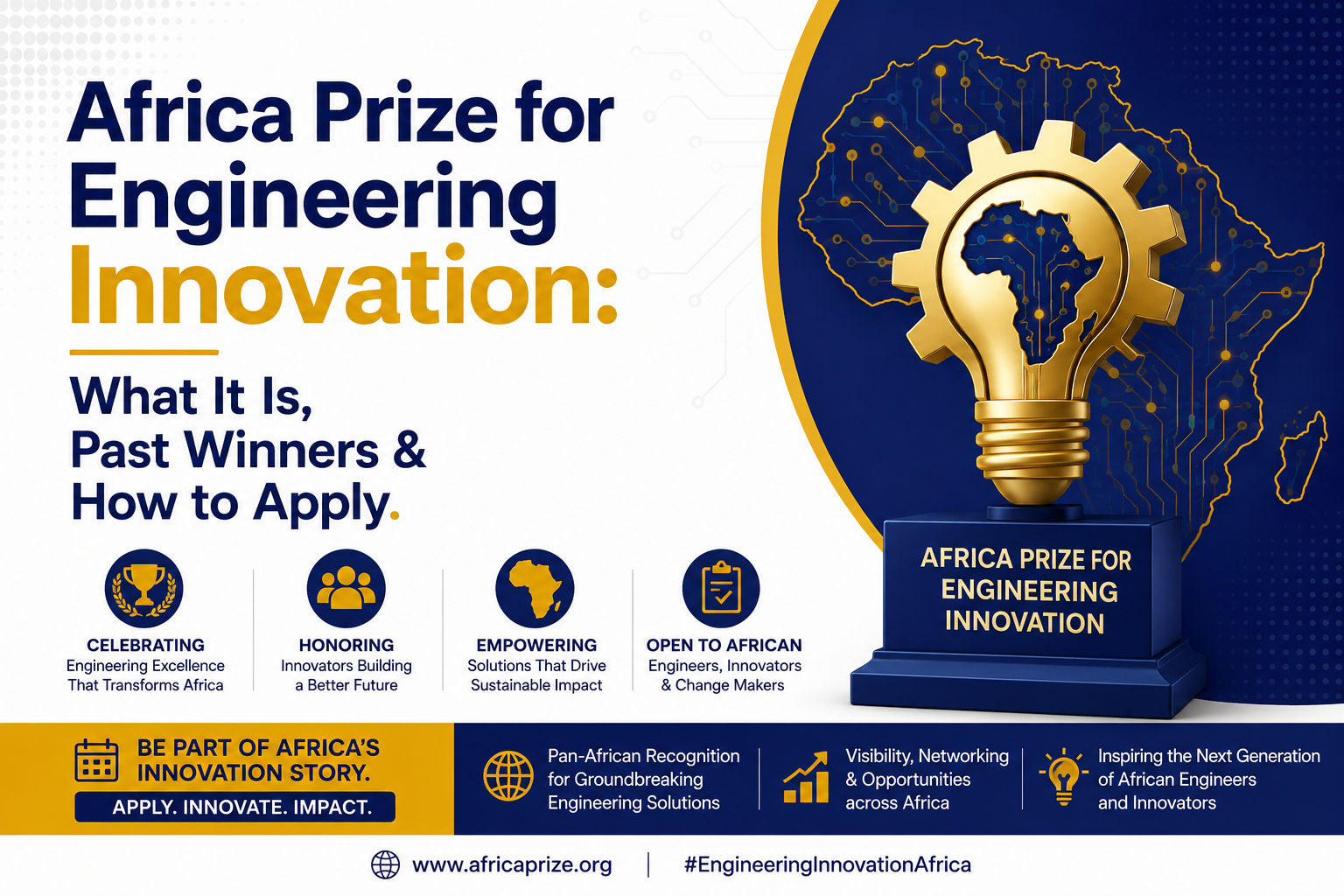
The most comprehensive guide on the web to Africa’s largest engineering award — from its 2014 origins to the 2026 shortlist, every past winner, full eligibility rules, and a step-by-step application guide.
📋 Table of Contents
- What Is the Africa Prize for Engineering Innovation?
- Who Runs It? The Royal Academy of Engineering
- Prize Structure, Money & Benefits (2026)
- Eligibility Criteria: Who Can Apply?
- How to Apply — Step-by-Step Guide
- Selection Process & Judging Criteria
- All Past Winners (2015–2025) — Full List
- 2025 Finalists: Terp 360, Neo Nest, Aquamet & E-Safiri
- 2026 Shortlist: All 16 Innovators & Their Countries
- Alumni Impact & Success Stories
- Diaspora Africans: Your Route Into Engineering Recognition
- Frequently Asked Questions (15 FAQs)
What Is the Africa Prize for Engineering Innovation?
The Africa Prize for Engineering Innovation is Africa’s largest dedicated engineering award. Founded by the Royal Academy of Engineering (RAEng) and launched in March 2014, it was created with a singular mission: to stimulate, celebrate, and reward engineering innovation and entrepreneurship across sub-Saharan Africa.
Unlike many African awards, the Africa Prize for Engineering Innovation does not merely hand out a trophy and move on. It provides a comprehensive commercialisation support package — covering training, mentoring, press coverage, UK residencies, and global networking — that transforms promising ideas into market-ready businesses. This holistic approach is what elevates it above every other engineering award on the continent.
🔑 Quick Definition
The Africa Prize for Engineering Innovation is a UK-backed, Royal Academy of Engineering award that gives African engineering entrepreneurs up to £50,000 in cash, plus an eight-month accelerator programme including two fully-funded international training weeks, expert mentorship, and press coverage — all aimed at helping them commercialise scalable solutions to Africa’s biggest challenges.
Since its launch, the Africa Prize for Engineering Innovation has supported more than 165 businesses across 22 countries, with alumni collectively raising over $39 million in grants and equity. Their innovations employ more than 40,000 people and directly benefit over 11 million people through products and services spanning healthcare, agritech, edtech, clean energy, and fintech.

Who Runs the Africa Prize? The Royal Academy of Engineering Explained
The Africa Prize for Engineering Innovation is organised and run by the Royal Academy of Engineering (RAEng), one of the world’s most prestigious engineering bodies. Founded in 1976 and headquartered at Prince Philip House in London, the Royal Academy of Engineering promotes excellence in engineering for the benefit of society and the UK economy.
UK Government Backing
The Africa Prize is part-funded by the UK’s Department for Science, Innovation and Technology (DSIT). This government partnership adds an important layer of credibility and signals the prize’s strategic importance as a vehicle for UK–Africa science and technology diplomacy. For applicants and observers in the UK and its diaspora communities, this UK government connection means the Africa Prize enjoys significant visibility in British policy, media, and academic circles.
Africa Prize Headquarters & Contact
The programme is administered through the Royal Academy of Engineering at:
Prince Philip House, 3 Carlton House Terrace, London SW1Y 5DG
Tel: (+44) 020 7766 0600
Official prize website: africaprize.raeng.org.uk
Africa Prize Structure, Prize Money & Benefits (2026)
The 2026 Africa Prize for Engineering Innovation significantly increased its prize fund compared to earlier years, reflecting the programme’s growing ambition and reach.
| Award | Prize Money (£) | Prize Money (USD approx.) | Notes |
|---|---|---|---|
| 🥇 Overall Winner | £50,000 | ~$63,000 | Decided by the judging panel |
| 🥈 Runner-Up (×3) | £10,000 each | ~$12,600 each | 3 runners-up receive equal prize |
| 👁️ One-to-Watch | £5,000 | ~$6,300 | Voted by live audience — most impactful pitch |
| 💰 Total Prize Fund | £85,000 | ~$113,000 | 2026 edition |
Beyond the Cash: The Full Africa Prize Benefits Package
Cash prizes are just one component. Every shortlisted innovator (up to 16 per year) receives a substantial non-cash package worth considerably more in commercial value:
- Eight-month tailored training programme covering financial management, market analysis, IP protection, scaling strategy, and commercialisation
- Two fully-funded training weeks — one in the UK (including site visits to leading UK engineering organisations) and one in a major African city
- Sector-specific engineering mentoring from experienced engineers and entrepreneurs
- Expert business mentoring from product development coaches and industry leaders
- Bespoke press coverage and communications support — PR value alone is significant for early-stage startups
- Access to the Royal Academy of Engineering’s global network of high-profile engineers, investors, and business leaders in both the UK and Africa
- Opportunity to pitch at the Africa Prize live final before a panel of world-class judges and a live and online global audience
- Entry into the Africa Prize alumni community of over 160 innovators with ongoing access to funding, development, and collaboration opportunities
💡 Why This Matters More Than Just the Prize Money
The Africa Prize has produced innovations now operating across 40+ countries on five continents, with alumni having introduced nearly 700 products and services to market. The training, network access, and press exposure are what consistently turn shortlisted participants into investable, bankable businesses — even those who don’t win.
Eligibility Criteria: Who Can Apply for the Africa Prize?
The Africa Prize for Engineering Innovation has clear eligibility requirements. Meeting all of them before applying is essential to avoid disqualification.
| Criterion | Requirement |
|---|---|
| Nationality / Residency | Lead applicant must be a citizen ordinarily residing in a sub-Saharan African country |
| Age | Lead applicant must be over 18 years old |
| Language | Must be fluent in English (the programme is conducted in English) |
| Stage of Development | Innovation must be in the early stages of commercialisation with a viable business plan |
| Hardware Innovations | Must include a working prototype and demonstrable customer interest |
| Software / App Innovations | Must have a functional minimum viable product (MVP) and evidence of traction |
| Required Documents | Letter of support, technical diagram, and a photo of the innovation |
| Sectors | Open to all sectors: healthcare, agritech, edtech, fintech, clean energy, mobility, water, and more |
⚠️ Diaspora Applicants: Note This
The Africa Prize specifically requires applicants to be ordinarily residing in sub-Saharan Africa — meaning Africans in the diaspora (UK, US, Canada, Europe) are not eligible for the main prize. However, diaspora innovators should explore the Dratech International Innovation Awards, which celebrate African excellence globally, including from abroad.
How to Apply for the Africa Prize for Engineering Innovation
The Africa Prize uses a two-stage application process designed to streamline submissions for both applicants and reviewers. Here is the complete step-by-step guide:
-
Check the Application Window
Applications open in mid-July and close in mid-September each year (at 4pm UTC+1). For the 2027 cycle, applications will open around July 2026. Mark your calendar — there is no rolling admissions. -
Complete Stage 1 — Initial Application
Submit your first-stage application at africaprize.raeng.org.uk. This requires your basic details, a description of your innovation, and initial supporting materials. -
Prepare Your Documentation
Gather: (1) a letter of support from a relevant stakeholder, (2) a technical diagram of your innovation, and (3) a clear photo of the innovation. For hardware, ensure your prototype is functional. For software/apps, document your MVP and any user traction data. -
Complete Stage 2 — Detailed Application
If selected to proceed from Stage 1, you’ll complete a more detailed second-stage application covering your business plan, market analysis, team structure, financial projections, and scalability roadmap. -
Await Shortlisting (announced ~March)
Up to 16 innovators are shortlisted. The shortlist is announced publicly, usually in March of the prize year (e.g., the 2026 shortlist was announced in March 2026). -
Eight-Month Programme (April–November)
Shortlisted innovators enter the eight-month training and mentoring programme, including a UK residency week and an African city residency week. -
Finalist Selection & Live Final (October)
Four finalists are selected by the judging panel to pitch at the live final (e.g., the 2026 final will be in Johannesburg in October 2026). The winner is announced at the event.
✅ Top Tips for a Winning Application
- Lead with documented evidence of impact — user numbers, revenue generated, lives touched
- Demonstrate scalability clearly: judges want to see how your solution reaches 100x more people
- Show strong team quality — judges weigh the capability of the founding team heavily
- Apply from sectors currently underrepresented in the prize (mobility, waste management, digital inclusion)
- Study previous winners’ innovations at africaprize.raeng.org.uk/awardees — understand what excellence looks like
Selection Process & Judging Criteria
Every finalist is assessed on a rigorous multi-dimensional framework. The 2025 judging panel was chaired by Rebecca Enonchong FREng, a pan-African tech entrepreneur and Fellow of the Royal Academy of Engineering, and included specialists from across the engineering, business, and entrepreneurship spectrum.
What Judges Look For
| Criterion | What It Means |
|---|---|
| Strength of Engineering Solution | Is the technology sound, novel, and well-executed? |
| Evidence of Impact | Documented proof that the innovation solves a real problem |
| Commercial Viability | Does the business model make financial sense? Can it sustain? |
| Potential to Scale | Can this reach 10x, 100x more people across Africa or globally? |
| Quality of the Team | Is the founding team capable of executing the vision? |
| Programme Learning | How well has the applicant applied insights from the 8-month programme? |
| Clarity of Future Vision | Does the innovator have a credible, ambitious roadmap? |
All Africa Prize for Engineering Innovation Past Winners (2015–2025)
Every Africa Prize winner represents a transformative engineering solution built in Africa, for Africa — and increasingly, for the world. Here is the complete list of winners from the prize’s inception to 2025.
Elly Savatia — Terp 360 (Kenya)
Terp 360 is an AI-powered app that translates speech into sign language using hyper-realistic 3D avatars, built alongside Kenya’s deaf and hard-of-hearing community. With over 2,300 locally recorded signs and support for Kenyan Sign Language in English and Swahili, the app directly addresses the chronic shortage of sign language interpreters across Africa. Savatia received his prize at the first-ever Francophone Africa final, held in Dakar, Senegal.
Esther Kimani — Early Crop Pest and Disease Detection Device (Kenya)
A solar-powered camera and AI system mounted on a 5-metre adjustable stand that continuously monitors crops within a 600-metre radius. It detects thousands of crop pests and pathogens within five seconds and notifies farmers via SMS — potentially increasing yields by 40% and reducing crop losses by 30%. Leased at just US$3/month, it democratises agricultural diagnostics that previously cost $60–$100 per visit.
Anatoli Kirigwajjo — YUNGA (Uganda) & Edmund Wessels — FlexiGyn (South Africa)
YUNGA is a community security network connecting neighbours and police via devices that send emergency alerts with location data — even offline via Long Range Wide Area Network. Over 2,500 people across 18 Ugandan communities were already on the YUNGA network at the time of winning.
FlexiGyn is a portable, battery-powered flexible hysteroscope that enables gynaecologists to diagnose and treat uterine conditions in the field without anaesthetic — dramatically improving women’s healthcare access in remote areas.
Norah Magero — VacciBox (Kenya)
A small, mobile, solar-powered fridge that safely stores and transports temperature-sensitive vaccines for use in field vaccinations and off-grid hospitals. The VacciBox addresses the cold-chain challenges that leave 3 in 10 Kenyan children inadequately vaccinated — a gap that became globally visible during the COVID-19 pandemic.
Noël N’guessan — KubeKo (Côte d’Ivoire)
KubeKo is a set of low-cost biowaste processing equipment — a composter and biodigester — designed for smallholder farmers in West Africa. It transforms agricultural post-harvest by-products into cooking gas and liquid compost, helping farmers generate extra income from the 30 million tonnes of biowaste disposed annually in Côte d’Ivoire.
Charlette N’Guessan — BACE API (Ghana)
BACE API uses facial recognition and AI to verify identities remotely, integrable into existing apps and systems. Targeted at financial institutions, it addresses Ghana’s significant identity fraud problem — where banks spend approximately $400 million annually on customer identification. Charlette N’Guessan became the first woman to win the Africa Prize for Engineering Innovation.
Neo Hutiri — Pelebox (South Africa)
Pelebox is a smart locker system for public healthcare facilities that dispenses chronic medication to patients via a one-time PIN — eliminating the long queues that plague South African clinics. Healthcare workers stock the lockers, log them digitally, and patients collect their medication independently, freeing clinic staff and improving patient dignity.
Brian Gitta & team — Matibabu (Uganda)
Matibabu is a non-invasive malaria testing device that clips onto a finger and uses red light to detect malaria in red blood cells — without drawing blood. Results appear within one minute on a linked mobile phone. In a continent responsible for 90% of the world’s 400,000 annual malaria deaths, Matibabu’s low cost and ease of use represent a potentially life-saving breakthrough.
Godwin Benson & team — Tuteria (Nigeria)
Tuteria is an online platform connecting Nigerians and Africans with vetted local tutors for almost any subject or skill. Launched in 2015, it grew to over 10,650 tutors and 3,540 learners within two years, addressing the 42 million children and adults in Nigeria with no reliable access to competent teachers.
Arthur Zang — Cardio-Pad (Cameroon)
The Cardio-Pad is a medical tablet enabling any healthcare professional to conduct heart examinations (ECG) anywhere in the world, transmitting results by mobile network to a cardiologist within 20 minutes. It brought cardiac diagnostics to rural Cameroon for the first time.
Dr Askwar Hilonga & team — Nanofilters (Tanzania)
Nanofilters integrate cutting-edge nanotechnology with sand-based water filtration to provide clean, safe drinking water affordably and sustainably in rural African settings where access to clean water remains a severe challenge. Custom-built per region, it makes previously polluted water bodies usable.
Africa Prize Winners at a Glance
| Year | Winner | Country | Innovation | Sector |
|---|---|---|---|---|
| 2025 | Elly Savatia | 🇰🇪 Kenya | Terp 360 | Assistive Tech / AI |
| 2024 | Esther Kimani | 🇰🇪 Kenya | Crop Pest Detection Device | AgriTech |
| 2023 | Anatoli Kirigwajjo & Edmund Wessels | 🇺🇬🇿🇦 Uganda / S. Africa | YUNGA / FlexiGyn | Security / MedTech |
| 2022 | Norah Magero | 🇰🇪 Kenya | VacciBox | HealthTech |
| 2021 | Noël N’guessan | 🇨🇮 Côte d’Ivoire | KubeKo | CleanTech / AgriTech |
| 2020 | Charlette N’Guessan | 🇬🇭 Ghana | BACE API | FinTech / AI |
| 2019 | Neo Hutiri | 🇿🇦 South Africa | Pelebox | HealthTech |
| 2018 | Brian Gitta | 🇺🇬 Uganda | Matibabu | HealthTech |
| 2017 | Godwin Benson | 🇳🇬 Nigeria | Tuteria | EdTech |
| 2016 | Arthur Zang | 🇨🇲 Cameroon | Cardio-Pad | MedTech |
| 2015 | Dr Askwar Hilonga | 🇹🇿 Tanzania | Nanofilters | WaterTech |
2025 Africa Prize Finalists: Terp 360, Neo Nest, Aquamet & E-Safiri
The 2025 Africa Prize live final was held in Dakar, Senegal — the first time the prize had ever been hosted in Francophone Africa — in October 2025. Four finalists competed for the £50,000 top prize before a live audience and a panel of seven judges chaired by Rebecca Enonchong FREng.
Terp 360 — Elly Savatia
Country: 🇰🇪 Kenya | Company: Signvrse
An AI-powered app translating speech into Kenyan Sign Language via hyper-realistic 3D avatars. With 2,300+ locally recorded signs, it addresses interpreter shortages in classrooms, workplaces, and public services. Elly called his win “a testament to the innovative assistive technology coming from Africa.”
Prize: £50,000
Neo Nest — Vivian Arinaitwe
Country: 🇺🇬 Uganda
A portable, low-cost neonatal warming and monitoring device that prevents hypothermia in newborns during ambulance transfers from rural clinics to referral hospitals. It generates heat through an electric circuit, monitors vitals, and uses colour-coded LED alerts to notify caregivers of malfunctions. Before the final, Vivian had already secured deployment agreements with health facilities in Uganda.
Prize: £10,000
Aquamet — Frank Owusu
Country: 🇬🇭 Ghana
A smart water-quality monitoring device for smallholder fish farmers that tracks key water parameters in real time, sends alerts, and provides actionable recommendations — reducing fish mortality and boosting yields, enabling sustainable and profitable aquaculture.
Prize: £10,000
E-Safiri — Carol Ofafa
Country: 🇰🇪 Kenya
Solar-powered electric vehicle (EV) charging and battery-swapping stations that enhance rural mobility and supply electricity to local communities — simultaneously addressing the clean transport and energy access gaps in underserved Kenyan communities.
Prize: £10,000
📌 About the 2025 Judging Panel
The 2025 panel was chaired by Rebecca Enonchong FREng (Pan-African tech entrepreneur) and included Sewu Steve Tawia, Richard Wylde FREng, Ian Shott CBE FREng, Yewande Odumosu, Marième Diop, and Karim Sy. Finalists were judged on engineering solution strength, evidence of impact, commercial viability, scalability potential, team quality, programme learning applied, and clarity of future vision.
2026 Africa Prize Shortlist: All 16 Innovators Across 11 Countries
On 25 March 2026, the Royal Academy of Engineering announced the 16 shortlisted innovators for the 2026 Africa Prize for Engineering Innovation. This was a record-setting cohort drawn from applications received from over 30 countries — with Lesotho and Niger represented for the first time ever in the prize’s history.
The 2026 shortlist totals a potential £85,000 prize fund, with the final to be held in Johannesburg, South Africa in October 2026.
2026 Shortlisted Countries
Selected 2026 Shortlist Highlights
| Innovation | Innovator | Country | Sector | Description |
|---|---|---|---|---|
| Fusion Wind Turbine | Johannes Amo-Aye | 🇬🇭 Ghana | Clean Energy | Hybrid wind and solar microgrid system providing reliable clean electricity to off-grid communities, reducing diesel reliance |
| MoyoECG | Alice Muhuhu | 🇰🇪 Kenya | HealthTech | AI-powered wearable ECG device enabling rural clinics to deliver hospital-grade cardiac screening without internet access |
| Farmflex | Mochesane Mpali | 🇱🇸 Lesotho | AgriTech / FinTech | AI-enabled smart farming platform helping smallholders grow more food with less water while gaining access to credit, insurance, and markets |
| Malawi Drop | Tadala Mtimuni | 🇲🇼 Malawi | WaterTech | Low-cost, refillable household water treatment device delivering safe drinking water at point of use for off-grid rural communities |
| Likita Care | Mamane Kabirou | 🇳🇪 Niger | HealthTech | Locally manufactured monitoring kit combining vital signs, cardiac, and prenatal monitoring with offline AI decision support |
| Efiwe | Chidi Nwaogu | 🇳🇬 Nigeria | EdTech | Mobile-first coding platform running offline on basic smartphones, teaching web development in 189 languages to young people excluded from digital education |
🗓️ 2026 Africa Prize Key Dates
- Shortlist announced: March 25, 2026
- UK residential week: April 2026
- Eight-month programme: April – November 2026
- Live Final: October 2026 — Johannesburg, South Africa
- Next application cycle opens: Mid-July 2026
- Next application deadline: Mid-September 2026
Africa Prize Alumni Impact: What Happens After the Prize
The Africa Prize’s lasting value goes far beyond the annual prize ceremony. The alumni programme is one of the most powerful outcomes of the entire initiative.
Notable Alumni Achievements
The impact of the Africa Prize alumni network can be illustrated through standout examples:
- Marie Ndieguene (Senegal, I3S) — Her post-harvest storage solution is now used by over 42,000 farmers across six communities, saving 135,130 tonnes of onions and potatoes (worth over £107 million) since 2020.
- Esther Kimani (Kenya, Crop Pest Device) — Her 895 deployed devices now feed data into a live agricultural tracking dashboard informing national policy decisions.
- Elly Savatia (Kenya, Terp 360) — Post-prize, Signvrse is developing an investor-ready business model and expanding Terp 360 into B2B markets across education, corporate, and healthcare sectors, with plans to reach Uganda and Rwanda.
All alumni are linked to specific UN Sustainable Development Goals (SDGs) through their innovations — a fact that strengthens their case for international funding and UN agency partnerships.
Diaspora Africans: How to Get Recognised for Your Engineering Innovation
While the Africa Prize for Engineering Innovation requires residency in sub-Saharan Africa, the African diaspora in the UK, US, Canada, and across Europe has its own ecosystem of recognition — and Dratech International sits at the centre of it.
🌍 Dratech International Innovation Awards — For Africans Everywhere
The Dratech International Innovation Awards (DIIA) recognise African engineers, tech founders, and innovators regardless of where they live. Whether you are building in Lagos or London, Nairobi or New York — the DIIA celebrates your contribution to African advancement in technology, AI, health, energy, and more.
Categories include AI-Driven Solution Excellence, Healthcare Innovation, EdTech, Fintech, Leadership in Tech, Environmental Sustainability, and many more. Nominations are open annually.
→ Nominate yourself or a colleague at dratech.org/dratech-awards/
Additionally, Dratech covers all major African tech awards in our African Tech Awards section — making it your one-stop hub for engineering and innovation recognition on the continent and in the diaspora.
For African innovators based in the UK, the Royal Academy of Engineering also offers additional programmes including the Engineering for Development Research Fellowships and Industry Fellowships — worth exploring at raeng.org.uk.
Is Your Innovation Changing Africa?
Whether you’re building in Accra, Johannesburg, or Atlanta — if your work is advancing African technology, science, or AI, Dratech International wants to celebrate and amplify it. Submit a nomination for the Dratech International Innovation Awards, or pitch your startup story to our editorial team.
Apply for the DIIA Award Explore Innovator ProfilesFrequently Asked Questions: Africa Prize for Engineering Innovation
These 15 direct-answer FAQs are optimised for Google’s knowledge graph, featured snippets, and AI answer engines including ChatGPT, Perplexity, and Google’s AI Overviews.
Further Reading on African Engineering & Innovation Awards
If this article on the Africa Prize for Engineering Innovation has been useful, explore these related resources on Dratech International:
- Dratech International Innovation Awards — Africa’s own platform for celebrating innovation, open to the diaspora
- African Tech Awards Coverage — Every major award recognising African innovation
- African Tech Innovators — Profiles of the engineers and founders shaping Africa’s future
- How Dratech’s Awards & Hackathons Work — The complete guide to Dratech’s recognition ecosystem
- Women in Tech Awards Guide — Celebrating female engineers and tech leaders
External Authority Sources
- Official Africa Prize Website — africaprize.raeng.org.uk
- Royal Academy of Engineering — raeng.org.uk
- Full Official List of Africa Prize Winners
📣 Share This Guide & Help African Innovators Find Their Prize
This is the most comprehensive guide to the Africa Prize for Engineering Innovation on the internet. If it helped you, share it with an engineer, founder, or innovator who deserves to know about it. Bookmark it — we update it every year with the latest winners and shortlists.
Nominate for the Dratech Awards Apply for the Africa PrizeDisclaimer: This article is an independent editorial resource published by Dratech International (dratech.org). Dratech is not affiliated with the Royal Academy of Engineering or the Africa Prize for Engineering Innovation. All facts have been sourced from official Royal Academy of Engineering announcements, press releases, and reputable media coverage. Prize amounts, dates, and eligibility criteria are subject to change — always verify current details at africaprize.raeng.org.uk.