

The only comprehensive resource for corporates, NGOs, diaspora communities, and individuals who want to nominate African innovators — from anywhere in the world. Updated for 2026.
Somewhere in Lagos, a fintech engineer just processed $1 million in cross-border payments for smallholder farmers who previously had no banking access. Somewhere in Nairobi, a 24-year-old developer built an AI diagnostic tool now used in three countries. Somewhere in the diaspora — London, Houston, Toronto — an African founder is bootstrapping a climate-tech solution that the continent desperately needs.
These innovators exist in the thousands. But without recognition, their work stays local. An African tech award changes that. It converts a local story into a global headline, a regional product into an investable asset, and a talented individual into a celebrated pioneer. The question is: how do you, as a nominator, make sure the right people are recognised?
This guide answers that question definitively. Whether you are a corporate HR team looking to spotlight an employee, an NGO wanting to honour a grantee, a university celebrating a graduate, or simply someone who knows an incredible innovator — this is your step-by-step playbook for how to nominate someone for an African tech award.
Why African Tech Award Nominations Matter More Than Ever
Africa’s technology ecosystem is the fastest-growing in the world. According to Disrupt Africa, the continent recorded over 1,000 active tech startups receiving investment in a single year, with Nigeria, Kenya, South Africa, and Egypt leading the charge. Yet recognition infrastructure has historically lagged behind the innovation itself.
An African tech award nomination is not simply ceremonial. The downstream effects are tangible and documented:
| Benefit | Impact on Nominee | Impact on Ecosystem |
|---|---|---|
| Credibility | Third-party validation that accelerates investor trust | Signals Africa’s innovation to global capital markets |
| Media Coverage | Press mentions, podcast invitations, conference keynotes | Builds African tech narrative for international audiences |
| Network Access | Invitations to exclusive panels, judge networks, alumni communities | Cross-border connections between African innovators |
| Funding Signals | Award wins appear in investor due diligence searches | Raises baseline quality expectation for African startups |
| Talent Attraction | Recognised companies attract better hires across the continent | Retains African talent in African organisations |
| Diaspora Signal | Visibility for Africans abroad seeking to return or invest home | Strengthens diaspora-homeland tech bridge |
Beyond the individual, every strong nomination you submit contributes to a permanent, searchable record of African technological excellence — the kind of institutional memory that the continent is actively building.
The Top African Tech Awards You Can Nominate For in 2026
Understanding the landscape of awards before you nominate is critical. Different awards serve different sectors, geographies, and career stages. Here is a definitive overview of the most credible African tech awards open to nominations in 2026.
🏆 Dratech African Innovation Award (DIIA)
Hosted by Dratech International. Covers AI, software, fintech, social impact, leadership, and sector-specific tech. Open globally to Africans at home and abroad. Free to nominate.
→ Nominate at dratech.org🌍 Africa Tech Summit Awards
Nairobi-based. Covers FinTech, HealthTech, AgriTech, AI, Web3, Climate Tech. Entry fee: $125 (waived for startups under 2 years). Annual ceremony in February.
→ africatechsummit.com📡 Africa Tech Festival Awards
Cape Town-based (AfricaCom). Recognises telecoms, connectivity, AI leadership, digital disruption, and humanitarian tech. Highly credible with global telecoms industry.
→ africatechfestival.com💰 Africa Fintech & AI Awards
15+ year legacy recognising Africa’s fintech and AI pioneers. Open to startups and established enterprises. Annual ceremony in Tanzania.
→ fintechandaiawards.com🦁 Africa Tech Week Awards
South Africa-focused. Requires revenue thresholds (R5M–R50M+). Strong categories: Digital Transformation, Women in Tech, HealthTech, AI Innovation.
→ africatechweek.co.za🎖️ African Leadership Awards
Recognises continental leaders across sectors including tech. Public-voting component combined with expert panel. Free to nominate via the official website.
→ africaleadershipawards.com| Award | Region Focus | Entry Fee | Diaspora Eligible | Key Sectors | Ceremony Month |
|---|---|---|---|---|---|
| Dratech DIIA | Pan-African + Diaspora | Free | ✅ Yes | AI, Software, Fintech, Social Impact | Rolling / Annual |
| Africa Tech Summit | East Africa (Nairobi) | $125 | ✅ Yes | FinTech, HealthTech, AgriTech, Web3 | February |
| Africa Tech Festival | Southern Africa (Cape Town) | Varies | ✅ Yes | Telecoms, AI, Connectivity, Disruption | November |
| Africa Fintech & AI Awards | East Africa (Tanzania) | Varies | ✅ Yes | Fintech, AI, Banking | Annual (Q1) |
| Africa Tech Week | South Africa | R-denominated | ⚠️ Limited | Digital Trans., Women in Tech, AI | November |
| African Leadership Awards | Pan-African | Free | ✅ Yes | Leadership, Social Impact, Tech | Annual |
Who Can Nominate Someone for an African Tech Award?
One of the most common misconceptions is that only insiders — judges, sponsors, or board members — can nominate for African tech awards. This is false. The vast majority of major African tech awards operate open-nomination systems specifically designed to cast the widest possible net.
The following groups are explicitly eligible to nominate in most award programmes:
- Individuals — Friends, colleagues, community members, mentors, or mentees who have observed exceptional work firsthand
- Corporations and enterprises — HR teams, CSR departments, or innovation leads who want to recognise vendors, partners, or employees
- NGOs and development organisations — Entities that work with African innovators and can speak to measurable social or economic impact
- Universities and research institutions — Academic supervisors, department heads, or alumni offices recognising graduating or employed innovators
- Diaspora organisations — African community groups in the US, UK, Canada, and Europe that track innovations back home
- Investors and accelerators — VCs, angel networks, and incubators that have a portfolio relationship with the nominee
- The nominee themselves — Self-nominations are accepted by most awards including the Dratech African Innovation Award and Africa Tech Summit Awards
- Media and journalists — Tech journalists covering the African ecosystem who can formally submit nominations based on published reporting
Understanding Eligibility: Does Your Nominee Qualify?
Before investing time in a nomination, confirm that your nominee meets the eligibility requirements. These vary significantly between awards. Here are the key dimensions to check:
Geographic Eligibility
Most pan-African awards require either that the nominee is African (by birth or nationality) or that the innovation primarily benefits or operates within Africa. Some awards, like the Africa Tech Week Awards, are geographically focused on South Africa and require company registration there. Others, like the Dratech African Innovation Award, accept nominations for the African diaspora worldwide.
Sector and Category Match
Each award has defined categories. Submitting a healthcare innovator to a fintech-only category wastes everyone’s time. Match your nominee to the specific category description, not just the award name. The Dratech DIIA judging criteria covers categories including AI, Software Innovation, Leadership in Tech, Social Impact, and Sector-Specific excellence.
Revenue and Scale Thresholds
Corporate-focused awards (particularly those targeting established enterprises) often require minimum revenue. The Africa Tech Week Awards, for example, requires annual revenue of R5 million and above for founder categories, and R50 million for senior leadership categories. Startup-focused awards and free-entry awards typically have no revenue minimum.
Innovation Recency
Most awards evaluate work from the previous 12–24 months. A 10-year-old product that is no longer actively innovating is less likely to be competitive than a two-year-old platform showing rapid growth and impact.
| Eligibility Factor | What to Check | Where to Verify |
|---|---|---|
| Geographic origin | African nationality OR innovation serving African market | Award FAQ / Terms page |
| Category fit | Nominee’s work matches category description precisely | Award categories page |
| Company age | Some startup categories require under 2–5 years of operation | Entry criteria or FAQs |
| Revenue threshold | Corporate awards often require R5M–R50M+ annual revenue | Specific category criteria |
| Innovation recency | Achievement should fall within the past 12–24 months | Award brief or judging criteria |
| Prior winner status | Some awards restrict repeat wins in the same category | Award FAQ |
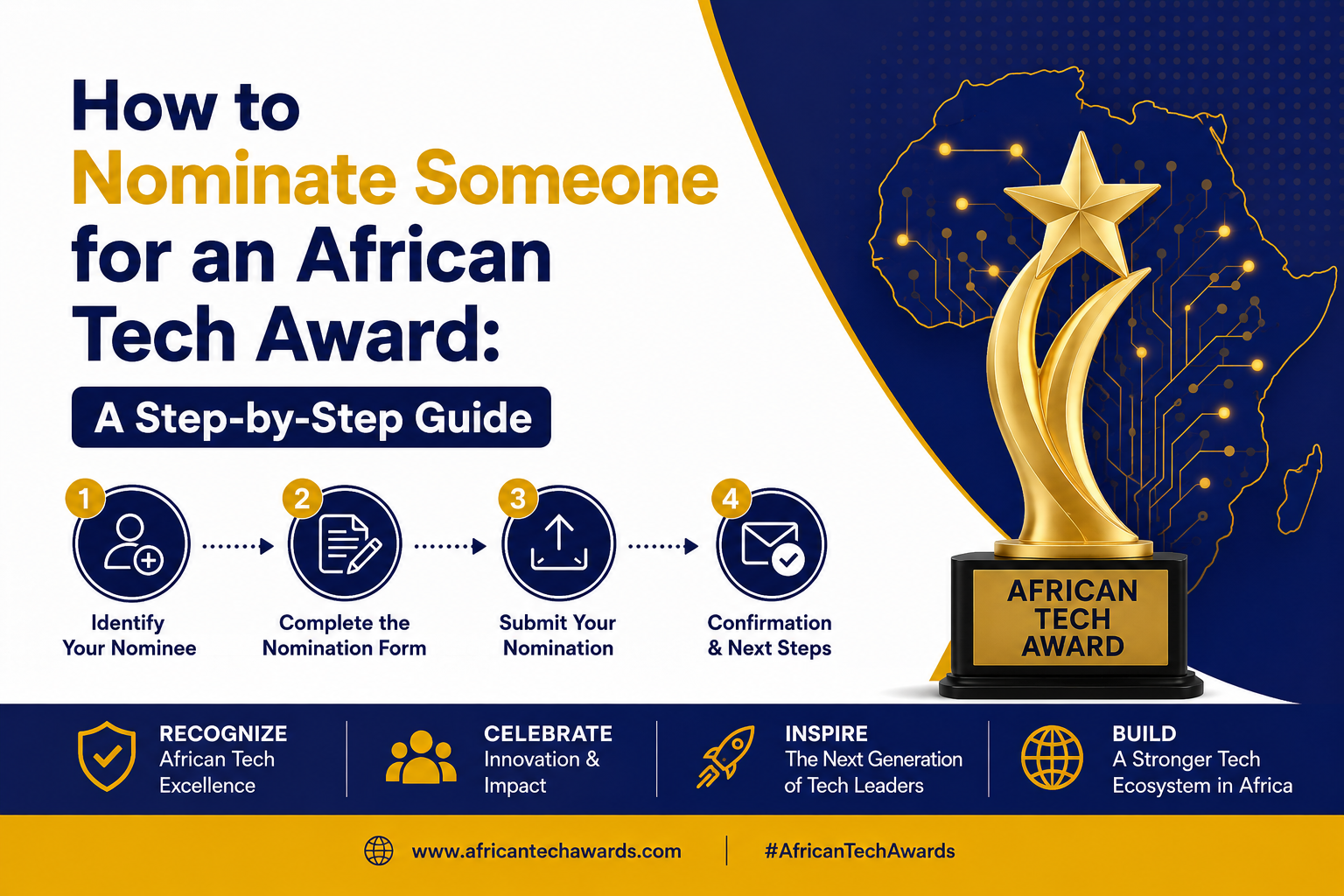
How to Nominate Someone for an African Tech Award: Step-by-Step
This is the definitive process. Follow it sequentially and you will have a nomination that stands out from the majority of submissions, which tend to be generic, underprepared, and poorly evidenced.
Choose the Right Award for Your Nominee
Match the nominee’s primary innovation, geography, and career stage to the most relevant award. A Nigerian AI startup founder is better served by the Dratech DIIA or Africa Tech Summit Awards than by the South Africa-focused Africa Tech Week Awards. Relevance of fit is the single biggest predictor of shortlisting.
Confirm Eligibility Before Investing Time
Read the full eligibility criteria, not just the headline description. Check geographic scope, revenue thresholds, company age restrictions, and whether the category is open to third-party nominators or self-nominations only. The DIIA judging criteria page is a transparent model worth reviewing for all awards.
Contact the Nominee and Obtain Their Consent
Always inform the nominee before submitting. Beyond courtesy, this is practically necessary — you will need information only they possess (revenue figures, user data, internal case studies). Nominees who know they are being nominated can actively contribute to strengthening the submission.
Gather All Supporting Evidence
This step takes the most time and produces the most competitive nominations. Collect: impact metrics (users, revenue, geographic reach), media mentions, partnership letters, case studies, product demos, and proof of the problem the innovation solves. Start this at least 2–3 weeks before the deadline.
Write the Nomination Statement
Draft a nomination aligned with the award’s stated judging criteria. Lead with a specific, data-backed achievement. Build the narrative around: the problem, the innovation, the impact, and the future potential. Every paragraph should answer the question: “Why should this person win this specific award?” Full writing guidance is in Section 6 below.
Complete the Nomination Form Carefully
Most awards use an online portal. Fill every field — incomplete nominations are typically disqualified automatically. Use the nominee’s professional title exactly as they use it. Double-check email addresses, URLs, and contact information. Poor form completion undermines even excellent narrative content.
Upload Supporting Documents
Convert all supporting materials to PDF unless the platform specifies otherwise. Name files clearly (e.g., “NomineeName_CaseStudy_2026.pdf”). Include: product description, impact report or summary, media coverage, letters of support, and a professional photograph of the nominee (minimum 300 DPI for print-quality awards).
Pay the Entry Fee (If Applicable)
Many free awards still require account creation or registration. Paid awards like the Africa Tech Summit Awards charge $125 per entry — but this is waived for startups under two years old, and female innovator / young innovator categories are free. Always check whether a fee waiver applies before paying.
Submit Before the Deadline — and Confirm Receipt
Submit at least 5 business days before the deadline to allow time to fix technical issues. After submitting, look for an automated confirmation email. If you do not receive one within 24 hours, contact the award organiser directly — non-delivery is a common, fixable problem that eliminates strong nominations.
Monitor Shortlisting and Support the Nominee
Shortlisted nominees are typically contacted 4–8 weeks after submission. Some awards then open a public voting phase — mobilise your network to vote. Others proceed directly to expert panel selection. Either way, be available to provide additional information if judges request it, and prepare the nominee for a potential judging interview.
How to Write a Winning African Tech Award Nomination
The nomination statement is where most entries are won or lost. Judges review dozens — sometimes hundreds — of submissions. A nomination that opens with “I am pleased to nominate [Name] for this prestigious award” is already losing ground. The nominations that win are the ones that give judges a story they cannot forget.
The Four-Part Structure That Works
Part 1: The Headline Achievement (First Paragraph)
Lead with your nominee’s single most impressive accomplishment, stated with specificity and a number. Not “has helped many farmers access credit” but “has enabled 47,000 smallholder farmers across three West African countries to access working capital loans for the first time, with a 94% repayment rate.” That single sentence tells the judge: this is real, this is measurable, this is significant.
Part 2: The Problem and the Innovation
Describe the market gap or societal problem that existed before your nominee’s innovation. Be concise — two to three sentences maximum. Then explain what the nominee built, in plain language that a non-technical judge can understand. Judges often include business leaders and policy officials, not just engineers.
Part 3: Impact, Evidence, and Scale
This is the body of your nomination. Use data aggressively. Acceptable evidence categories include: user or customer numbers, revenue or transaction volume, geographic reach, jobs created or supported, awards or certifications previously received, partnership signatories, media mentions from credible sources, and independent impact assessments. Quote from these sources rather than paraphrasing from memory.
Part 4: Why Now, Why This Award, Why This Person
Close by connecting the nominee’s work explicitly to the award’s stated mission. If the award celebrates African AI innovation, your closing paragraph should articulate exactly why your nominee embodies that mission better than anyone else in the field. Future potential — the scalability of the solution — also belongs here.
Every sentence in your nomination should answer: why does this person’s story matter more than anyone else’s this year?
Language and Tone Guidelines
- Write in third person: “Dr. Amara Osei has built…” not “I believe Dr. Osei…”
- Use active verbs: “launched,” “scaled,” “secured,” “transformed” — not “has been involved in”
- Quantify everything you possibly can — judges default to scepticism about unverified claims
- Avoid superlatives without evidence: “one of the best” is meaningless; “ranked #1 in Nigeria by X publication in 2025” is compelling
- Mirror the award’s own language back at the judges — use their category keywords in your narrative
- Keep sentences under 30 words wherever possible — clarity over complexity
- End every major claim with a parenthetical source or “see Appendix A” to signal that evidence exists
What Evidence to Collect Before You Nominate
The quality of your evidence package determines whether your narrative is believed. Here is a complete checklist of evidence types, ranked by typical judge preference:
| Evidence Type | Format | Judge Impact | How to Obtain |
|---|---|---|---|
| Impact metrics (users, revenue, reach) | PDF data summary or dashboard screenshot | ⭐⭐⭐⭐⭐ Highest | Request from nominee directly |
| Case study or impact report | 2–4 page PDF | ⭐⭐⭐⭐⭐ Highest | Co-create with nominee; use their existing reports |
| Media coverage (credible publications) | PDF clippings or URLs | ⭐⭐⭐⭐ High | Google News search, TechCabal, Disrupt Africa archives |
| Letters of support (from clients/partners) | Signed PDF on letterhead | ⭐⭐⭐⭐ High | Request 2–3 from key stakeholders |
| Product demo or live URL | URL or video link | ⭐⭐⭐ Medium-High | Live product, App Store link, or recorded demo video |
| Nominee biography | 1-page PDF or LinkedIn URL | ⭐⭐⭐ Medium | Request professional bio from nominee |
| Awards or certifications | Certificate copies or announcements | ⭐⭐⭐ Medium | Nominee’s records or public announcements |
| High-resolution photograph | JPG/PNG, min. 300 DPI | ⭐⭐ Presentation | Professional headshot from nominee |
Common Mistakes That Get African Tech Nominations Rejected
1. Wrong Category Selection
Submitting a fintech innovator to an AgriTech award, or a social enterprise to a corporate leadership category, immediately signals that the nominator did not engage seriously with the award. Judges use category match as a proxy for nomination quality.
2. Vague Claims Without Evidence
“Has impacted millions of lives” without a source is not a claim — it is a placeholder that wastes judges’ time. Every quantitative claim in your nomination must be verifiable. If you cannot source a number, do not include it.
3. Writing About the Nominator Rather Than the Nominee
Nominations that spend more than one sentence establishing who the nominator is are misdirected. Judges are evaluating the nominee. Your credibility as a nominator matters far less than the quality of the evidence you provide.
4. Ignoring the Judging Criteria
Award judging criteria are public documents, not bureaucratic formalities. They tell you exactly what weights the judges assign to innovation, impact, scalability, and leadership. A nomination that addresses all four criteria explicitly will always outscore one that addresses only two — regardless of the nominee’s underlying merit.
5. Submitting at the Last Minute
Technical failures — portal timeouts, file upload errors, payment failures — are most common in the 48 hours before a deadline. Submissions made on the deadline day also receive less careful review from organisers who are dealing with volume. Submit five working days early, minimum.
6. Not Proofreading
A nomination for an innovation award that contains spelling errors and grammatical inconsistencies communicates that the nominator does not take the award seriously. Have at least one other person proofread the final submission before it goes in.
A Special Note for the African Diaspora: Nominating From Abroad
If you are part of the African diaspora — based in the United Kingdom, United States, Canada, Germany, France, or anywhere else — this section is written directly for you.
You occupy a uniquely powerful position in the African tech award ecosystem. You often have the professional networks, English-language writing skills, and international media literacy to craft nominations that truly compete at the highest level. You may also have direct knowledge of innovators back home whose work is exceptional but has never received the external visibility it deserves.
You Can Nominate Innovators in Africa from Anywhere
The overwhelming majority of African tech awards explicitly accept nominations from the diaspora. The Dratech African Innovation Award, for instance, was designed to bridge exactly this gap — celebrating African talent whether it operates from Accra, Abuja, Atlanta, or Amsterdam. Visit dratech.org/dratech-awards to begin a nomination today.
You Can Also Nominate Africans in the Diaspora
Diaspora innovators — African founders and technologists building in London, Toronto, Houston, or Dubai whose work directly benefits or originates from Africa — are eligible for most pan-African awards. The key criterion is usually the African origin of the innovator or the African focus of the innovation, not the country of current residence.
Practical Advantages Diaspora Nominators Have
- Access to international media sources to verify and cite the nominee’s achievements
- Familiarity with award writing conventions used by Western corporate award systems
- Ability to engage investor networks and advisory boards as letter-of-support signatories
- International perspective that strengthens the “global impact” dimensions of a nomination
- Time zone overlap with award bodies in Europe (UK-based African tech events) for efficient follow-up
How to Nominate Someone for the Dratech African Innovation Award (DIIA)
The Dratech African Innovation Award is one of the most accessible, comprehensive, and globally inclusive African tech awards available. It was built specifically to recognise the breadth of African innovation — from AI to agritech, from social impact to software excellence — with no geographic restrictions on who can nominate.
Award Categories
The DIIA recognises excellence across six streams: Core Technology Awards (groundbreaking tech innovation), Software Innovation Excellence, Impact and Leadership Awards, Sector-Specific Awards (Tech Service Providers), Social Impact Awards (Tech for Good), and Recognition of Impactful Technology. Each category has a distinct set of criteria published at dratech.org/diia-judging-criteria.
The Judging Panel
Nominations are evaluated by Dratech’s panel of industry leaders and seasoned professionals, who assess each submission on creativity, impact, and scalability. The Dratech team also actively discovers innovators through research and outreach — but a formal nomination from a peer, employer, or community member carries significant weight. You can learn more about the judging process and apply to become a judge yourself at dratech.org/become-a-judge.
How to Submit a DIIA Nomination
Visit dratech.org/dratech-awards. Select the most relevant award stream for your nominee. Complete the online nomination form with the nominee’s details, a description of their innovation, and evidence of impact. Supporting materials can be uploaded or linked. The Dratech team processes nominations throughout the year and communicates directly with both nominators and nominees about next steps.
Pro Tips to Maximise Your Nomination’s Success Rate
Nominate for Multiple Awards Simultaneously
There is no rule against nominating the same innovator across multiple award bodies. In fact, experienced nominators prepare a core nomination document and then adapt it to the specific language and criteria of each award. A single research effort can generate three to five distinct nominations. Coordinate with the nominee to ensure they are comfortable with each submission.
Build a Nomination Portfolio, Not Just a Single Entry
Award-winning innovators are rarely one-and-done. The most recognisable names in African tech — from Flutterwave’s founders to M-PESA’s team — appeared in multiple award contexts over multiple years before achieving household-name status. Treat nomination as a multi-year strategy, not a single event.
Leverage Africa’s Tech Media to Strengthen Your Nomination
Publications like TechCabal, Disrupt Africa, Ventureburn, and Techpoint Africa frequently profile innovators. A recent feature article from any of these publications is strong supporting evidence. If your nominee has not yet been profiled, consider pitching their story to one of these outlets before the nomination deadline — simultaneously building nomination evidence and organic publicity.
Use the Nomination to Brief Investors
For corporate nominators, a completed award nomination is also a condensed investment case. The same document that you submit to an award body — tight narrative, data-backed impact claims, clear scalability argument — is the skeleton of an excellent investor brief. Many startups have used their nomination narrative as the foundation of their next fundraising pitch deck.
- Dratech African Innovation Award: Past Winners, Criteria & How to Apply (2026 Complete Guide)
- African Tech Awards — Full Category Directory & Spotlight Reviews
- DIIA Judging Criteria — What Dratech Judges Look For
- Become a Dratech Awards Judge — Apply Here
- African Tech Innovators — Profiles & Startup Stories