

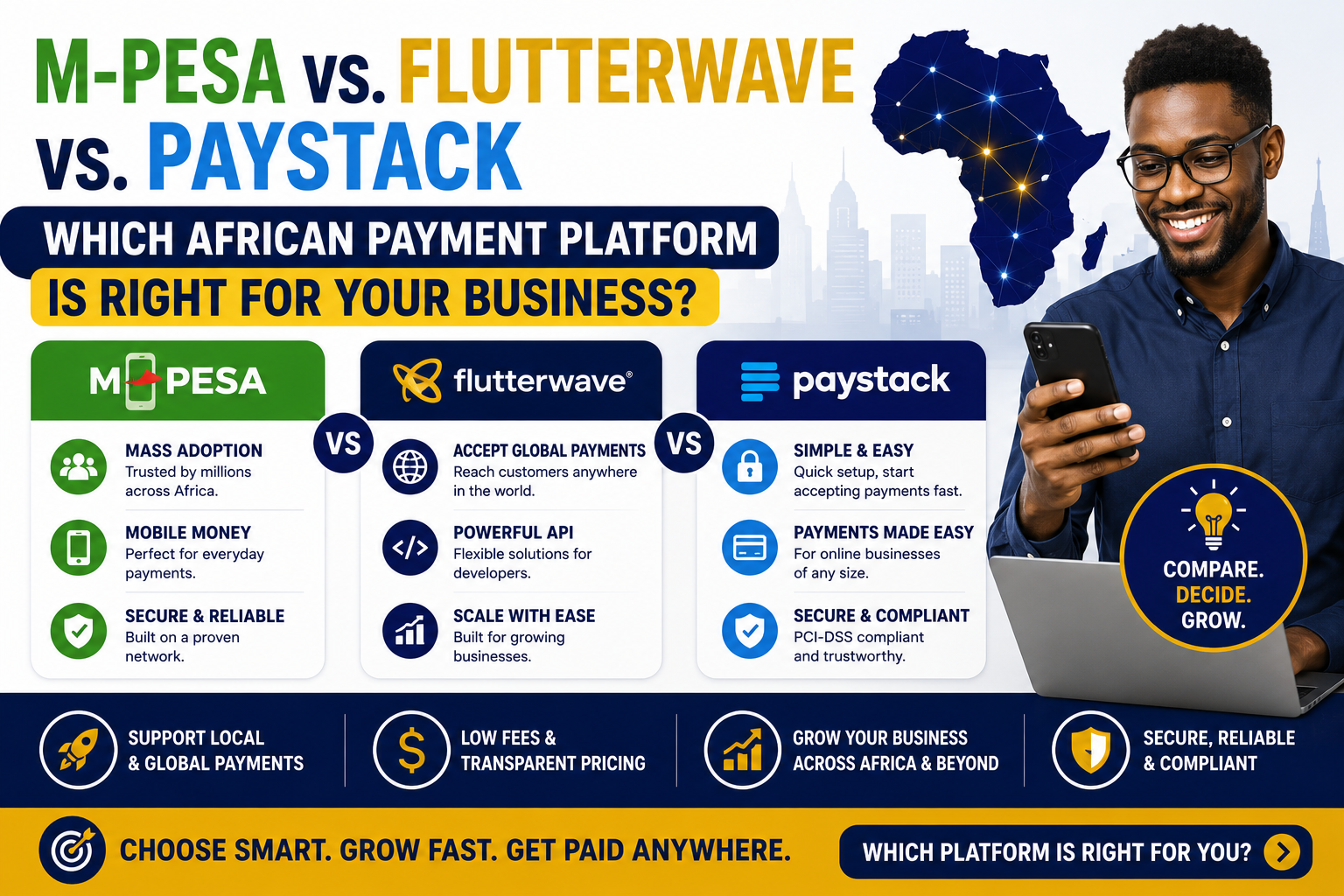
M-Pesa is the dominant mobile money service in East Africa (Kenya, Tanzania, Ethiopia), serving 50M+ users with peer-to-peer transfers, merchant payments, and diaspora remittances. Flutterwave is Africa’s most valuable fintech unicorn ($3B+), processing payments in 150 currencies across 34+ African countries — best for international and multi-market businesses. Paystack (acquired by Stripe for $200M+) is the go-to payment gateway for Nigerian, Ghanaian, and Kenyan businesses online. The right platform depends on your geography, business model, and whether your customers are local or international.
Africa’s Payment Revolution: Why This Decision Matters More Than Ever
Africa’s digital payments market is one of the fastest-growing in the world. With over 1.4 billion people, a smartphone adoption rate accelerating at remarkable pace, and a largely unbanked population embracing mobile money, the continent has become the global frontier for financial innovation. At the center of this transformation stand three giants: M-Pesa, Flutterwave, and Paystack.
Whether you are a Nigerian e-commerce founder, a Kenyan small business owner, a British tech company entering Africa, or a Ghanaian in Canada trying to send money home — your choice of payment platform will determine whether your customers can pay you seamlessly, whether your margins survive the fee structure, and whether your business can scale across borders.
No competitor has built a truly comprehensive guide on M-Pesa vs. Flutterwave vs. Paystack that serves every type of reader. This article changes that. We have analysed fees, countries, integrations, security, diaspora use, and business fit so you never need to look elsewhere.
Platform Overviews at a Glance
Before we dive deep, here is a snapshot of who built these platforms, who they were built for, and what category each dominates.
These are not truly competing products in every sense. M-Pesa is a mobile money operator; Flutterwave and Paystack are payment gateways. In fact, both Flutterwave and Paystack accept M-Pesa as a payment method in East Africa, meaning they can work together rather than against each other.
M-Pesa: Africa’s Mobile Money Pioneer — A Deep Dive
Launched in Kenya by Safaricom on 6 March 2007, M-Pesa is arguably the most consequential financial innovation Africa has ever produced. The name combines M (mobile) and Pesa (money in Swahili). What began as a simple airtime credit system evolved into a comprehensive financial ecosystem that has processed KES 20.2 trillion (~$155 billion) in transaction value in just the first half of Safaricom’s financial year 2025–2026 alone.
M-Pesa is not merely a payment app — it is, for millions of East Africans, their entire bank. It has driven financial inclusion in Kenya to over 80%, a remarkable figure for a developing market. M-Pesa operates as a joint venture between Safaricom and Vodacom Group (M-Pesa Africa), extending across 7 African countries.
How M-Pesa Works
M-Pesa is tied to your mobile SIM card. Users register with a national ID at any M-Pesa agent, then use USSD code *334# or the M-Pesa app to:
- Send money to any registered or unregistered user
- Pay for goods and services via Lipa na M-Pesa (merchant till numbers)
- Withdraw cash at 300,000+ agent outlets across Kenya
- Pay bills (KPLC electricity, water, DSTV, etc.)
- Access microloans via Fuliza (overdraft) and M-Shwari (savings and credit)
- Receive international remittances from diaspora via Western Union, MoneyGram, Remitly, WorldRemit, Wave, and Ria
- Shop globally using the M-Pesa GlobalPay Visa virtual card at 100M+ merchants in 200+ countries
M-Pesa’s Business Products
For entrepreneurs and enterprises, M-Pesa offers robust business tools:
- Lipa na M-Pesa (LNM): Till numbers for in-store and online merchant payments at ~0.39% per transaction.
- Pochi la Biashara: Informal business wallets, now at 1.15M+ active tills (up 81.7% year-on-year).
- M-Pesa Business App: Manage business transactions digitally, with 300,000+ merchants enrolled.
- M-Pesa API (Daraja): Allows developers to integrate M-Pesa payments into websites, apps, and systems using the Safaricom Daraja API.
- Bulk Payments: For payroll, supplier payments, and government disbursements.
M-Pesa’s Geographic Reach in 2025
| Country | Launch Year | Operator | Status |
|---|---|---|---|
| 🇰🇪 Kenya | 2007 | Safaricom | Dominant — 35.8M monthly active users |
| 🇹🇿 Tanzania | 2008 | Vodacom | 22M+ users; Global Pay launched 2025 |
| 🇨🇩 DR Congo | 2012 | Vodacom | Active, growing |
| 🇲🇿 Mozambique | 2013 | Vodacom | Active |
| 🇱🇸 Lesotho | 2013 | Vodacom | Active |
| 🇬🇭 Ghana | 2015 | Vodafone | Active |
| 🇪🇹 Ethiopia | 2023 | Safaricom ET | 10M+ users; explosive growth |
M-Pesa’s global remittance service grew 11.5% to KES 296 billion in the six months to September 2025, with 1.3 million distinct diaspora customers. This underlines how M-Pesa is rapidly evolving from a local mobile wallet to a global financial bridge for East Africans worldwide.
M-Pesa Fees & Charges (2025)
| Transaction Range (KES) | Send to M-Pesa User | Withdraw from Agent | Merchant Payment (LNM) |
|---|---|---|---|
| 1 – 100 | Free | N/A (min KES 50) | ~0.39% |
| 101 – 500 | KES 11 | KES 27 | ~0.39% |
| 501 – 1,000 | KES 15 | KES 27 | ~0.39% |
| 1,001 – 2,500 | KES 25–40 | KES 27 | ~0.39% |
| 2,501 – 5,000 | KES 55–60 | KES 49–66 | ~0.39% |
| 5,001 – 10,000 | KES 75–85 | KES 82–110 | ~0.39% |
| 10,001 – 20,000 | KES 95–100 | KES 159–176 | ~0.39% |
| 20,001 – 70,000 | KES 108 | KES 187–330 | ~0.39% |
The average overall M-Pesa fee across all transactions is approximately 0.51% of value (excluding cash withdrawals) — very competitive vs card processing fees globally. However, the fee for a KES 101 transfer is 6.9% — making M-Pesa significantly more expensive for very small-value P2P transfers. Smart users batch their transactions to minimize fees. M-Pesa wallet limit: KES 500,000. Daily transaction limit: KES 500,000.
M-Pesa Strengths & Weaknesses
| ✅ Strengths | ⚠️ Limitations |
|---|---|
| Works without internet (USSD) | Only in 7 African countries |
| No bank account needed | Telco-dependent (needs Safaricom/Vodacom SIM) |
| Massive agent network (300,000+ in Kenya) | International card payments not natively supported |
| Instant transfers, 24/7 | Currency conversion fees for diaspora sending |
| Fuliza overdraft facility for SMEs | Primarily consumer-focused; less robust for enterprise API needs |
| M-Pesa GlobalPay for global shopping | Not available in West Africa (Nigeria, Senegal, etc.) |
Flutterwave: Africa’s Global Payment Infrastructure — A Deep Dive
Flutterwave was founded in 2016 by Nigerian engineer Olugbenga ‘GB’ Agboola and has grown into Africa’s most valuable fintech startup, with a valuation exceeding $3 billion after raising ~$500 million across multiple rounds including a $250 million Series D in 2022. Headquartered in San Francisco with deep operational roots in Lagos, Flutterwave describes itself as the payment infrastructure for the global merchant community serving Africa and beyond.
Unlike M-Pesa (which is consumer-first) or Paystack (which is Africa-local-first), Flutterwave was built from day one to be the bridge between global commerce and Africa. It processes transactions in 150 currencies across 34+ African countries, and in 2025 reported nearly $1 billion in East Asia-to-Africa transactions alone — a sign of its growing role as a China-Africa trade corridor.
Core Flutterwave Products
- Rave (Payment Gateway API): Developer-grade API for websites and mobile apps to accept cards, mobile money, bank transfers, USSD, and more.
- Flutterwave Store: Free e-commerce storefront for non-technical merchants to set up and sell products online.
- Payment Links: Share-anywhere payment links for freelancers, consultants, and service providers.
- Send (Remittance App): Consumer-focused app for diaspora Africans to send money home to Africa.
- Barter by Flutterwave: Virtual USD/NGN cards for international online shopping and subscriptions.
- POS Terminals: Physical payment terminals for in-store payments across Africa.
- Invoicing: Professional invoice creation and tracking for B2B payments.
- Stablecoin Payments (Coming 2026): Flutterwave is building Africa’s largest stablecoin wallet infrastructure for faster settlement in USD-pegged digital currencies.
Flutterwave Supported Payment Methods
Flutterwave accepts: Visa, Mastercard, Verve cards · Bank transfers · USSD · M-Pesa (Kenya, Tanzania) · MTN Mobile Money · Airtel Money · Orange Money · Google Pay · Apple Pay · PayPal (in select markets) · Virtual cards · Barter wallets · Bank direct debit.
Flutterwave Fees in 2025
| Transaction Type | Fee | Notes |
|---|---|---|
| Local NGN transactions (Nigeria) | 2% per transaction | Up from 1.4%, effective April 11, 2025 |
| Fixed fee (Nigeria local) | ₦50 per transaction | Applies per transaction |
| International card payments | 4.8% | Up from 3.8%; effective Nov 2024 due to Visa/MC interchange increase |
| International alternate payment methods | 2% | Bank transfers, Apple Pay, Google Pay, Mobile Money outside your country |
| Other African countries (cards) | ~2.9%–3.8% | Varies by country; check Flutterwave pricing page |
| Payouts / withdrawals | Varies | ₦45 per bank transfer (Nigeria); varies internationally |
| Settlement (local) | T+1 | Next business day |
| Settlement (international) | T+3 to T+5 | Depends on region |
By default on Flutterwave, the customer bears the transaction charge. You can switch this on your Flutterwave dashboard so that you (the merchant) absorb the fee — useful for competitive pricing. This flexibility is a significant advantage over many competitors.
Flutterwave’s Global Expansion in 2025
In 2025, Flutterwave launched services in Cameroon, Senegal, and Zambia. Transaction volumes in Ghana grew 47x in the first half of 2025. East Asia-to-Africa corridors (primarily China) processed nearly $1 billion — driven by partnerships with Chinese fintech firms Norafirst and Skyee. The company is actively targeting profitability and has discussed a potential IPO.
Flutterwave Strengths & Weaknesses
| ✅ Strengths | ⚠️ Limitations |
|---|---|
| 150 currencies — unmatched in Africa | Fee increases (local NGN now 2% + ₦50) |
| 34+ African countries | International card fee now 4.8% — one of Africa’s highest |
| Multiple payment methods incl. M-Pesa | API docs less intuitive than Paystack’s (per some developers) |
| Visa, Mastercard, Worldpay partnerships | Dispute resolution slower for cross-border transactions |
| Virtual dollar cards via Barter | Still not profitable (as of early 2025) |
| Stablecoin roadmap for fast settlement | Customer support response time can be inconsistent |
Paystack: The Developer’s Payment Gateway — A Deep Dive
Paystack was co-founded in 2015 by Shola Akinlade and Ezra Olubi, both Nigerian computer science graduates, and launched publicly after being accepted into Y Combinator in 2016. In October 2020, Stripe acquired Paystack for over $200 million — the largest fintech acquisition in Africa at the time — calling Paystack its “growth engine for modern businesses in Africa.”
Paystack’s philosophy is developer-first, merchant-second. Its APIs are among the cleanest and best-documented on the continent, enabling businesses to embed payments into virtually any platform within hours. The checkout experience Paystack delivers is widely regarded as the best in Nigeria and West Africa — clean, fast, and with above-average transaction success rates.
Paystack is currently available in Nigeria, Ghana, Kenya, South Africa, Côte d’Ivoire, and Rwanda. It has processed over 50% of all online payments in Nigeria at its peak and serves 60,000+ businesses including FedEx, UPS, and MTN.
Core Paystack Products
- Payment Gateway API: Accept cards, bank transfers, USSD, mobile money, and POS via one integration.
- Paystack Commerce (Storefront): Build an online store without code.
- Payment Pages: No-code payment links and embeddable forms.
- Recurring Billing / Subscriptions: For SaaS businesses and subscription commerce.
- Paystack Terminal (POS): Physical POS machines for Nigerian businesses (₦100,000 outright or ₦17,000/month for 6 months).
- Transfers / Payouts: Send money to Nigerian bank accounts.
- Identity Verification: BVN and account number verification APIs.
- Invoicing: Professional invoice management for B2B.
Paystack Supported Payment Methods
Cards (Visa, Mastercard, Verve) · Bank transfer · USSD · Mobile money (M-Pesa in Kenya; AirtelTigo, Vodafone, MTN in Ghana) · QR Code · POS · Virtual accounts.
Paystack Fees in 2025
| Transaction Type | Fee | Notes |
|---|---|---|
| Local Nigeria (cards, bank transfer) | 1.5% + ₦100 | ₦100 waived for transactions under ₦2,500. Capped at ₦2,000 max |
| International cards (Nigeria) | 3.9% + ₦100 | Settled in NGN by default; can opt for USD settlement |
| Ghana (local GHS) | ~1.95% + GHS 0.25 | Check Paystack Ghana pricing page for latest |
| Kenya (local KES) | ~2.9% | Mobile money incl. M-Pesa supported |
| South Africa (local ZAR) | ~2.9% | Cards and bank transfers |
| Educational institutions (Nigeria) | 0.7% capped at ₦1,500 | Special sector rate |
| Payouts / transfers | Free for NGN, ZAR transfers; ₦20–₦100 for others | Transparent payout schedule |
| Settlement (local) | T+1 | Next business day |
| POS transactions | 1.5% per successful transaction | Nigeria only currently |
Paystack’s ₦2,000 local transaction fee cap is a massive advantage for high-value transactions. A ₦500,000 transaction would theoretically cost ₦7,600 at 1.5% — but Paystack caps it at ₦2,000. This makes Paystack the cheapest option for large-ticket Nigerian transactions.
Paystack’s Developer Ecosystem
Paystack integrates natively with Shopify, WooCommerce, Magento, Wix, OpenCart, and dozens more e-commerce platforms. Its REST API has consistently received high marks from African developers for clarity and reliability. The SDK is available in JavaScript, PHP, Python, Java, Go, Ruby, and .NET — making it the most accessible gateway for African-built apps.
Paystack Strengths & Weaknesses
| ✅ Strengths | ⚠️ Limitations |
|---|---|
| Best checkout UX in Nigeria | Only 6 countries (vs Flutterwave’s 34+) |
| Stripe infrastructure = world-class reliability | Cross-border capability less expansive than Flutterwave |
| ₦2,000 fee cap for local transactions | No virtual card product for users (unlike Flutterwave’s Barter) |
| Best-in-class API documentation | POS hardware only available in Nigeria |
| Free storefront builder | Requires registered business; no individual account option |
| Subscription billing and invoicing | International card fee (3.9%) higher than some alternatives |
Fee Comparison: M-Pesa vs. Flutterwave vs. Paystack — Which Is Cheapest?
This is the most-searched question around these three platforms — and the answer is nuanced. The cheapest platform depends entirely on where you are, who your customers are, and how large your transactions are.
| Scenario | M-Pesa | Flutterwave | Paystack | 🏆 Winner |
|---|---|---|---|---|
| Local Nigeria transaction (₦50,000) | N/A | 2% = ₦1,000 + ₦50 | 1.5% = ₦750 + ₦100 (capped ₦2,000) | Paystack |
| Large Nigeria transaction (₦500,000) | N/A | 2% = ₦10,000 | Capped at ₦2,000 | Paystack (by far) |
| International card payment from US/UK | Via remittance partners | 4.8% | 3.9% + ₦100 | Paystack |
| East Africa mobile money (KES 5,000) | KES 60 (1.2%) | ~2.9% in Kenya | ~2.9% in Kenya | M-Pesa |
| Cross-border Africa (Nigeria → Ghana merchant) | N/A | International processing fee applies | Limited cross-border | Flutterwave |
| Multi-currency (USD, EUR, GBP) | N/A | ✔ 150 currencies | Limited | Flutterwave |
| Peer-to-peer transfer (no internet) | Free (under KES 100) / tiered fee | N/A | N/A | M-Pesa |
| Merchant payment (physical store, East Africa) | ~0.39% (LNM) | POS available in some markets | POS Nigeria only | M-Pesa |
| Educational institution (Nigeria) | N/A | Standard 2% | 0.7% capped ₦1,500 | Paystack |
Paystack is cheapest for Nigerian local businesses, especially for high-value transactions (the ₦2,000 cap is transformational). M-Pesa is cheapest for East African merchants and peer-to-peer transfers within its network. Flutterwave is most expensive per transaction but offers the broadest reach — the fee is the cost of cross-border access.
Countries & Availability: M-Pesa vs. Flutterwave vs. Paystack
| Country / Region | M-Pesa | Flutterwave | Paystack |
|---|---|---|---|
| 🇳🇬 Nigeria | ✗ | ✔ | ✔ |
| 🇰🇪 Kenya | ✔ (Dominant) | ✔ | ✔ |
| 🇬🇭 Ghana | ✔ | ✔ | ✔ |
| 🇿🇦 South Africa | ✗ | ✔ | ✔ |
| 🇹🇿 Tanzania | ✔ | ✔ | ✗ |
| 🇺🇬 Uganda | Via partners | ✔ | ✗ |
| 🇷🇼 Rwanda | Via partners | ✔ | ✔ |
| 🇨🇮 Côte d’Ivoire | ✗ | ✔ | ✔ |
| 🇨🇲 Cameroon | ✗ | ✔ (2025) | ✗ |
| 🇸🇳 Senegal | ✗ | ✔ (2025) | ✗ |
| 🇿🇲 Zambia | ✗ | ✔ (2025) | ✗ |
| 🇲🇿 Mozambique | ✔ | Partial | ✗ |
| 🇪🇹 Ethiopia | ✔ (10M+ users) | Limited | ✗ |
| 🌍 Rest of Africa (30+ countries) | ✗ | ✔ | ✗ |
| 🌐 Global (international merchants) | Via GlobalPay virtual card | ✔ (HQ in USA) | Accept intl cards only |
| 🇺🇸 US / 🇬🇧 UK (Diaspora sending) | ✔ via Western Union / MoneyGram / Remitly | ✔ via Send app | Customers can pay with intl cards |
Key takeaway: Flutterwave wins on raw geographic coverage across Africa. Paystack wins on depth within its six markets. M-Pesa wins on ground-level penetration in East Africa where its agent network is unrivalled.
Feature-by-Feature Comparison: M-Pesa vs. Flutterwave vs. Paystack
| Feature | M-Pesa | Flutterwave | Paystack |
|---|---|---|---|
| Card payments (Visa/MC) | ✗ | ✔ | ✔ |
| Bank transfers | ✗ | ✔ | ✔ |
| USSD payments | ✔ | ✔ | ✔ |
| Mobile money | ✔ (primary) | ✔ (incl. M-Pesa) | ✔ (GH, KE) |
| Multi-currency support | ✗ | ✔ (150 currencies) | Limited |
| Payment links | ✗ | ✔ | ✔ |
| Free storefront/online store | ✗ | ✔ | ✔ |
| Subscription / recurring billing | ✗ | ✔ | ✔ |
| Invoicing | ✗ | ✔ | ✔ |
| Virtual (dollar) card | ✔ (GlobalPay) | ✔ (Barter) | ✗ |
| Physical POS terminal | ✔ (via agents) | ✔ | ✔ (Nigeria only) |
| Bulk payments / payroll | ✔ | ✔ | ✔ |
| Developer API / SDK | ✔ (Daraja API) | ✔ | ✔ (best docs) |
| Shopify / WooCommerce plugin | ✗ | ✔ | ✔ |
| Microloans / overdraft | ✔ (Fuliza, M-Shwari) | ✗ | ✗ |
| Savings product | ✔ (M-Shwari) | ✗ | ✗ |
| Remittance (diaspora) | ✔ (primary) | ✔ (Send app) | Accept intl cards |
| No bank account required | ✔ | ✗ | ✗ |
| Works offline (USSD only) | ✔ | ✗ | ✗ |
| Stablecoins / crypto | ✗ | Pilot 2025–26 | ✗ |
| PCI-DSS compliant | ✔ | ✔ | ✔ |
| ISO 27001 certified | ✔ | ✔ | ✔ |
| Identity verification (BVN/NIN) | ✗ | Via partners | ✔ |
| Free to sign up | ✔ | ✔ | ✔ |
| Individual (non-business) account | ✔ | ✔ (limited) | ✗ (business only) |
Which Platform for Which Business? M-Pesa vs. Flutterwave vs. Paystack Use Cases
🛍️ Nigerian E-Commerce Store
Paystack’s WooCommerce and Shopify plugins, clean checkout, and ₦2,000 fee cap make it the clear winner for Nigerian online retail.
🌍 Pan-African SaaS / Digital Product
Selling software or digital goods across Nigeria, Kenya, Ghana, and Francophone Africa? Flutterwave’s 34+ country reach and 150 currencies is the only gateway that covers you.
🏪 Kenyan/Tanzanian Retail Business
If your customers are in East Africa, accepting Lipa na M-Pesa is non-negotiable. The 675,000+ active merchant tills prove this is where East African commerce happens.
🏢 Western Business Entering Africa
A US, UK, or European business wanting to sell to Africa should start with Flutterwave. It’s the only platform with a US headquarters, 150-currency support, and a global merchant onboarding process.
💻 Nigerian Startup / Tech Founder
Paystack’s API docs, high transaction success rates, and Stripe backing make it the #1 choice for Nigerian tech startups building payment-embedded products.
🎓 Kenyan/Ethiopian School or University
M-Pesa’s Lipa na M-Pesa is the default way schools collect school fees in Kenya. No bank account needed for parents — just a phone number.
💰 Freelancer / Remote Worker (Africa → World)
Flutterwave Payment Links + multi-currency support allow African freelancers to get paid in USD, GBP, or EUR by global clients and receive funds into their Nigerian, Ghanaian, or Kenyan accounts.
📦 Subscription / Membership Business (Nigeria)
Paystack’s subscription billing infrastructure is the most battle-tested in Nigeria, used by media companies, gyms, and SaaS platforms for recurring payments.
🌾 Agricultural / Rural Business (East Africa)
M-Pesa’s USSD access means farmers and rural vendors with no smartphones or internet can still receive payments — a major advantage no gateway can match.
For Africans in the Diaspora: US, UK, Canada — Which Platform Should You Use?
If you are a Nigerian, Kenyan, Ghanaian, or Ethiopian living in North America or Europe, your relationship with African payment platforms is different from those on the continent. Your needs typically include: sending money home, receiving payments from African clients, running a business back home remotely, or shopping on African platforms.
Sending Money to Africa (Remittances)
None of the three platforms is a primary remittance platform in the traditional sense, but each has a diaspora play:
- M-Pesa: The best option for sending money to Kenya, Tanzania, or Ethiopia. Partners include Western Union, MoneyGram, Remitly, WorldRemit, Wave, and Ria. M-Pesa global remittances hit KES 296 billion in HY2025/26 — growing 11.5%. The M-Pesa GlobalPay virtual card also lets East Africans spend abroad.
- Flutterwave Send: Flutterwave’s consumer remittance app allows diaspora Africans to send money directly to Nigerian, Ghanaian, and Kenyan bank accounts and mobile wallets. Competitive rates.
- Paystack: Not a remittance service. Paystack receives international card payments for businesses — it won’t send money from the UK to Nigeria for personal use.
For diaspora remittances, also consider LemFi (reviewed on Dratech) and Zeepay, which are purpose-built for diaspora money transfers at competitive rates.
Running an African Business Remotely from the Diaspora
If you have a business back home in Africa and want to accept online payments from Africa-based customers, Paystack or Flutterwave are your best options. Both can be managed remotely via dashboard. Paystack requires a locally registered business; Flutterwave is more flexible for diaspora founders operating internationally.
African diaspora professionals in the US and UK are increasingly launching Africa-focused businesses — from digital media to fintech to education. Dratech’s Make Money Online guide covers the best platforms and business models for Africans globally.
For Western & Foreign Businesses Entering Africa: M-Pesa vs. Flutterwave vs. Paystack
Africa is the world’s last major growth market for e-commerce, SaaS, and digital services. US, European, and Asian businesses entering Africa face a unique payments challenge: their Stripe or PayPal accounts do not work for local African customers who predominantly pay via bank transfer, USSD, or mobile money.
Which Gateway Should a Foreign Business Use?
Flutterwave is the default starting point. It is headquartered in San Francisco, has English-language onboarding designed for international businesses, and can accept customer payments from Nigeria, Kenya, Ghana, South Africa, and 30+ more countries in 150+ currencies. A US business can sign up, integrate the Flutterwave API, and start accepting Nigerian Naira, Kenyan Shilling, and Ghanaian Cedi within days.
Paystack is for businesses committed to specific African markets — particularly Nigeria. If you are launching a product exclusively for Nigeria or Ghana, Paystack will deliver a superior checkout experience and higher success rates. However, your business will need to be registered in one of Paystack’s supported countries.
M-Pesa (Daraja API) is essential if you are launching in Kenya or East Africa. Any app serving Kenyan consumers must integrate M-Pesa — it is how East Africans pay for everything from Netflix to electricity to university fees.
Do not assume African consumers will pay by international credit card. In Nigeria, bank transfers and USSD dominate. In Kenya, M-Pesa is king. In Ghana, mobile money (MTN MoMo) is dominant. The platform you choose must support the payment methods your customers actually use — not just the ones familiar to Western markets. Flutterwave covers the broadest range of local African payment methods.
Developer & Integration Guide: M-Pesa vs. Flutterwave vs. Paystack
API Quality & Documentation
Paystack consistently ranks highest among African developers for API documentation quality. Its Paystack Docs are comprehensive, with clear endpoint references, example code, and a sandbox testing environment. Flutterwave’s developer portal is thorough but occasionally receives criticism for inconsistency. M-Pesa’s Daraja API portal is well-regarded for Kenya-focused developers, though it requires a Safaricom developer account.
E-Commerce Platform Integrations
| Platform | M-Pesa | Flutterwave | Paystack |
|---|---|---|---|
| Shopify | Via third-party | ✔ (official) | ✔ (official) |
| WooCommerce | ✔ (official plugin) | ✔ | ✔ (preferred partner) |
| Magento | ✗ | ✔ | ✔ |
| Wix | ✗ | ✔ | ✔ |
| PrestaShop | ✗ | ✔ | ✔ |
| Custom REST API | ✔ (Daraja) | ✔ | ✔ |
| React Native / Flutter SDK | Community SDKs | ✔ | ✔ |
Security & Regulatory Compliance: Are These Platforms Safe?
All three platforms are regulated and operate under stringent financial compliance frameworks. Here is what each holds:
| Compliance / Certification | M-Pesa | Flutterwave | Paystack |
|---|---|---|---|
| PCI-DSS Level 1 | ✔ | ✔ | ✔ |
| ISO 27001 (Information Security) | ✔ | ✔ | ✔ |
| ISO 22301 (Business Continuity) | ✔ | ✔ | ✔ |
| Central Bank of Nigeria (CBN) Licensed | N/A | ✔ | ✔ |
| Communications Authority of Kenya Licensed | ✔ (Safaricom) | Compliant | Compliant |
| Bank of Ghana Licensed | ✔ (via Vodafone) | ✔ | ✔ |
| NDIC Insured (Nigeria) | N/A | N/A | ✔ (via partner banks) |
| 2-Factor Authentication | ✔ (PIN) | ✔ | ✔ |
| Fraud Detection / AML | ✔ | ✔ | ✔ |
All three platforms use 256-bit SSL encryption for data in transit and maintain fraud detection systems. Paystack’s Stripe parentage gives it access to Stripe’s world-class fraud prevention infrastructure. Flutterwave’s ISO certifications confirm enterprise-grade security practices. M-Pesa’s SIM-based authentication (USSD PIN) provides a unique layer of security that does not require internet access.
Final Verdict: M-Pesa vs. Flutterwave vs. Paystack — Expert Recommendation
After analysing fees, features, geographic reach, developer experience, security, and real-world use cases, here is our definitive verdict for every type of business:
East African businesses (Kenya, Tanzania, Ethiopia), rural merchants, peer-to-peer payments, diaspora remittances to East Africa, and any context where internet access is unreliable. If your customers are in Kenya, M-Pesa is non-negotiable.
Pan-African and international businesses, Western companies entering Africa, freelancers earning in foreign currency, multi-country e-commerce, and businesses needing 150-currency support. The broadest reach on the continent.
Nigerian, Ghanaian, and Kenyan online businesses, tech startups, e-commerce stores, subscription platforms, and any developer building payment-embedded apps. Best-in-class checkout UX and the lowest local transaction fees in Nigeria.
The smartest African businesses use more than one. A Nigerian startup might use Paystack for local customers and Flutterwave for international buyers. A Kenyan business integrates M-Pesa for local payments and Flutterwave for cross-border transactions. There is no single winner — there is only the right tool for your specific context.
15 Frequently Asked Questions: M-Pesa vs. Flutterwave vs. Paystack
These are the most common questions people search about these three platforms — answered directly for Google Knowledge Graph, AI Overviews, and featured snippets.
1. Which is cheaper for transactions: M-Pesa, Flutterwave, or Paystack?
For local Nigerian businesses, Paystack is cheapest at 1.5% + ₦100, capped at ₦2,000 per transaction — making it unbeatable for large-value payments. For East African mobile money, M-Pesa’s Lipa na M-Pesa charges just ~0.39%, the lowest merchant rate of the three. Flutterwave is the most expensive locally (2% + ₦50 in Nigeria as of April 2025; 4.8% for international cards) but offers the broadest multi-country reach. The cheapest platform depends entirely on your geography and transaction type.
2. Are M-Pesa, Flutterwave, and Paystack available globally?
Flutterwave is the most globally accessible, operating in 34+ African countries and accepting payments in 150+ currencies from customers worldwide. Its US headquarters also makes global merchant onboarding easy. Paystack serves businesses in 6 countries: Nigeria, Ghana, Kenya, South Africa, Côte d’Ivoire, and Rwanda. M-Pesa operates in 7 African countries (Kenya, Tanzania, DR Congo, Mozambique, Lesotho, Ghana, Ethiopia) and offers diaspora remittance services globally through partners like Western Union, MoneyGram, and Remitly. None of the three currently supports merchant sign-ups across all global regions the way Stripe does.
3. Do I need a registered business to use Flutterwave, Paystack, or M-Pesa?
M-Pesa can be used by individuals without any business registration — just a national ID and a SIM card. Flutterwave allows individual accounts with limited features, but full merchant access (higher limits, business dashboard) requires business registration. Paystack strictly requires a registered business — it does not onboard individual/personal accounts. If you are an informal trader or unregistered business, M-Pesa is your most accessible entry point; for registered businesses, Paystack or Flutterwave provide more robust tools.
4. Is Paystack better than Flutterwave?
Neither is universally “better” — they serve different needs. Paystack is better for Nigerian, Ghanaian, or Kenyan businesses focused on local customers: it has cleaner checkout UX, higher transaction success rates, and lower local fees (with a ₦2,000 cap). Flutterwave is better for businesses operating across multiple African countries or receiving international payments: it supports 150 currencies, 34+ countries, and multiple international payment methods including Google Pay and Apple Pay. Many African businesses use both simultaneously.
5. What are the top 5 best payment gateways in Africa in 2025?
The top 5 African payment gateways in 2025 are: 1. Flutterwave — best for cross-border and multi-currency payments across Africa; 2. Paystack — best for local African online businesses, especially Nigeria; 3. M-Pesa (via Daraja API) — best for East African mobile money integration; 4. Moniepoint — best for Nigerian SMEs and POS-heavy businesses; 5. Interswitch/Quickteller — best for enterprise-level payments in Nigeria with deep bank integrations.
6. What is the best payment platform in Nigeria?
Paystack is widely regarded as the best payment platform for online businesses in Nigeria, thanks to its high transaction success rate, superior checkout experience, developer-friendly APIs, and low fee structure with a ₦2,000 cap. Flutterwave is the best for Nigerian businesses with international customers. For physical/POS businesses, Moniepoint and OPay are leading alternatives. Read our detailed OPay review for comparison.
7. Which payment gateway is best in Nigeria for e-commerce?
For Nigerian e-commerce, Paystack is the #1 recommendation. It integrates directly with Shopify and WooCommerce, has the highest checkout success rates, offers a free online storefront, and its ₦2,000 transaction fee cap significantly reduces costs for high-value orders. Flutterwave is preferred if your Nigerian store also serves international buyers who want to pay in USD, GBP, or EUR.
8. Can Africans in the diaspora (US, UK, Canada) use these platforms?
Yes. M-Pesa allows Africans abroad to send money to Kenya, Tanzania, and other M-Pesa countries via Western Union, Remitly, MoneyGram, and WorldRemit partners; its GlobalPay Visa virtual card also enables diaspora Kenyans to pay internationally. Flutterwave’s Send app enables diaspora Africans to send money to Nigerian, Ghanaian, and Kenyan accounts directly. Paystack allows diaspora customers to pay African businesses using international cards (Visa/Mastercard), but it is not a person-to-person money transfer service. Diaspora Africans in the US or UK should also consider dedicated remittance platforms like LemFi or Zeepay.
9. Does Flutterwave support M-Pesa payments?
Yes. Flutterwave supports M-Pesa as a payment method for customers in Kenya and Tanzania. When a Kenyan or Tanzanian customer pays through a Flutterwave-powered checkout, they can select M-Pesa as their payment option alongside cards and bank transfer. This means M-Pesa and Flutterwave are complementary — Flutterwave acts as the business gateway while M-Pesa is one of its supported consumer payment methods.
10. What currencies does Flutterwave support?
Flutterwave supports over 150 currencies, including NGN (Nigerian Naira), KES (Kenyan Shilling), GHS (Ghanaian Cedi), ZAR (South African Rand), USD, GBP, EUR, CNY, and many more. This makes it the most globally capable African payment gateway for businesses trading across borders or with international clients. Merchants can choose to be settled in their local currency or in hard currency (USD, GBP, EUR) where available.
11. Is Paystack owned by Stripe?
Yes. Stripe acquired Paystack in October 2020 for over $200 million, in one of the largest fintech acquisitions in Africa’s history. Paystack continues to operate as an independent brand with its Nigerian leadership team (co-founders Shola Akinlade and Ezra Olubi) intact. The acquisition gives Paystack access to Stripe’s global infrastructure, payment technology, and fraud prevention tools — a major advantage over competitors. Read our profile of Paystack co-founder Shola Akinlade for the full story.
12. What is M-Pesa’s transaction limit in 2025?
In Kenya (2025), M-Pesa wallet maximum balance: KES 500,000. Daily transaction limit: KES 500,000. Maximum single send money transaction: KES 70,000. Maximum single withdrawal from agent: KES 250,000. Deposits are free and unlimited. Registration and balance inquiry are always free. These limits were significantly increased in 2025, giving businesses more flexibility for larger transactions.
13. Can foreign (non-African) businesses use Flutterwave and Paystack?
Flutterwave is fully designed for global merchants — any business worldwide can sign up (it is headquartered in San Francisco) and start accepting payments from African customers. It is the recommended choice for Western businesses entering Africa. Paystack requires your business to be registered in one of its 6 supported countries (Nigeria, Ghana, Kenya, South Africa, Rwanda, or Côte d’Ivoire). A foreign business can use Paystack by registering a subsidiary in one of these countries, or by working through a local business partner. M-Pesa requires integration with Safaricom’s Daraja API, available to any developer registering on the Safaricom developer portal.
14. How long does settlement take on Flutterwave vs Paystack?
Both Flutterwave and Paystack settle local payments at T+1 (the next business day). For international settlements, Flutterwave typically takes 3–5 business days, depending on the region and currency. Paystack’s international settlement schedule varies by country and is disclosed during account setup. M-Pesa settlements for Lipa na M-Pesa merchants happen within 24–48 hours to the business’s registered bank account.
15. Which platform is best for e-commerce businesses across Africa?
The answer depends on your target market: Paystack is best for e-commerce focused on Nigeria, Ghana, or Kenya — it integrates natively with Shopify and WooCommerce and delivers the cleanest checkout experience. Flutterwave is best for pan-African e-commerce or international stores selling into Africa — it covers 34+ countries, supports 150 currencies, and handles the complexity of cross-border African commerce. M-Pesa is essential for any e-commerce business selling to customers in Kenya or Tanzania, as a payment method option rather than a standalone gateway. Many successful African e-commerce businesses integrate both Paystack (or Flutterwave) as their primary gateway and M-Pesa as an additional payment option for East African customers.